
Mount Kenya University Lands in The United Kingdom
Mount Kenya University has established a framework for MoUs with several universities in the UK that include Oxford, University of Bradford, Nottingham University, Nottingham Trent University and Regent’s University hosted by Kenya High Commission in the UK Lazarus Amayo last week among them Mount Kenya University, Maasai Mara, Jaramogi and Dedan Kimathi.
The UK forum involved UK University Consortium for Africa, and Kenya University Consortium where the UK University Consortium for Africa comprises of 8 universities in the UK who have come together to support African students get scholarships and tuition discounts and they are Bath Spa University, University of Bradford, University of the West of England, London Metropolitan University, University Campus Suffolk, Teesside University, University of Central Lancashire and UCFB Wembley.
Mount Kenya University’s growth is attributable to partnerships, many different actors working together. The MKU-UK partnerships are geared towards benchmarking quality, academic exchange programmes, staff and student exchange as well as leading to joint proposal writing, joint research and joint publishing.

The MKU Institute of Security Studies, Justice and Ethics (ISSJE) in particular will partner with University of Bradford, UK, in offering programmes in Security, Justice and Ethics. Bradford is the oldest university department dedicated to the study of peace and conflict not just in the UK but also in the world
The University of Bradford’s Department has students from over 50 nationalities and its alumni include Dr. Saeb Muhammad Salih Erekat, currently a member of the Palestinian Parliament and Chief Palestinian Negotiator in the Israel-Palestine conflict and such are the professionals MKU’s ISSJE seeks to produce
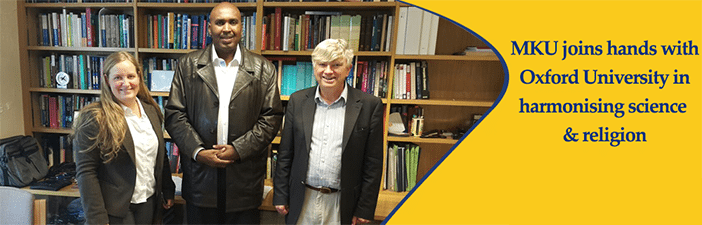
MKU has also partnered with Oxford to bridge the gap between Science and Religion. In Africa, Science is sometimes brushed off by some communities as witchcraft and collecting specimen for research is a challenge, and testing vaccines, for example is a challenge as in some cases of researchers being sent away by communities.
Last year, a team of scientists from Oxford University visited Mount Kenya University Thika Main Campus to explore initiatives that can bridge the dichotomy between science and religion in Africa and last week, an MKU team led by Dr. Francis Muregi, Director, and Research, reciprocated the visit by Prof. Andrew Briggs, a Professor of Nanomaterials at Oxford. They developed a funding proposal on ‘Kenyan Scientific and Religion Affiliation’
The Project aims to:
- Encourage culturally-sensitive and constructive interactions among all those who are concerned with the relationship between science and the Christian faith in Kenya
- Facilitate discussions surrounding questions of how science (and scientific findings) can contribute positively to Christian faith and biblical interpretation
- Promote sustainable development through synergistic interaction between science and Christian faith in addressing socio-economic, health and environmental challenges in Kenya.

- January 2026 (220)
- February 2026 (248)
- March 2026 (287)
- April 2026 (208)
- May 2026 (191)
- June 2026 (238)
- July 2026 (278)
- August 2026 (44)
- January 2025 (119)
- February 2025 (191)
- March 2025 (212)
- April 2025 (193)
- May 2025 (161)
- June 2025 (157)
- July 2025 (227)
- August 2025 (211)
- September 2025 (267)
- October 2025 (297)
- November 2025 (230)
- December 2025 (220)
- January 2024 (238)
- February 2024 (227)
- March 2024 (190)
- April 2024 (133)
- May 2024 (157)
- June 2024 (145)
- July 2024 (136)
- August 2024 (154)
- September 2024 (212)
- October 2024 (255)
- November 2024 (196)
- December 2024 (143)
- January 2023 (182)
- February 2023 (203)
- March 2023 (322)
- April 2023 (297)
- May 2023 (267)
- June 2023 (214)
- July 2023 (212)
- August 2023 (257)
- September 2023 (237)
- October 2023 (264)
- November 2023 (286)
- December 2023 (177)
- January 2022 (293)
- February 2022 (329)
- March 2022 (358)
- April 2022 (292)
- May 2022 (271)
- June 2022 (232)
- July 2022 (278)
- August 2022 (253)
- September 2022 (246)
- October 2022 (196)
- November 2022 (232)
- December 2022 (167)
- January 2021 (182)
- February 2021 (227)
- March 2021 (325)
- April 2021 (259)
- May 2021 (285)
- June 2021 (272)
- July 2021 (277)
- August 2021 (232)
- September 2021 (271)
- October 2021 (304)
- November 2021 (364)
- December 2021 (249)
- January 2020 (272)
- February 2020 (310)
- March 2020 (390)
- April 2020 (321)
- May 2020 (335)
- June 2020 (327)
- July 2020 (333)
- August 2020 (276)
- September 2020 (214)
- October 2020 (233)
- November 2020 (242)
- December 2020 (187)
- January 2019 (251)
- February 2019 (215)
- March 2019 (283)
- April 2019 (254)
- May 2019 (269)
- June 2019 (249)
- July 2019 (335)
- August 2019 (292)
- September 2019 (306)
- October 2019 (313)
- November 2019 (362)
- December 2019 (318)
- January 2018 (291)
- February 2018 (213)
- March 2018 (275)
- April 2018 (223)
- May 2018 (235)
- June 2018 (176)
- July 2018 (256)
- August 2018 (247)
- September 2018 (255)
- October 2018 (282)
- November 2018 (282)
- December 2018 (184)
- January 2017 (183)
- February 2017 (194)
- March 2017 (207)
- April 2017 (104)
- May 2017 (169)
- June 2017 (205)
- July 2017 (189)
- August 2017 (195)
- September 2017 (186)
- October 2017 (235)
- November 2017 (253)
- December 2017 (266)
- January 2016 (164)
- February 2016 (165)
- March 2016 (189)
- April 2016 (143)
- May 2016 (245)
- June 2016 (182)
- July 2016 (271)
- August 2016 (247)
- September 2016 (233)
- October 2016 (191)
- November 2016 (243)
- December 2016 (153)
- January 2015 (1)
- February 2015 (4)
- March 2015 (164)
- April 2015 (107)
- May 2015 (116)
- June 2015 (119)
- July 2015 (145)
- August 2015 (157)
- September 2015 (186)
- October 2015 (169)
- November 2015 (173)
- December 2015 (205)
- March 2014 (2)
- March 2013 (10)
- June 2013 (1)
- March 2012 (7)
- April 2012 (15)
- May 2012 (1)
- July 2012 (1)
- August 2012 (4)
- October 2012 (2)
- November 2012 (2)
- December 2012 (1)