
Safaricom Numbers and the Economy of Kenya

Kenya is an amazing country in terms of its telecommunication sector. There are 37.72 million mobile phone subscribers in the country. This implies that the country have more active SIM cards than the total population of Uganda. Safaricom alone has 24.41 million subscribers or simply 64.7 percent of all the subscribers.
Safaricom released its full year financial report for the year that ended in March 2016. The telecommunication company made profits of more than 37 billion shillings. What do the numbers of Safaricom reveal about the economy of the country? The remaining companies like Airtel, Orange & Equity have combined subscribers of 13.31 million subscribers only. That’s 35.3 of all the subscribers. In total, Kenyans spoke for 10.25 billion minutes on the phone in 2015, equivalent to speaking on the phone for 11 days without stopping.
Safaricom has emerged as the East Africa’s leading revenue earner among all listed public corporations in the whole of the East Africa region.

Safaricom recorded a total revenue of 195.7 billion shillings. This implies that the firm collected an average of 500 million shillings per day. Out of the 195.7 billion shillings, operation costs as well as the cost of depreciated assets were deducted. Safaricom remained with 55.76 billion shillings before tax. In total revenue for the year, Safaricom contributed 17.66 billion shillings. This is an equivalent of 9 percent of Safaricom’s overall earnings.
See the table below:
| TOTAL | AVERAGE | COSTS | BEFORE TAX | REVENUE |
| 195.7 B | 500 M | 139.94 B | 55.76 B | 17.66 B |
The country’s total revenue during the year was 1.295 trillion shillings. Out of this mount, Safaricom contributed 17.66 billion shillings. This implies that if the country had 73 companies like Safaricom*, then no other tax would have been imposed on people.
Safaricom expects to make a profit of Kshs. 33 billion in Financial Year 2017 and revenues of 200 billion shillings. The Government of Kenya earned 28.318 billion shillings from Safaricom. Out of this, 17.66 billion shillings in taxes and 10.66 billion shillings in dividends.
The country has more than 50,000 registered corporations and Safaricom is above them all giving a feeling that thousands of these corporations are unproductive in terms of earning revenue to the country.
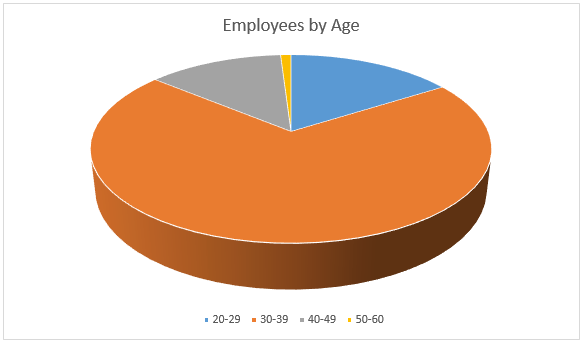
Safaricom has around 4000 permanent employees. The overall of the employees are young. 70 percent of them are in their 30s, 16 percent still in their 20s and 85 percent of the total workforce is in Nairobi.
With 4000 permanent employees, how many families are being supported? How many of these employees are helping in the building of the economy? How many of these employees have employed other people?
The unemployment rate in the country is very high. 80 percent of the unemployed people in the country are the youth. Safaricom takes this very seriously in all of the employments, the youth are given the first priority.
See the image below:
The telecommunication company spent Kshs. 41 billion to pay salaries, rent, advertise, lease lines & run network. For salaries alone, the company spent close to 12 billion shillings.
Safaricom has over 40,000 M-PESA agents across the country. This implies that more than 40,000 people have jobs as M-PESA agents. Most of these agents have also employed other people who are working for them.
During the release of the financial report, MPESA agents earned 14.6 billion shillings in commissions. That’s approximately 147 thousands shillings in commission per agent. Using MPESA earned Safaricom 41.5 billion. That’s more than the income of 90 percent of Kenyan banks. Such a company is a company worth embracing and protecting.
Another key contribution is the establishment of Safaricom Foundation. Established in August 2003 by Safaricom Limited, The Safaricom Foundation is one of the largest corporate Foundations in Kenya. Since its inception, it have invested over 1.8 billion shillings or approximately US$ 21 million in education, health, economic empowerment, the environment, arts and culture, music and sports. In addition, it has also responded to disasters and humanitarian emergencies.
From the few numbers above, Safaricom is very key to the economy of Kenya. Here is a summary of some of the benefits of this economic telecommunication giant:
- The company has revolutionized the communication sector in Kenya. Safaricom has just become part and parcel of almost every Kenyan. The Company alone has 24.41 million subscribers or simply 64.7 percent of all the subscribers.
- The company is a huge contributor of revenue to the government. The company has been the top revenue contributor for years and the largest profit generator in East Africa. The Government of Kenya for instance earned 28.318 billion shillings from Safaricom. Out of this, 17.66 billion shillings in taxes and 10.66 billion shillings in dividends.
- M-PESA has made financial movements in the country easy and accessible. 80 percent of Kenyans now save and transact their businesses and finances by use of mobile phone and M-PESA plays a very big role.
- Many people have been employed by the company providing an opportunity of many families to be supported. The company has around 4000 permanent employees. The overall of them are young.
- Nine out of ten SMSs sent in Kenya are sent from Safaricom while Seven out of ten calls from Safaricom implying that the services are more convenient to many.
- The agents selling airtime earned Kshs. 10.78Bn in commissions for the year that ended in the month of March.
Some of the information appearing in this article has been taken from Manwa Magoma, curated from his Twitter feed as shown in the tweets embedded below:
2. Safaricom has 24.41Mn (64.7%) subs. That is nearly everyone above 15 years old. #SafaricomNumbers
— Manwa Magoma (@ManwaMagoma) May 19, 2016
Read more of these tweets here.
* These sentiments are also shared by Kwame Owino on his post in the Daily Nation talking about Safaricom’s accounts on Kenya’s Economic policy
Article by Juma Fred.

About Soko Directory Team
Soko Directory is a Financial and Markets digital portal that tracks brands, listed firms on the NSE, SMEs and trend setters in the markets eco-system.Find us on Facebook: facebook.com/SokoDirectory and on Twitter: twitter.com/SokoDirectory

- January 2026 (220)
- February 2026 (248)
- March 2026 (287)
- April 2026 (207)
- May 2026 (192)
- June 2026 (238)
- July 2026 (281)
- August 2026 (225)
- September 2026 (253)
- October 2026 (2)
- January 2025 (119)
- February 2025 (191)
- March 2025 (212)
- April 2025 (193)
- May 2025 (161)
- June 2025 (157)
- July 2025 (227)
- August 2025 (211)
- September 2025 (267)
- October 2025 (297)
- November 2025 (230)
- December 2025 (220)
- January 2024 (238)
- February 2024 (227)
- March 2024 (190)
- April 2024 (133)
- May 2024 (157)
- June 2024 (145)
- July 2024 (136)
- August 2024 (154)
- September 2024 (212)
- October 2024 (255)
- November 2024 (196)
- December 2024 (143)
- January 2023 (182)
- February 2023 (203)
- March 2023 (322)
- April 2023 (297)
- May 2023 (267)
- June 2023 (214)
- July 2023 (212)
- August 2023 (257)
- September 2023 (237)
- October 2023 (264)
- November 2023 (286)
- December 2023 (177)
- January 2022 (293)
- February 2022 (329)
- March 2022 (358)
- April 2022 (292)
- May 2022 (271)
- June 2022 (232)
- July 2022 (278)
- August 2022 (253)
- September 2022 (246)
- October 2022 (196)
- November 2022 (232)
- December 2022 (167)
- January 2021 (182)
- February 2021 (227)
- March 2021 (325)
- April 2021 (259)
- May 2021 (285)
- June 2021 (272)
- July 2021 (277)
- August 2021 (232)
- September 2021 (271)
- October 2021 (303)
- November 2021 (364)
- December 2021 (249)
- January 2020 (272)
- February 2020 (310)
- March 2020 (390)
- April 2020 (321)
- May 2020 (335)
- June 2020 (327)
- July 2020 (333)
- August 2020 (276)
- September 2020 (214)
- October 2020 (233)
- November 2020 (242)
- December 2020 (187)
- January 2019 (251)
- February 2019 (215)
- March 2019 (283)
- April 2019 (254)
- May 2019 (269)
- June 2019 (249)
- July 2019 (335)
- August 2019 (292)
- September 2019 (306)
- October 2019 (313)
- November 2019 (362)
- December 2019 (318)
- January 2018 (291)
- February 2018 (213)
- March 2018 (275)
- April 2018 (223)
- May 2018 (235)
- June 2018 (176)
- July 2018 (256)
- August 2018 (247)
- September 2018 (255)
- October 2018 (282)
- November 2018 (282)
- December 2018 (184)
- January 2017 (183)
- February 2017 (194)
- March 2017 (207)
- April 2017 (104)
- May 2017 (169)
- June 2017 (205)
- July 2017 (189)
- August 2017 (195)
- September 2017 (186)
- October 2017 (235)
- November 2017 (253)
- December 2017 (266)
- January 2016 (164)
- February 2016 (165)
- March 2016 (189)
- April 2016 (143)
- May 2016 (245)
- June 2016 (182)
- July 2016 (271)
- August 2016 (247)
- September 2016 (233)
- October 2016 (191)
- November 2016 (243)
- December 2016 (153)
- January 2015 (1)
- February 2015 (4)
- March 2015 (164)
- April 2015 (107)
- May 2015 (116)
- June 2015 (119)
- July 2015 (145)
- August 2015 (157)
- September 2015 (186)
- October 2015 (169)
- November 2015 (173)
- December 2015 (205)
- March 2014 (2)
- March 2013 (10)
- June 2013 (1)
- March 2012 (7)
- April 2012 (15)
- May 2012 (1)
- July 2012 (1)
- August 2012 (4)
- October 2012 (2)
- November 2012 (2)
- December 2012 (1)