
Did KNEC Ignore Crucial Steps in 2016 KCSE?

The Kenya National Union of Teachers (KNUT) has come up with a detailed report on some of the steps that KNEC overlooked in the process of marking the 2016 Kenya Certificate of Secondary Education (KCSE) thus leading to a big number of students scoring below C+.
According to the report dubbed “The Glaring Shortcomings”, the critical process which is normally used to moderate the results was not done. It further disclosed that a uniform grading system was adopted for all subjects against the normal practice where each subject used to have its own grading system different from others.
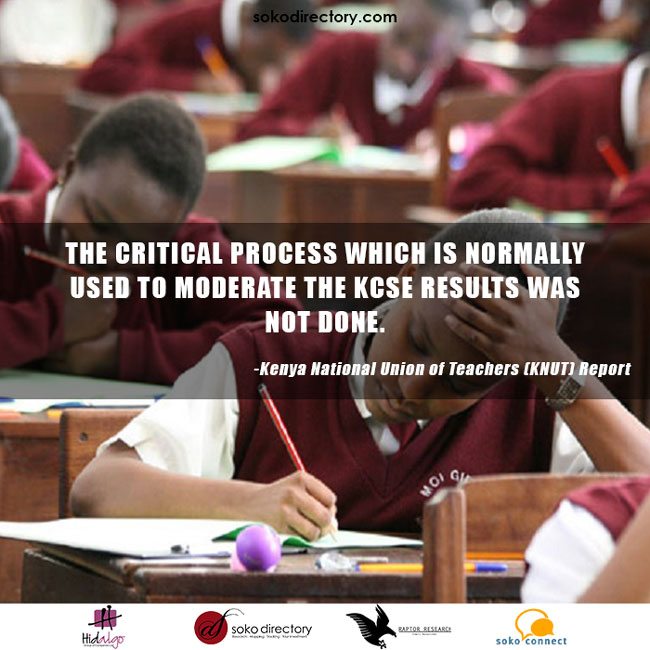

Some of the areas that were analyzed on the process used in marking of the examinations include the following:
- The examiners did not have the chance to interact with the questions before going to the marking centres. Usually, they are always familiarized with the questions before the marking process kicked off.
- The marking scheme was not subjected to discussion and adoption by examiners before marking commenced. It was imposed on the markers. In the past, examiners were to go through the marking schemes and make changes where possible before embarking on marking the examinations
- The marking scheme was made deliberately for students to fail. This was argued out that even in cases where questions had earlier been repeated from previous KCSE past papers, the marking differed sharply leading to failure of students.
- Instead of examiners being allowed to fill in the mark sheet provided by KNEC so as to carry out the counter-checking process, they mark were taken directly to KNEC so as to be fed on the system.
- After examinations marking is over in December, the markers often go back around January to mark stray scripts. Stray scripts are papers, which were never marked for certain logistical reasons such as mix up in packaging. This time round, it was not clear when stray scripts were marked.
- The award ceremony, which is presided over by the chief examiner was not followed, this is the moderation exercise where the performance of students across the country is checked then propose on grading system so as to normalize the grades.
- Apart from the massive errors in the computation of marks, the report discloses that it is clear that no cross-checking was done.
- The report also says that schools that have been performing well will be labeled as cheats without evidence being put forward.
The question here is whether the outlined mistakes will be revised so that students can get their required marks. Out of the 574,125 candidates who sat the examinations, some 295,463 students scored grade D and below. Of these, 33,399 scored E, 149,929 attained grade D– while 112,135 posted grade D. Only 141 candidates scored the coveted grade A with some 4,645 candidates scoring grade A– while 10,975 attained B+. These results were one of its kind which has never been experienced in the past years.
Related: KNEC’s First Test as Parents Head To Court over Exam Results

About Soko Directory Team
Soko Directory is a Financial and Markets digital portal that tracks brands, listed firms on the NSE, SMEs and trend setters in the markets eco-system.Find us on Facebook: facebook.com/SokoDirectory and on Twitter: twitter.com/SokoDirectory

- January 2026 (220)
- February 2026 (243)
- March 2026 (72)
- January 2025 (119)
- February 2025 (191)
- March 2025 (212)
- April 2025 (193)
- May 2025 (161)
- June 2025 (157)
- July 2025 (227)
- August 2025 (211)
- September 2025 (270)
- October 2025 (297)
- November 2025 (230)
- December 2025 (219)
- January 2024 (238)
- February 2024 (227)
- March 2024 (190)
- April 2024 (133)
- May 2024 (157)
- June 2024 (145)
- July 2024 (136)
- August 2024 (154)
- September 2024 (212)
- October 2024 (255)
- November 2024 (196)
- December 2024 (143)
- January 2023 (182)
- February 2023 (203)
- March 2023 (322)
- April 2023 (297)
- May 2023 (267)
- June 2023 (214)
- July 2023 (212)
- August 2023 (257)
- September 2023 (237)
- October 2023 (264)
- November 2023 (286)
- December 2023 (177)
- January 2022 (293)
- February 2022 (329)
- March 2022 (358)
- April 2022 (292)
- May 2022 (271)
- June 2022 (232)
- July 2022 (278)
- August 2022 (253)
- September 2022 (246)
- October 2022 (196)
- November 2022 (232)
- December 2022 (167)
- January 2021 (182)
- February 2021 (227)
- March 2021 (325)
- April 2021 (259)
- May 2021 (285)
- June 2021 (272)
- July 2021 (277)
- August 2021 (232)
- September 2021 (271)
- October 2021 (304)
- November 2021 (364)
- December 2021 (249)
- January 2020 (272)
- February 2020 (310)
- March 2020 (390)
- April 2020 (321)
- May 2020 (335)
- June 2020 (327)
- July 2020 (333)
- August 2020 (276)
- September 2020 (214)
- October 2020 (233)
- November 2020 (242)
- December 2020 (187)
- January 2019 (251)
- February 2019 (215)
- March 2019 (283)
- April 2019 (254)
- May 2019 (269)
- June 2019 (249)
- July 2019 (335)
- August 2019 (293)
- September 2019 (306)
- October 2019 (313)
- November 2019 (362)
- December 2019 (318)
- January 2018 (291)
- February 2018 (213)
- March 2018 (275)
- April 2018 (223)
- May 2018 (235)
- June 2018 (176)
- July 2018 (256)
- August 2018 (247)
- September 2018 (255)
- October 2018 (282)
- November 2018 (282)
- December 2018 (184)
- January 2017 (183)
- February 2017 (194)
- March 2017 (207)
- April 2017 (104)
- May 2017 (169)
- June 2017 (205)
- July 2017 (189)
- August 2017 (195)
- September 2017 (186)
- October 2017 (235)
- November 2017 (253)
- December 2017 (266)
- January 2016 (164)
- February 2016 (165)
- March 2016 (189)
- April 2016 (143)
- May 2016 (245)
- June 2016 (182)
- July 2016 (271)
- August 2016 (247)
- September 2016 (233)
- October 2016 (191)
- November 2016 (243)
- December 2016 (153)
- January 2015 (1)
- February 2015 (4)
- March 2015 (164)
- April 2015 (107)
- May 2015 (116)
- June 2015 (119)
- July 2015 (145)
- August 2015 (157)
- September 2015 (186)
- October 2015 (169)
- November 2015 (173)
- December 2015 (205)
- March 2014 (2)
- March 2013 (10)
- June 2013 (1)
- March 2012 (7)
- April 2012 (15)
- May 2012 (1)
- July 2012 (1)
- August 2012 (4)
- October 2012 (2)
- November 2012 (2)
- December 2012 (1)