
T-Bills Undersubscribed During the Week As Government Reopens the 15-Year Bond

During the week, T-bills were undersubscribed, with overall subscription coming in at 74.9 percent compared to 60.8 percent recorded the previous week, on account of tight liquidity in the money market according to a weekly report by Cytonn Investments
Despite the low subscription rate, the government acceptance rate was low at 52.7 percent, compared to 89.8 percent the previous week. Subscription rates on the 91, 182 and 364-day papers came in at 86.2, 93.7 and 48.7 percent respectively from 86.8, 40.2 and 64.2 percent respectively as witnessed the previous week.
Yields on the 91, 182 and 364-day T-bills remained unchanged during the week, closing at 8.6, 10.5 and 11.0 percent respectively, as the government turned away expensive money, evidenced by the average bid rates for the 182-day and 364-day papers that came in at 10.6 and 11.1 percent respectively.

There has been a shift by investors on the subscription, with most investing in the 91-day and 182-day papers, an indication of the uncertainties in the interest rates environment. The 182-day paper continues to offer investors the best returns on a risk-adjusted basis and hence received the highest subscription level this week.
The Interbank rate
The interbank rate decreased by 20 bps to 7.5 percent from 7.7 percent registered the previous week. The rate has been high since the jump in December, where it reached a high of 8.7 percent from 3.8 percent at the start of November. The volumes transacted have equally been high, averaging about 23.1 billion shillings compared to 20.0 billion shillings the previous week.
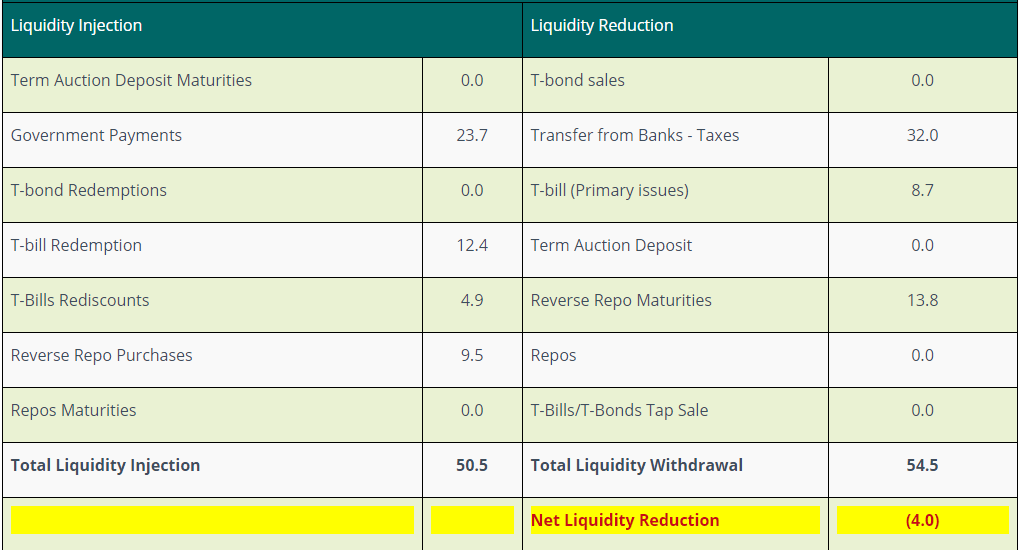
Liquidity in the money market has been tight and last week there was a net liquidity reduction of 4.0 billion shillings which was driven by reduced reverse repo purchases and government payments that came in at 9.5 billion shillings and 23.7 billion shillings respectively from 18.6 billion shillings and 30.9 billion shillings the previous week respectively.
To further explain the tight liquidity position, there was:
- Increased activity in the reverse repo market at a rate of 10.0 percent
- T-bill rediscounting worth 4.9 billion shillings.
Usually the T-bill rediscounting rate is punitive to investors as it is calculated at 3.0 percent higher than the prevailing interest rate.
Below is a summary of the money market activity during the week:
The 15-Year Bond
The government has re-opened the 15-year bond it issued in 2007, in a bid to raise 30.0 billion shillings for budgetary support, which will see investors participate up until 24th January 2017.
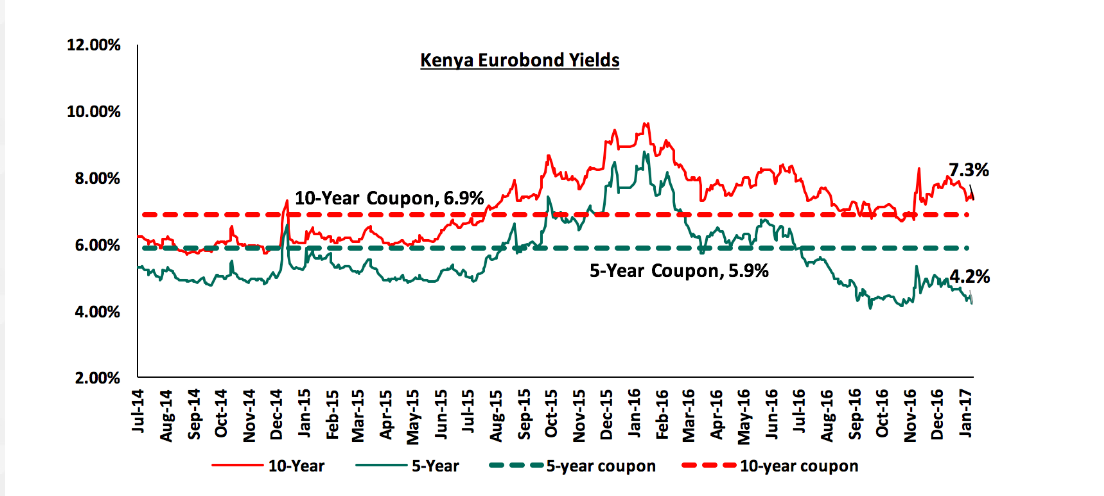
According to Bloomberg, the yield on the 10-year Eurobond remained unchanged from the previous week at 7.3 percent whereas that of the 5-year Eurobond decreased week on week by 10 bps to 4.2 percent down from 4.3 percent the previous week. Since the mid-January 2016 peak, yields on the Kenya Eurobonds have declined by 4.6 percent points and 2.3 percent points, respectively, for the 5-year and 10-year bond due to improving macroeconomic conditions. This is an indication that Kenya remains an attractive investment destination as shown below:

About Juma
Juma is an enthusiastic journalist who believes that journalism has power to change the world either negatively or positively depending on how one uses it.(020) 528 0222 or Email: info@sokodirectory.com

- January 2026 (220)
- February 2026 (248)
- March 2026 (287)
- April 2026 (207)
- May 2026 (192)
- June 2026 (238)
- July 2026 (279)
- August 2026 (223)
- September 2026 (55)
- January 2025 (119)
- February 2025 (191)
- March 2025 (212)
- April 2025 (193)
- May 2025 (161)
- June 2025 (157)
- July 2025 (227)
- August 2025 (211)
- September 2025 (267)
- October 2025 (297)
- November 2025 (230)
- December 2025 (220)
- January 2024 (238)
- February 2024 (227)
- March 2024 (190)
- April 2024 (133)
- May 2024 (157)
- June 2024 (145)
- July 2024 (136)
- August 2024 (154)
- September 2024 (212)
- October 2024 (255)
- November 2024 (196)
- December 2024 (143)
- January 2023 (182)
- February 2023 (203)
- March 2023 (322)
- April 2023 (297)
- May 2023 (267)
- June 2023 (214)
- July 2023 (212)
- August 2023 (257)
- September 2023 (237)
- October 2023 (264)
- November 2023 (286)
- December 2023 (177)
- January 2022 (293)
- February 2022 (329)
- March 2022 (358)
- April 2022 (292)
- May 2022 (271)
- June 2022 (232)
- July 2022 (278)
- August 2022 (253)
- September 2022 (246)
- October 2022 (196)
- November 2022 (232)
- December 2022 (167)
- January 2021 (182)
- February 2021 (227)
- March 2021 (325)
- April 2021 (259)
- May 2021 (285)
- June 2021 (272)
- July 2021 (277)
- August 2021 (232)
- September 2021 (271)
- October 2021 (303)
- November 2021 (364)
- December 2021 (249)
- January 2020 (272)
- February 2020 (310)
- March 2020 (390)
- April 2020 (321)
- May 2020 (335)
- June 2020 (327)
- July 2020 (333)
- August 2020 (276)
- September 2020 (214)
- October 2020 (233)
- November 2020 (242)
- December 2020 (187)
- January 2019 (251)
- February 2019 (215)
- March 2019 (283)
- April 2019 (254)
- May 2019 (269)
- June 2019 (249)
- July 2019 (335)
- August 2019 (292)
- September 2019 (306)
- October 2019 (313)
- November 2019 (362)
- December 2019 (318)
- January 2018 (291)
- February 2018 (213)
- March 2018 (275)
- April 2018 (223)
- May 2018 (235)
- June 2018 (176)
- July 2018 (256)
- August 2018 (247)
- September 2018 (255)
- October 2018 (282)
- November 2018 (282)
- December 2018 (184)
- January 2017 (183)
- February 2017 (194)
- March 2017 (207)
- April 2017 (104)
- May 2017 (169)
- June 2017 (205)
- July 2017 (189)
- August 2017 (195)
- September 2017 (186)
- October 2017 (235)
- November 2017 (253)
- December 2017 (266)
- January 2016 (164)
- February 2016 (165)
- March 2016 (189)
- April 2016 (143)
- May 2016 (245)
- June 2016 (182)
- July 2016 (271)
- August 2016 (247)
- September 2016 (233)
- October 2016 (191)
- November 2016 (243)
- December 2016 (153)
- January 2015 (1)
- February 2015 (4)
- March 2015 (164)
- April 2015 (107)
- May 2015 (116)
- June 2015 (119)
- July 2015 (145)
- August 2015 (157)
- September 2015 (186)
- October 2015 (169)
- November 2015 (173)
- December 2015 (205)
- March 2014 (2)
- March 2013 (10)
- June 2013 (1)
- March 2012 (7)
- April 2012 (15)
- May 2012 (1)
- July 2012 (1)
- August 2012 (4)
- October 2012 (2)
- November 2012 (2)
- December 2012 (1)