
Banana farming in Kenya under threat from Fungus
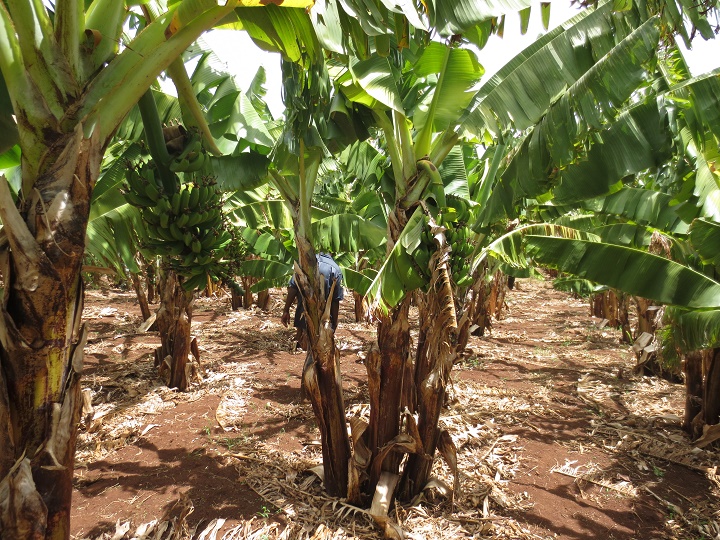
Over 300,000 banana farmers in Kenya are facing a great threat from the deadly banana fungus which poses major risks to the world’s banana production.
According to FAO’s Director of Plant Production and Protection Division Hans Dreyer, the fungus is an insidious disease that can last for years in soils and can hitchhike to new fields and destinations through a number of means such as infected planting materials, water, shoes, farm tools and vehicles.
“We need to move quickly to prevent its further spread from where it is right now and to support already affected countries in their efforts to cope with the disease,” said Hans Dreyer.

Hans noted that the long-term resilience of banana production systems can only be improved through continuous monitoring, robust containment strategies, strengthening national capacities and enhancing international collaboration to deploy integrated disease management approaches.

Fusarium wilt TR4 was first detected in Southeast Asia in the 1990s and has now been identified at 19 sites in 10 countries, including the Near East, South Asia and Mozambique in sub-Saharan Africa.
The global programme is initially targeting 67 countries in a bid to prevent its spread and management.
Without a coordinated intervention, scientists estimate that the disease could affect up to 1.6 million hectares of current banana lands by 2040, representing one-sixth of current global production with an estimated annual value of USD 10 billion.
The programme aims to reduce the potentially affected area by up to 60 percent.
“There is also an important knowledge gap regarding the biology and management of the fungus and we aim to address these through this collaborative initiative, also promoting introduction of more biodiversity and improved agronomic practices into banana production systems” said Ann Tutwiler, the Director General of Bioversity International, speaking on her behalf and that of the IITA.
“The disease is also an important concern for the industry and the trade of this popular fruit,” added Pascal Liu, coordinator of the World Banana Forum.
The five-year programme is designed to build on existing initiatives tackling the disease and focuses on strengthening local technical capacities and supporting the development of science-based technologies and tools through research on biology and epidemiology of the fungus, its detection, surveillance, rapid containment actions, soil health and the development of resistant cultivars.
If effectively rolled out, it is estimated that every USD 1 invested in the programme today will produce benefits of between USD 98 and USD 196 in 20 years’ time.

About Soko Directory Team
Soko Directory is a Financial and Markets digital portal that tracks brands, listed firms on the NSE, SMEs and trend setters in the markets eco-system.Find us on Facebook: facebook.com/SokoDirectory and on Twitter: twitter.com/SokoDirectory

- January 2026 (220)
- February 2026 (246)
- March 2026 (286)
- April 2026 (200)
- January 2025 (119)
- February 2025 (191)
- March 2025 (212)
- April 2025 (193)
- May 2025 (161)
- June 2025 (157)
- July 2025 (227)
- August 2025 (211)
- September 2025 (270)
- October 2025 (297)
- November 2025 (230)
- December 2025 (219)
- January 2024 (238)
- February 2024 (227)
- March 2024 (190)
- April 2024 (133)
- May 2024 (157)
- June 2024 (145)
- July 2024 (136)
- August 2024 (154)
- September 2024 (212)
- October 2024 (255)
- November 2024 (196)
- December 2024 (143)
- January 2023 (182)
- February 2023 (203)
- March 2023 (322)
- April 2023 (297)
- May 2023 (267)
- June 2023 (214)
- July 2023 (212)
- August 2023 (257)
- September 2023 (237)
- October 2023 (264)
- November 2023 (286)
- December 2023 (177)
- January 2022 (293)
- February 2022 (329)
- March 2022 (358)
- April 2022 (292)
- May 2022 (271)
- June 2022 (232)
- July 2022 (278)
- August 2022 (253)
- September 2022 (246)
- October 2022 (196)
- November 2022 (232)
- December 2022 (167)
- January 2021 (182)
- February 2021 (227)
- March 2021 (325)
- April 2021 (259)
- May 2021 (285)
- June 2021 (272)
- July 2021 (277)
- August 2021 (232)
- September 2021 (271)
- October 2021 (304)
- November 2021 (364)
- December 2021 (249)
- January 2020 (272)
- February 2020 (310)
- March 2020 (390)
- April 2020 (321)
- May 2020 (335)
- June 2020 (327)
- July 2020 (333)
- August 2020 (276)
- September 2020 (214)
- October 2020 (233)
- November 2020 (242)
- December 2020 (187)
- January 2019 (251)
- February 2019 (215)
- March 2019 (283)
- April 2019 (254)
- May 2019 (269)
- June 2019 (249)
- July 2019 (335)
- August 2019 (293)
- September 2019 (306)
- October 2019 (313)
- November 2019 (362)
- December 2019 (318)
- January 2018 (291)
- February 2018 (213)
- March 2018 (275)
- April 2018 (223)
- May 2018 (235)
- June 2018 (176)
- July 2018 (256)
- August 2018 (247)
- September 2018 (255)
- October 2018 (282)
- November 2018 (282)
- December 2018 (184)
- January 2017 (183)
- February 2017 (194)
- March 2017 (207)
- April 2017 (104)
- May 2017 (169)
- June 2017 (205)
- July 2017 (189)
- August 2017 (195)
- September 2017 (186)
- October 2017 (235)
- November 2017 (253)
- December 2017 (266)
- January 2016 (164)
- February 2016 (165)
- March 2016 (189)
- April 2016 (143)
- May 2016 (245)
- June 2016 (182)
- July 2016 (271)
- August 2016 (247)
- September 2016 (233)
- October 2016 (191)
- November 2016 (243)
- December 2016 (153)
- January 2015 (1)
- February 2015 (4)
- March 2015 (164)
- April 2015 (107)
- May 2015 (116)
- June 2015 (119)
- July 2015 (145)
- August 2015 (157)
- September 2015 (186)
- October 2015 (169)
- November 2015 (173)
- December 2015 (205)
- March 2014 (2)
- March 2013 (10)
- June 2013 (1)
- March 2012 (7)
- April 2012 (15)
- May 2012 (1)
- July 2012 (1)
- August 2012 (4)
- October 2012 (2)
- November 2012 (2)
- December 2012 (1)