
How Can the Youth Use IP Rights as Collateral For Loans?

KEY POINTS
The creative economy has become increasingly reliant on digital technologies. Electronic platforms, file sharing, and music streaming, among others, have led to new business models – and to protect their innovations, people have acquired Intellectual Property (IP) rights to these innovations.
KEY TAKEAWAYS
The potential advantage of integrating intellectual property rights within the financial system cannot be emphasized enough. It can be leveraged to create opportunities for youth to further their businesses.
Over the past few years, the creative economy has thrived, mainly exacerbated by technological innovations and the youth’s constant desire to be atop the digital trends. Electronic platforms, file sharing, and music streaming, among others, have led to new business models – and to protect their innovations, people have acquired Intellectual Property (IP rights) to these innovations.
IP rights are a form of property granted through trademarks, patents, industrial designs, copyrights, and geographical indications, among others, that enable the owner to exercise a monopoly on their assets.
The popularity of IP rights has pushed the financial sector, especially the asset-based lenders, to turn to IP portfolios as another form of collateral to secure their loans.

In 2017, the Movable Property Security Rights Act (“MPSRA”) was enacted in Kenya as a policy guiding how movable property such as intellectual property rights can be used as collateral for credit.
This marked the first time in Kenya for intangible assets to be recognized as valid collateral for accessing credit from financial institutions.
But despite the enactment, the uptake has been low. The challenge of IP rights as collateral for credit is faced with serious concerns associated with the actualization of the concept. Valuation of IP rights, for instance, is one of the biggest challenges.
Lenders must first ascertain whether the asset is commercially viable or not – this is mainly since a bank’s ability to find a ready market to sell the IP rights in the event of a default is another challenge altogether.
ALSO READ: Anticipated Drop in Land Under Maize Likely to Cause Food Crisis in Kenya
But despite this and other challenges, the potential advantage of integrating intellectual property rights within the financial system cannot be emphasized enough. It can be leveraged to create opportunities for youth to further their businesses.
For example, a startup company in the tech industry could benefit significantly if it could obtain financing on the security of the IP rights comprised in its applications. It would then use these resources for product innovation or expand its growth for more profitability.
The big question is, how can this be achieved in Kenya? This is the third topic of My Chat With a Bank CEO by the Kenya Bankers Association (KBA).
Scheduled for the 25th of March, this third edition of KBA’s CEO chat will feature Joseph Njuguna, CEO Rafiki Microfinance Bank, as he delves into detail on intellectual property matters as possible collateral for youth loans.
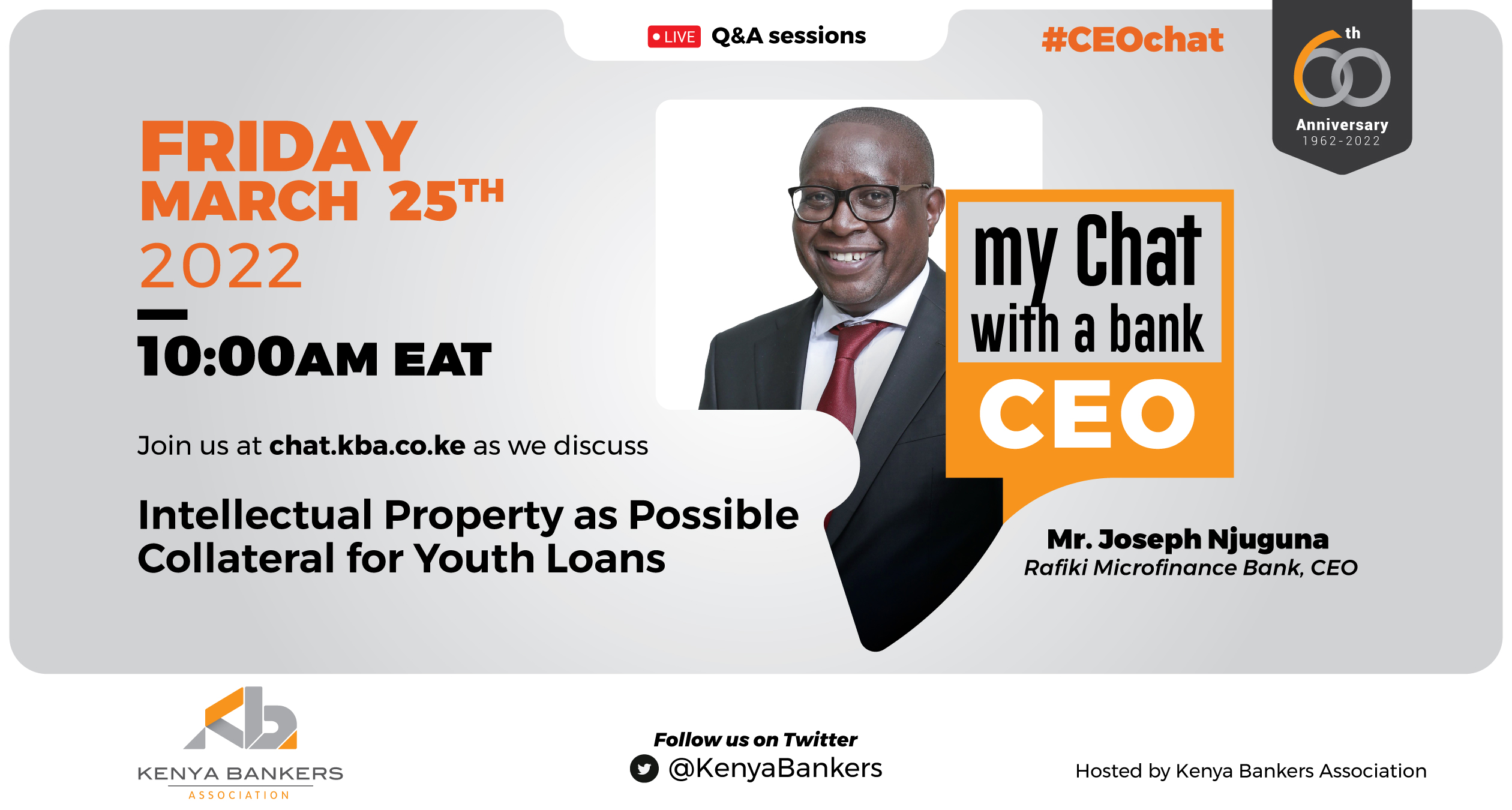
Mr. Njuguna will highlight ways in which Intellectual Property—mainly developed by the youth— can be leveraged to facilitate access credit.
He will also explore opportunities to enhance business management skills among the youth to ensure that their businesses are guaranteed profitability and growth prospects.
If you want to become a part of the forum, you can register on chat.kba.co.ke, where the sessions will be hosted
The KBA chat sessions are open to all, and public members are encouraged to log on and engage in productive conversations on banking in Kenya.

About Soko Directory Team
Soko Directory is a Financial and Markets digital portal that tracks brands, listed firms on the NSE, SMEs and trend setters in the markets eco-system.Find us on Facebook: facebook.com/SokoDirectory and on Twitter: twitter.com/SokoDirectory

- January 2026 (220)
- February 2026 (248)
- March 2026 (287)
- April 2026 (208)
- May 2026 (191)
- June 2026 (238)
- July 2026 (279)
- August 2026 (140)
- January 2025 (119)
- February 2025 (191)
- March 2025 (212)
- April 2025 (193)
- May 2025 (161)
- June 2025 (157)
- July 2025 (227)
- August 2025 (211)
- September 2025 (267)
- October 2025 (297)
- November 2025 (230)
- December 2025 (220)
- January 2024 (238)
- February 2024 (227)
- March 2024 (190)
- April 2024 (133)
- May 2024 (157)
- June 2024 (145)
- July 2024 (136)
- August 2024 (154)
- September 2024 (212)
- October 2024 (255)
- November 2024 (196)
- December 2024 (143)
- January 2023 (182)
- February 2023 (203)
- March 2023 (322)
- April 2023 (297)
- May 2023 (267)
- June 2023 (214)
- July 2023 (212)
- August 2023 (257)
- September 2023 (237)
- October 2023 (264)
- November 2023 (286)
- December 2023 (177)
- January 2022 (293)
- February 2022 (329)
- March 2022 (358)
- April 2022 (292)
- May 2022 (271)
- June 2022 (232)
- July 2022 (278)
- August 2022 (253)
- September 2022 (246)
- October 2022 (196)
- November 2022 (232)
- December 2022 (167)
- January 2021 (182)
- February 2021 (227)
- March 2021 (325)
- April 2021 (259)
- May 2021 (285)
- June 2021 (272)
- July 2021 (277)
- August 2021 (232)
- September 2021 (271)
- October 2021 (303)
- November 2021 (364)
- December 2021 (249)
- January 2020 (272)
- February 2020 (310)
- March 2020 (390)
- April 2020 (321)
- May 2020 (335)
- June 2020 (327)
- July 2020 (333)
- August 2020 (276)
- September 2020 (214)
- October 2020 (233)
- November 2020 (242)
- December 2020 (187)
- January 2019 (251)
- February 2019 (215)
- March 2019 (283)
- April 2019 (254)
- May 2019 (269)
- June 2019 (249)
- July 2019 (335)
- August 2019 (292)
- September 2019 (306)
- October 2019 (313)
- November 2019 (362)
- December 2019 (318)
- January 2018 (291)
- February 2018 (213)
- March 2018 (275)
- April 2018 (223)
- May 2018 (235)
- June 2018 (176)
- July 2018 (256)
- August 2018 (247)
- September 2018 (255)
- October 2018 (282)
- November 2018 (282)
- December 2018 (184)
- January 2017 (183)
- February 2017 (194)
- March 2017 (207)
- April 2017 (104)
- May 2017 (169)
- June 2017 (205)
- July 2017 (189)
- August 2017 (195)
- September 2017 (186)
- October 2017 (235)
- November 2017 (253)
- December 2017 (266)
- January 2016 (164)
- February 2016 (165)
- March 2016 (189)
- April 2016 (143)
- May 2016 (245)
- June 2016 (182)
- July 2016 (271)
- August 2016 (247)
- September 2016 (233)
- October 2016 (191)
- November 2016 (243)
- December 2016 (153)
- January 2015 (1)
- February 2015 (4)
- March 2015 (164)
- April 2015 (107)
- May 2015 (116)
- June 2015 (119)
- July 2015 (145)
- August 2015 (157)
- September 2015 (186)
- October 2015 (169)
- November 2015 (173)
- December 2015 (205)
- March 2014 (2)
- March 2013 (10)
- June 2013 (1)
- March 2012 (7)
- April 2012 (15)
- May 2012 (1)
- July 2012 (1)
- August 2012 (4)
- October 2012 (2)
- November 2012 (2)
- December 2012 (1)