
KSh 100M Smallholder Farmers From KCB And USAID
KEY POINTS
USAID’s Kenya Investment Mechanism (KIM) will support the design and improvement of suitable financing products for livestock value chain players, with the objective of enhancing lending to the livestock sector and providing linkages to other USAID programs that can enhance smallholder farmers’ productivity.
KEY TAKEAWAYS
The first phase of the program is under implementation in 10 counties: Laikipia, Baringo, Samburu, Taita Taveta, Narok, Kajiado, Mombasa, Kwale, Kilifi, Marsabit. The second phase of the programme will roll out in Isiolo, Wajir, Tana River, Lamu, Garissa, Turkana, West Pokot, Busia, Mandera and Kitui.
Livestock farmers in Kenya’s arid and semi-arid lands (ASALs) are set to receive training and financing from KCB Foundation following a partnership with the United States Agency for International Development’s Kenya Investment Mechanism.
The partnership will train and equip farmers from ASALs with climate-smart agricultural practices to mitigate the dire impacts of climate change. The two-year partnership will mobilize KShs.100 million in financing for the farmers through strategic partners with a goal of growing the funding to KShs. 500 million.
The first year of the partnership will see KCB train bank staff on livestock financing. Additionally, at least 50 livestock cooperatives and farmers’ groups will receive technical support to increase their productivity.

Due to climate change, the recurrence and intensity of droughts have increased in Kenya, particularly affecting the ASALs, which now experience droughts almost on an annual basis.
The ongoing drought is the latest in an increasingly short cycle, leaving more than 2.5 million people on the brink of starvation and poverty. Pastoralists and farmers now have less and less time to recover.
USAID’s Kenya Investment Mechanism (KIM) will support the design and improvement of suitable financing products for livestock value chain players, with the objective of enhancing lending to the livestock sector and providing linkages to other USAID programs that can enhance smallholder farmers’ productivity.
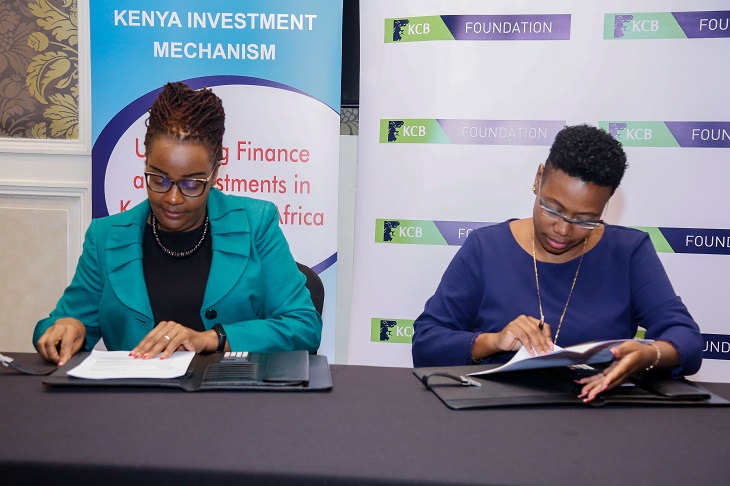
Speaking during the Memorandum of Understanding (MoU) signing, KCB Head of Foundation Caroline Wanjeri said: “The partnership is aligned with our commitment to enhance sustainable agricultural practices in ASALs, to improve their commercial viability and livestock value chain by enhancing access to credit and markets, leading to better income opportunities.”
“The training of KCB staff on livestock financing will enable the bank to identify better ways to support smallholder farmers, who would otherwise be considered high risk. By working through farmer producer organizations, we are able to reach more farmers, improve their commercial practices, enhance access to credit and bring in value-addition,” she added.
KCB Foundation supports smallholder farmers through its enterprise development program that works with Farmer Producer Organizations (FPOs) focusing on four value chains: meat, dairy, apiculture, and aquaculture.
On her part, Kenya Investment Mechanism’s Deputy Chief of Party Dr. Grace Mwai noted that “We work through strategic partnerships with local partners such as the KCB Foundation to enhance our private capital mobilization efforts for the agricultural sector.”
Partnerships with institutions like KCB Foundation are critical in transforming the market. The collaboration we have established with the Foundation will go a long way in unlocking financing for the livestock sector in the meat, milk, honey, and fish value chains.”
Kenya Investment Mechanism is a five-year USAID project aimed at unlocking private finance and investment for key sectors of Kenya’s economy, including agriculture. This is in line with the reality that agribusinesses and smallholder farmers must deal with the challenges caused by chronic underinvestment in the sector.
Last month, the KCB Foundation launched a KSh. 14.6 million Livestock Identification and Tracking System (LITS) program across three counties; Taita Taveta, Kajiado, and Laikipia to enhance the market for local and international trade in animals and animal products and improve the security of animal assets.
In January this year, the foundation set aside Ksh. 50 million to support over 5,000 farmers in the form of working capital and asset-based financing from 20 counties in the livestock value chain.
The first phase of the program is under implementation in 10 counties: Laikipia, Baringo, Samburu, Taita Taveta, Narok, Kajiado, Mombasa, Kwale, Kilifi, Marsabit. The second phase of the programme will roll out in Isiolo, Wajir, Tana River, Lamu, Garissa, Turkana, West Pokot, Busia, Mandera and Kitui.

About Soko Directory Team
Soko Directory is a Financial and Markets digital portal that tracks brands, listed firms on the NSE, SMEs and trend setters in the markets eco-system.Find us on Facebook: facebook.com/SokoDirectory and on Twitter: twitter.com/SokoDirectory

- January 2026 (220)
- February 2026 (246)
- March 2026 (286)
- April 2026 (111)
- January 2025 (119)
- February 2025 (191)
- March 2025 (212)
- April 2025 (193)
- May 2025 (161)
- June 2025 (157)
- July 2025 (227)
- August 2025 (211)
- September 2025 (270)
- October 2025 (297)
- November 2025 (230)
- December 2025 (219)
- January 2024 (238)
- February 2024 (227)
- March 2024 (190)
- April 2024 (133)
- May 2024 (157)
- June 2024 (145)
- July 2024 (136)
- August 2024 (154)
- September 2024 (212)
- October 2024 (255)
- November 2024 (196)
- December 2024 (143)
- January 2023 (182)
- February 2023 (203)
- March 2023 (322)
- April 2023 (297)
- May 2023 (267)
- June 2023 (214)
- July 2023 (212)
- August 2023 (257)
- September 2023 (237)
- October 2023 (264)
- November 2023 (286)
- December 2023 (177)
- January 2022 (293)
- February 2022 (329)
- March 2022 (358)
- April 2022 (292)
- May 2022 (271)
- June 2022 (232)
- July 2022 (278)
- August 2022 (253)
- September 2022 (246)
- October 2022 (196)
- November 2022 (232)
- December 2022 (167)
- January 2021 (182)
- February 2021 (227)
- March 2021 (325)
- April 2021 (259)
- May 2021 (285)
- June 2021 (272)
- July 2021 (277)
- August 2021 (232)
- September 2021 (271)
- October 2021 (304)
- November 2021 (364)
- December 2021 (249)
- January 2020 (272)
- February 2020 (310)
- March 2020 (390)
- April 2020 (321)
- May 2020 (335)
- June 2020 (327)
- July 2020 (333)
- August 2020 (276)
- September 2020 (214)
- October 2020 (233)
- November 2020 (242)
- December 2020 (187)
- January 2019 (251)
- February 2019 (215)
- March 2019 (283)
- April 2019 (254)
- May 2019 (269)
- June 2019 (249)
- July 2019 (335)
- August 2019 (293)
- September 2019 (306)
- October 2019 (313)
- November 2019 (362)
- December 2019 (318)
- January 2018 (291)
- February 2018 (213)
- March 2018 (275)
- April 2018 (223)
- May 2018 (235)
- June 2018 (176)
- July 2018 (256)
- August 2018 (247)
- September 2018 (255)
- October 2018 (282)
- November 2018 (282)
- December 2018 (184)
- January 2017 (183)
- February 2017 (194)
- March 2017 (207)
- April 2017 (104)
- May 2017 (169)
- June 2017 (205)
- July 2017 (189)
- August 2017 (195)
- September 2017 (186)
- October 2017 (235)
- November 2017 (253)
- December 2017 (266)
- January 2016 (164)
- February 2016 (165)
- March 2016 (189)
- April 2016 (143)
- May 2016 (245)
- June 2016 (182)
- July 2016 (271)
- August 2016 (247)
- September 2016 (233)
- October 2016 (191)
- November 2016 (243)
- December 2016 (153)
- January 2015 (1)
- February 2015 (4)
- March 2015 (164)
- April 2015 (107)
- May 2015 (116)
- June 2015 (119)
- July 2015 (145)
- August 2015 (157)
- September 2015 (186)
- October 2015 (169)
- November 2015 (173)
- December 2015 (205)
- March 2014 (2)
- March 2013 (10)
- June 2013 (1)
- March 2012 (7)
- April 2012 (15)
- May 2012 (1)
- July 2012 (1)
- August 2012 (4)
- October 2012 (2)
- November 2012 (2)
- December 2012 (1)