
Key Themes That Shaped The Banking Sector Performance In Q1’2022

KEY POINTS
Kenya still remains overbanked as the number of banks remains relatively high compared to the population. To bring the ratio to 5.5x, we need to reduce the number of banks from the current 38 banks to 30 banks.
KEY TAKEAWAYS
The listed banks’ management quality also improved, with the Cost to Income ratio improving by 10.4% points to 53.1%, from 63.5% recorded in Q1’2021, as banks continued to reduce their provisioning levels following the improvement business environment during the period.
The Core Earnings per Share (EPS) for the listed banks recorded a weighted growth of 37.9% in Q1’2022, from a weighted growth of 28.4% recorded in Q1’2021, mainly attributable to a 21.4% growth in non-funded income coupled with a 17.7% growth in net interest income.
Additionally, the Asset Quality for the listed banks improved in Q1’2022, with the gross NPL ratio declining by 1.0% point to 12.5%, from 13.5% in Q1’2021. Despite this improvement in the asset quality, the NPL ratio remains higher than the 10-year average of 8.1%.
The listed banks’ management quality also improved, with the Cost to Income ratio improving by 10.4% points to 53.1%, from 63.5% recorded in Q1’2021, as banks continued to reduce their provisioning levels following the improvement business environment during the period.

The themes that shaped the sector include:
Regulation of Digital Lenders
The Central Bank of Kenya (CBK) enacted the law to regulate digital lenders, granting the bank the authority to license and oversee previously unregulated digital credit providers.
The regulations were published on 18th March 2022 and allowed digital lenders a period of six months to acquire licenses from CBK. The regulations are aimed at protecting borrowers against the predatory practices of unregulated digital credit providers, particularly their high costs, unethical debt collection practices, and misuse of personal information.
“We expect the move to streamline the digital lending services sector and weed out unscrupulous digital lenders who have taken advantage of the unregulated space to violate various consumer rights and privacy,” said Cytonn.
Regional Expansion through Mergers and Acquisitions
Kenyan banks are looking at having an extensive regional reach. On 8th June 2022, Centum Investment Company PLC announced that it had entered into a binding agreement to sell its 83.4% shareholding in Sidian Bank to Access Bank PLC, for consideration of Kshs 4.3 bn subject to relevant approval from the Central bank of Kenya and the Competition Authority of Kenya.
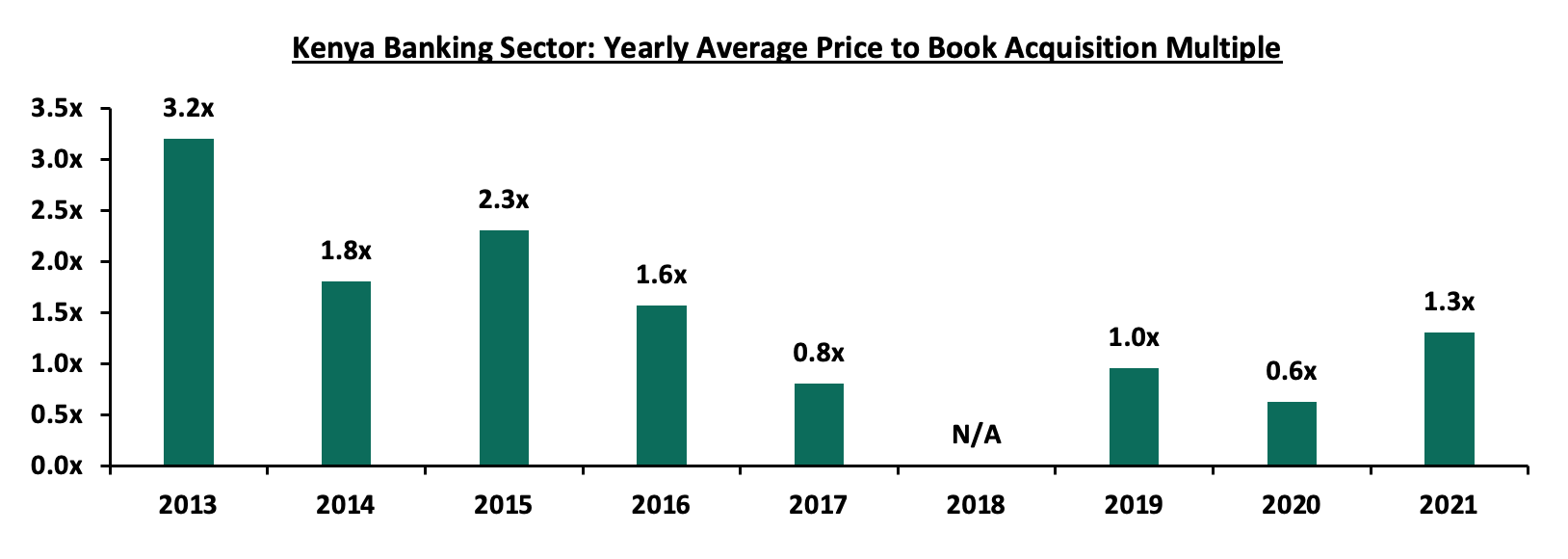
The price consideration from Access Bank translates to a Price to Book Value (P/B) of 1.1x, which is lower than the 8-year acquisitions average P/B of 1.3x, but higher than the current average P/B of the listed banking stocks of 0.9x.
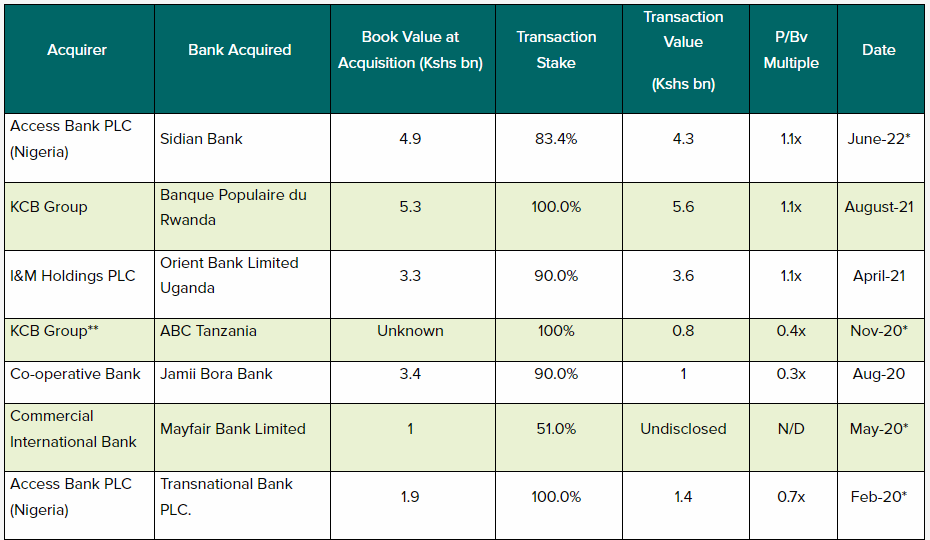
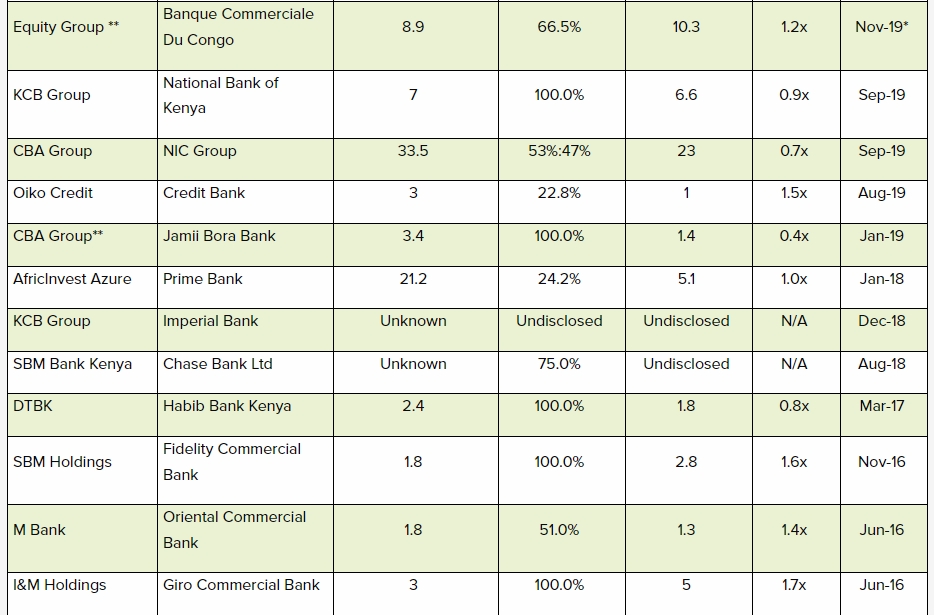

The acquisition valuations for banks have been recovering, with the valuations increasing from an average of 0.6x in 2020 to 1.3x in 2021. This however still remains low compared to historical prices paid as highlighted in the chart below;
The number of commercial banks in Kenya currently stands at 38, the same as in Q1’2022 but lower than the 43 licensed banks in FY’2015.
The ratio of the number of banks per 10 million population in Kenya now stands at 7.1x, which is a reduction from 9.0x in FY’2015 demonstrating continued consolidation of the banking sector.