
Banks Brace For Risk-Based Lending As NCBA’s Muathi Kilonzo Outlines Sector Outlook
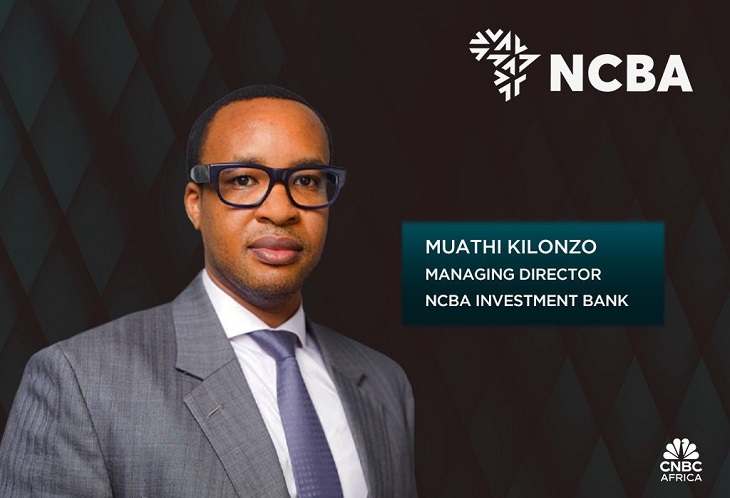
Kenya’s banking industry is undergoing a period of notable transformation, marked by the implementation of a risk-based credit pricing framework against the backdrop of moderating inflation and persistently high interest rates.
Speaking on these developments to CNBC Africa, NCBA Investment Bank Managing Director Muathi Kilonzo outlined how financial institutions are recalibrating their strategies while also identifying new growth prospects in capital markets and investment management.
As of July 2025, the Central Bank of Kenya’s (CBK) benchmark lending rate stood at 15.24 percent, keeping borrowing costs elevated. With private sector credit expansion remaining subdued, Kilonzo noted that commercial banks are cautiously restructuring their loan portfolios. He observed that CBK’s policy measures are beginning to stimulate activity, particularly in the Treasury bill market, which is often viewed as a leading indicator of investor sentiment.

“CBK’s efforts to reduce the policy rate are encouraging private sector credit growth. We are already witnessing positive movement in the Treasury bill market,” said Kilonzo. “The 91-day T-bill has dropped to approximately 8 percent, down from double digits just months ago. This is drawing investor interest even though lending volumes remain constrained.”
Read Also: NCBA Launches ELEV8 LIVE Studio, Unlocking Kenya’s Creative Economy
Kilonzo further highlighted a fundamental shift within Kenya’s investment landscape, particularly at the Nairobi Securities Exchange (NSE). Once dominated by foreign investors, the NSE is now increasingly driven by local participants, a trend that is reshaping market dynamics.
“The Nairobi Securities Exchange, previously reliant on foreign activity, is now supported by local investors,” Kilonzo stated. “This has strengthened our brokerage operations, while our unit trust and wealth management businesses are recording significant growth as Kenyans pursue diverse investment opportunities.”
This transition underscores the growing appetite for wealth management and diversified investment solutions among both retail and institutional investors. NCBA Investment Bank is positioning itself to play a central role in this evolution, offering innovative products, customized advisory services, and contributing to market development.
Despite economic headwinds, several industries continue to demonstrate resilience. Tourism, buoyed by a strong post-pandemic rebound, remains a bright spot, while Kenya’s coffee sector is benefiting from increased global demand. However, manufacturing continues to face challenges, largely due to structural inefficiencies and rising production costs.
“The difficulties in manufacturing are consistent with long-standing competitiveness and infrastructure issues,” Kilonzo noted.
On the transition to risk-based lending, Kilonzo emphasized that the framework is both timely and beneficial. The model allows banks to determine loan pricing based on individual borrower risk profiles, aligning Kenya with international best practices.
“This model is aligned with global standards,” he remarked. “While it will take some months for the sector to fully adjust, the clarity it provides in loan pricing is a positive development for the broader economy.”
For borrowers, the framework implies that those with stronger credit histories may access more favorable rates, while higher-risk clients may face steeper costs. For lenders, it provides greater flexibility in managing credit risks.
The sector continues to grapple with elevated non-performing loans (NPLs), which remain at about 14 percent. Nonetheless, Kilonzo expressed optimism that improvements in GDP growth, export revenues, and tourism recovery would gradually ease the pressure.
Concerns over Kenya’s external debt, particularly Eurobond obligations, have also lessened. According to Kilonzo, improved foreign exchange reserves, a recent S&P credit rating upgrade, and currency stability have bolstered investor confidence.
Looking ahead, Kilonzo underscored the critical role of household spending in stimulating credit demand. With inflation moderating and macroeconomic stability improving, banks anticipate renewed consumer and business confidence.
“As purchasing power strengthens, banks will see increased lending activity,” he affirmed.
In the interim, NCBA and other financial institutions are focusing on innovation in wealth management, advisory, and digital banking to meet evolving client needs. While the transition to risk-based lending requires adjustment, industry leaders are confident that it will promote a more resilient, transparent, and sustainable financial system.
Read Also: NCBA Group Makes Ksh 11.1 Billion In Profits After Tax In 6 Months

About Soko Directory Team
Soko Directory is a Financial and Markets digital portal that tracks brands, listed firms on the NSE, SMEs and trend setters in the markets eco-system.Find us on Facebook: facebook.com/SokoDirectory and on Twitter: twitter.com/SokoDirectory

- January 2026 (220)
- February 2026 (243)
- March 2026 (91)
- January 2025 (119)
- February 2025 (191)
- March 2025 (212)
- April 2025 (193)
- May 2025 (161)
- June 2025 (157)
- July 2025 (227)
- August 2025 (211)
- September 2025 (270)
- October 2025 (297)
- November 2025 (230)
- December 2025 (219)
- January 2024 (238)
- February 2024 (227)
- March 2024 (190)
- April 2024 (133)
- May 2024 (157)
- June 2024 (145)
- July 2024 (136)
- August 2024 (154)
- September 2024 (212)
- October 2024 (255)
- November 2024 (196)
- December 2024 (143)
- January 2023 (182)
- February 2023 (203)
- March 2023 (322)
- April 2023 (297)
- May 2023 (267)
- June 2023 (214)
- July 2023 (212)
- August 2023 (257)
- September 2023 (237)
- October 2023 (264)
- November 2023 (286)
- December 2023 (177)
- January 2022 (293)
- February 2022 (329)
- March 2022 (358)
- April 2022 (292)
- May 2022 (271)
- June 2022 (232)
- July 2022 (278)
- August 2022 (253)
- September 2022 (246)
- October 2022 (196)
- November 2022 (232)
- December 2022 (167)
- January 2021 (182)
- February 2021 (227)
- March 2021 (325)
- April 2021 (259)
- May 2021 (285)
- June 2021 (272)
- July 2021 (277)
- August 2021 (232)
- September 2021 (271)
- October 2021 (304)
- November 2021 (364)
- December 2021 (249)
- January 2020 (272)
- February 2020 (310)
- March 2020 (390)
- April 2020 (321)
- May 2020 (335)
- June 2020 (327)
- July 2020 (333)
- August 2020 (276)
- September 2020 (214)
- October 2020 (233)
- November 2020 (242)
- December 2020 (187)
- January 2019 (251)
- February 2019 (215)
- March 2019 (283)
- April 2019 (254)
- May 2019 (269)
- June 2019 (249)
- July 2019 (335)
- August 2019 (293)
- September 2019 (306)
- October 2019 (313)
- November 2019 (362)
- December 2019 (318)
- January 2018 (291)
- February 2018 (213)
- March 2018 (275)
- April 2018 (223)
- May 2018 (235)
- June 2018 (176)
- July 2018 (256)
- August 2018 (247)
- September 2018 (255)
- October 2018 (282)
- November 2018 (282)
- December 2018 (184)
- January 2017 (183)
- February 2017 (194)
- March 2017 (207)
- April 2017 (104)
- May 2017 (169)
- June 2017 (205)
- July 2017 (189)
- August 2017 (195)
- September 2017 (186)
- October 2017 (235)
- November 2017 (253)
- December 2017 (266)
- January 2016 (164)
- February 2016 (165)
- March 2016 (189)
- April 2016 (143)
- May 2016 (245)
- June 2016 (182)
- July 2016 (271)
- August 2016 (247)
- September 2016 (233)
- October 2016 (191)
- November 2016 (243)
- December 2016 (153)
- January 2015 (1)
- February 2015 (4)
- March 2015 (164)
- April 2015 (107)
- May 2015 (116)
- June 2015 (119)
- July 2015 (145)
- August 2015 (157)
- September 2015 (186)
- October 2015 (169)
- November 2015 (173)
- December 2015 (205)
- March 2014 (2)
- March 2013 (10)
- June 2013 (1)
- March 2012 (7)
- April 2012 (15)
- May 2012 (1)
- July 2012 (1)
- August 2012 (4)
- October 2012 (2)
- November 2012 (2)
- December 2012 (1)