
Catalytic Capital: How European Investment Bank Support Is Bridging Kenya’s Digital Divide
Kenya’s economy is increasingly digital, but access is still uneven, especially for low-income households in informal settlements and peri-urban areas. Nationally, in early 2025, about 27.4 million Kenyans had internet access, representing a penetration rate of 48.0% of the total population, according to DataReportal’s “Digital 2025” report. This figure is a significant increase from previous years, with the number of users growing from 22.71 million in January 2024 to 27.4 million in early 2025.
If you live in neighborhoods like Mathare, Kibera, or the outer edges of Kayole, the barrier isn’t simply “coverage.” It’s the full stack of inclusion: affordable, unlimited connectivity at home; devices that can actually utilize it; and digital skills relevant to income generation. Kenya’s mobile data revolution has made basic access widespread, but mobile bundles are expensive per gigabyte, and poor households quickly reach their limits for work, study, telemedicine, or small-business growth. The result is a usage gap; people are technically “online,” but locked out of higher-value digital activities that require stable, unlimited, and fixed-like connections.
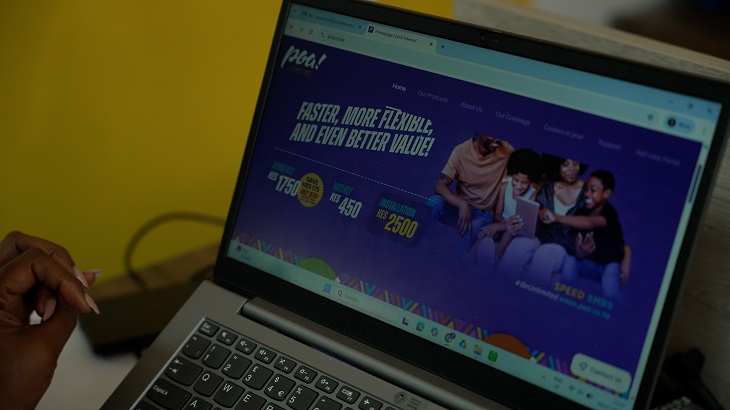
This is the gap Poa Internet set out to close. Poa’s model focuses on providing high quality internet to low-income, high-density neighborhoods, places most fiber operators underserve or price out. The company deploys cost-efficient last-mile infrastructure and sells unlimited home plans and community Wi-Fi at price points a mass market can sustain. As of today, Poa provides home internet from Ksh 1,575 per month or Ksh 450 per week, with a modest installation fee, crucial for cash-constrained households that budget week-to-week.

Why does this matter? Because the leap from capped mobile data to unlimited home Wi-Fi changes behavior. According to the European Investment Bank’s (EIB) 2024/25 Global Impact Report, a July 2024 survey of 800 Poa Internet users found that 85% use their internet for professional purposes, 68% reported increased income or savings, and 62% obtained home Wi-Fi for the first time via Poa Internet (rising to 70% among lower-income households). In short, Poa doesn’t just connect people; it catalyzes livelihoods.
Poa Internet was facing some infrastructural gap challenges in trying to bring unlimited internet to the masses in low-income neighborhoods. They needed significant funding to set up the infrastructure, like radio masts, towers, and a fiber cable network.
Read Also: Strengthening Africa’s Venture Capital Landscape As Oxford University Hosts Leading VC Fund Managers
It was while sourcing funding to grow the company that Poa Internet was introduced to the Boost Africa initiative by a private equity fund called Seedstars Ventures. The initiative is a joint venture between the European Investment Bank and the African Development Bank, with support from the European Commission. Boost Africa looks to provide financing to Funds operating across Africa, as well as beneficiary start-ups or businesses that the Funds invest in. It also provides technical support to both Fund managers and founders of businesses to be able to build a thriving venture capital ecosystem that is attractive to investors.
“We have been working with Boost Africa through a fund called Seedstars Africa, and the capital they provided to us has been used to finance additional infrastructure and additional equipment that we provide to our customers. The capital has also helped to hire additional people and to train those people in all the necessary skills to either sell and deliver internet services to our customers,” said Andy Halsall, Poa Internet CEO.
There is no doubt that the Poa Internet impact didn’t occur in isolation. Boost Africa initiative blends provision of capital and expertise to help startups scale inclusive services. The Bank documents how Poa’s unlimited, affordable home internet directly addresses the usage gap and supports remote work, e-commerce, and digital financial services, activities that translate connectivity into incomes.
“Boost Africa Initiative is part of the European Union’s Global Gateway Initiative, where we are supporting sectors ranging from agriculture, logistics, to education, and also the creative industry.. The aim is to support private sector businesses in Africa, in turn creating sustainable jobs for its population and improving economic prospects. We have a strong focus on youth and women-led businesses and have supported companies like Poa Internet, Shamba Pride, and many others,” said Edward Claessen, Head of European Investment Bank, Regional Hub for East Africa.
Three lessons come out of this Poa Internet story:
- Price and product design must fit low, irregular incomes. Weekly options and low install fees matter as much as the monthly sticker price. Poa’s tariff structure is not a marketing gimmick; it’s a core inclusion feature that aligns with the cash-flow realities of informal work.
- Unlimited home Wi-Fi drives “moving up the stack.” The EIB-reported outcomes, higher earnings/savings, skill acquisition, and professional networking, are all activities that explode in value with always-on, uncapped connectivity. Data-capped mobile alone rarely supports that shift.
- Blended and catalytic finance de-risks the frontier. EIB’s involvement through early investment in private equity funds, as well as the unique structure of a junior tranche (where EIB commits to take on first losses should there be any), didn’t just inject money; it validated the model, attracted co-investors, and paired capital with measurement and technical assistance so impact and scale moved together.
As one of the customers who deals with a workshop puts it, “I have been using Poa Internet for approximately two years. It has helped me in posting my products online on WhatsApp, TikTok, and other social media channels to help me reach my customers. It is very affordable and very good in terms of speed.”
Poa Internet today employs about 400 people who sell, install, and support customers, and “many of those people have been hired within 12 to 18 months since we got funds through the Boost Africa Initiative,” adds the Poa Internet CEO. “Since we started talking to Boost Africa, we have expanded our services across Nairobi, Mombasa, Nakuru, and Eldoret.”
There is no doubt that Kenya’s digital future won’t be judged by average penetration rates alone, but by whether the poorest households can use the internet to earn, learn, and build resilience.
Poa’s approach, with the help of Boost Africa, affordable, unlimited home Wi-Fi in low-income neighborhoods, is showing that inclusion can be both impactful and commercially sustainable.
Read Also: Kenyan Affordable Housing Projects Advance With EIB Global Support

About Juma
Juma is an enthusiastic journalist who believes that journalism has power to change the world either negatively or positively depending on how one uses it.(020) 528 0222 or Email: info@sokodirectory.com
- January 2026 (220)
- February 2026 (243)
- March 2026 (54)
- January 2025 (119)
- February 2025 (191)
- March 2025 (212)
- April 2025 (193)
- May 2025 (161)
- June 2025 (157)
- July 2025 (227)
- August 2025 (211)
- September 2025 (270)
- October 2025 (297)
- November 2025 (230)
- December 2025 (219)
- January 2024 (238)
- February 2024 (227)
- March 2024 (190)
- April 2024 (133)
- May 2024 (157)
- June 2024 (145)
- July 2024 (136)
- August 2024 (154)
- September 2024 (212)
- October 2024 (255)
- November 2024 (196)
- December 2024 (143)
- January 2023 (182)
- February 2023 (203)
- March 2023 (322)
- April 2023 (297)
- May 2023 (267)
- June 2023 (214)
- July 2023 (212)
- August 2023 (257)
- September 2023 (237)
- October 2023 (264)
- November 2023 (286)
- December 2023 (177)
- January 2022 (293)
- February 2022 (329)
- March 2022 (358)
- April 2022 (292)
- May 2022 (271)
- June 2022 (232)
- July 2022 (278)
- August 2022 (253)
- September 2022 (246)
- October 2022 (196)
- November 2022 (232)
- December 2022 (167)
- January 2021 (182)
- February 2021 (227)
- March 2021 (325)
- April 2021 (259)
- May 2021 (285)
- June 2021 (272)
- July 2021 (277)
- August 2021 (232)
- September 2021 (271)
- October 2021 (304)
- November 2021 (364)
- December 2021 (249)
- January 2020 (272)
- February 2020 (310)
- March 2020 (390)
- April 2020 (321)
- May 2020 (335)
- June 2020 (327)
- July 2020 (333)
- August 2020 (276)
- September 2020 (214)
- October 2020 (233)
- November 2020 (242)
- December 2020 (187)
- January 2019 (251)
- February 2019 (215)
- March 2019 (283)
- April 2019 (254)
- May 2019 (269)
- June 2019 (249)
- July 2019 (335)
- August 2019 (293)
- September 2019 (306)
- October 2019 (313)
- November 2019 (362)
- December 2019 (318)
- January 2018 (291)
- February 2018 (213)
- March 2018 (275)
- April 2018 (223)
- May 2018 (235)
- June 2018 (176)
- July 2018 (256)
- August 2018 (247)
- September 2018 (255)
- October 2018 (282)
- November 2018 (282)
- December 2018 (184)
- January 2017 (183)
- February 2017 (194)
- March 2017 (207)
- April 2017 (104)
- May 2017 (169)
- June 2017 (205)
- July 2017 (189)
- August 2017 (195)
- September 2017 (186)
- October 2017 (235)
- November 2017 (253)
- December 2017 (266)
- January 2016 (164)
- February 2016 (165)
- March 2016 (189)
- April 2016 (143)
- May 2016 (245)
- June 2016 (182)
- July 2016 (271)
- August 2016 (247)
- September 2016 (233)
- October 2016 (191)
- November 2016 (243)
- December 2016 (153)
- January 2015 (1)
- February 2015 (4)
- March 2015 (164)
- April 2015 (107)
- May 2015 (116)
- June 2015 (119)
- July 2015 (145)
- August 2015 (157)
- September 2015 (186)
- October 2015 (169)
- November 2015 (173)
- December 2015 (205)
- March 2014 (2)
- March 2013 (10)
- June 2013 (1)
- March 2012 (7)
- April 2012 (15)
- May 2012 (1)
- July 2012 (1)
- August 2012 (4)
- October 2012 (2)
- November 2012 (2)
- December 2012 (1)