
What Safaricom’s IPO Can Teach Every KPC IPO Investor

In March 2008, Kenyans borrowed against their homes, and Chamas pooled their savings to buy Safaricom shares.
As a result, the IPO was 4.63 times oversubscribed. In the end, it minted a generation of retail investors who still talk about that moment today.
What nobody noticed at the time, before the oversubscription was announced, before any analyst had spoken, ordinary Kenyans were already signalling their intentions on Google.

They turned to Google and searched for “how to apply for Safaricom shares,” “is Safaricom IPO worth it,” and so on to find answers and information.
In aggregate, they formed the most honest real-time sentiment signal available. Nobody was reading it then.
Eighteen years later, the KPC IPO created a similar moment. This time, we HAVE the data.
Over five weeks, I tracked Kenya Pipeline Company’s IPO search behavior using Google Trends and other search optimization tools that any Kenyan can access.
What the data shows goes beyond this IPO.
It reveals how Kenyans behave as investors when they think nobody is watching.
And stacked against Safaricom’s 18-year search history, it points to what happens after March 9th, when KPC will officially be listed on the NSE.
The Silence Before the Storm
From October to December 2025, ‘Kenya Pipeline IPO’ was a ghost term in Kenya’s search landscape.
The articles existed. Bloomberg had published it. Business Daily Africa had covered the privatisation framework. But almost nobody was searching for it yet.
The chart below tells the story more precisely than any description can.
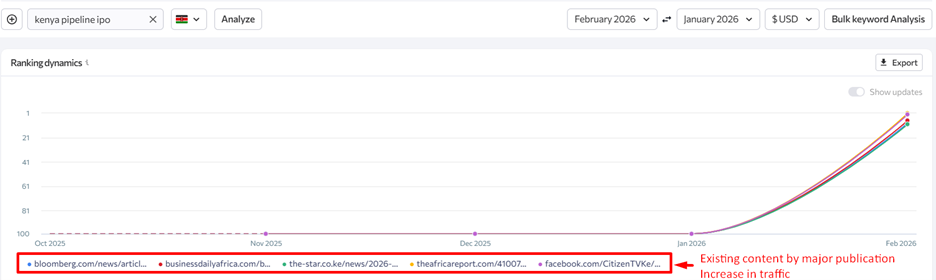
As you can see, every major publisher, Bloomberg, Business Daily Africa, The Star, The Africa Report, Citizen TV, was sitting at search position 80 to 100 throughout the final quarter of 2025. Buried.
Effectively invisible to anyone who had not already heard about the IPO through another channel.
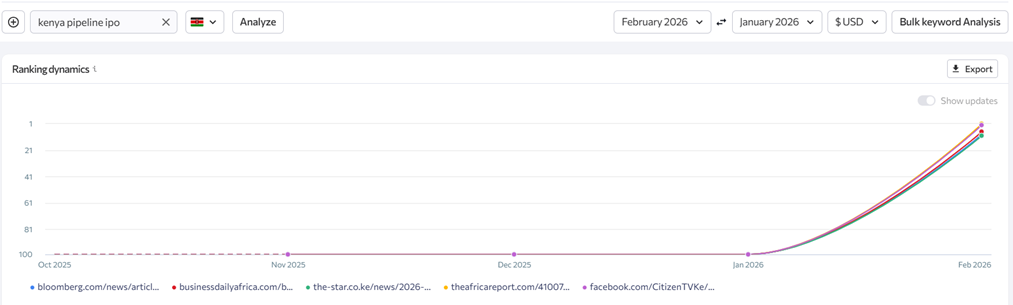
‘Kenya pipeline ipo’ — Bloomberg, Business Daily, The Star, The Africa Report, and Citizen TV, ranking from position 80–100 to position 1–5, October 2025 to February 2026
This is the pre-announcement baseline. Institutional attention existed. Public awareness did not. The demand was latent, waiting for a trigger.
KEY INSIGHT
When major publishers start writing about a topic that has low public search volume, that is not a sign that the topic is unimportant. It is a sign that institutions are positioning themselves before retail demand arrives. The ranking competition is a leading indicator. The volume number is a lagging one.
January 19 and the Trigger
The moment the Kenya Pipeline IPO officially opened on January 19, search behavior changed overnight.
Google Trends indexed ‘Kenya Pipeline IPO’ at 100, the maximum possible score, within days of the announcement.
The standalone term ‘Kenya Pipeline’ followed the same trajectory.
The KPC brand itself, the yellow line, sustained the highest average interest of 13 across the entire three-month period.
Higher than the IPO-specific search term. This is significant: people were not just searching for the transaction.
They were searching for the company. Brand curiosity outlasted the deal window.
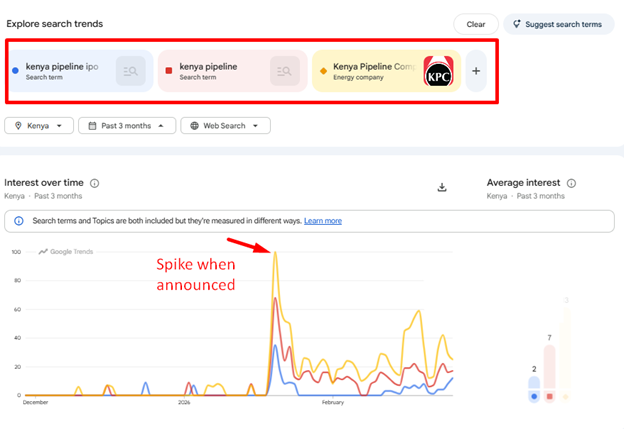
Google Trends: ‘kenya pipeline ipo’ + ‘kenya pipeline’ + KPC brand — spike to 100 on January 19 when IPO opened, second spike in February when extension was announced. Kenya, past 3 months.
Simultaneously, the ranking competition chart shows every major publisher jumping from position 80 to the top five in the same week.
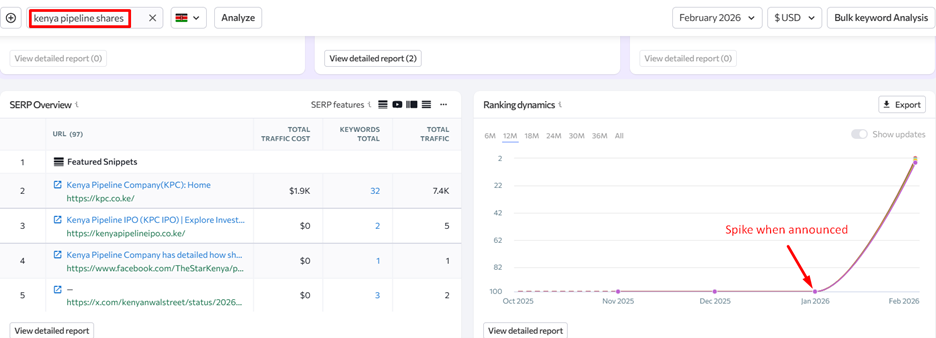
‘Kenya Pipeline shares’ search term spikes after IPO announcement
This was not a coincidence. Each newsroom was tracking the same demand signal and publishing to capture it.
KEY INSIGHT
A spike to 100 on Google Trends does not mean 100 searches. It means that week had the highest relative search volume in the tracked period. For a term sitting at 2 to 3 for months, a jump to 100 represents a 30 to 50 times increase in public attention in a matter of days. Monthly volume tools never capture this because they average across the flat months.
What Makes KPC 2026 Different From Safaricom 2008
The Safaricom IPO in 2008 was a transaction for people who already understood what they were buying.
The Kenya Pipeline IPO in 2026 was also a financial education event.
The data makes this visible.
When ‘Kenya Pipeline IPO’ spiked, so did the standalone search term ‘ipo,’ recording an average of 8 during the KPC window.
And the broader topic ‘Initial Public Offering’ moved in lockstep.
Kenyans were not just searching for this specific deal. Many were learning what an IPO is for the first time, triggered by this deal.
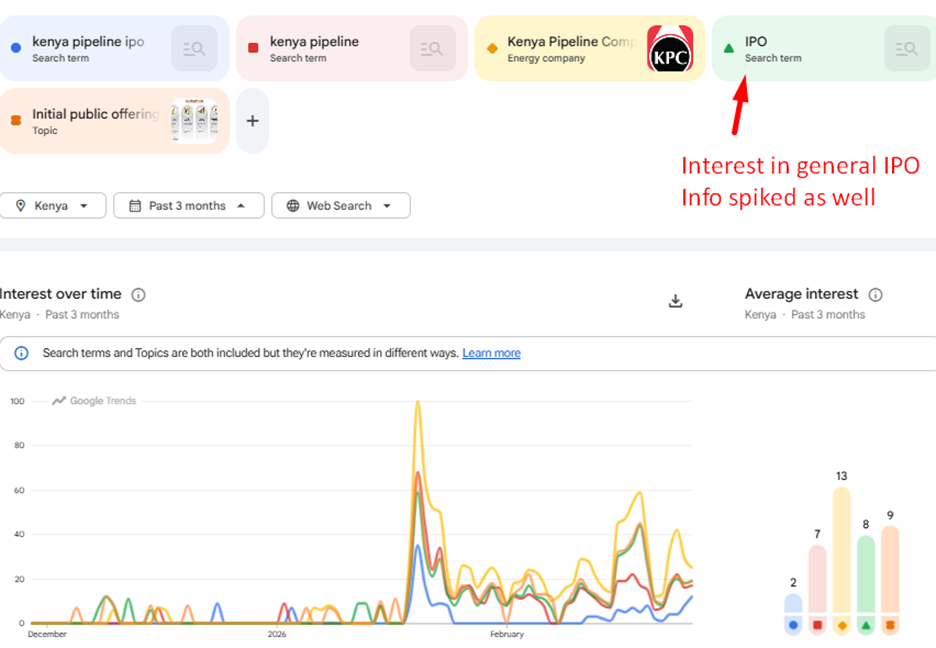
Google Trends: ‘kenya pipeline ipo’ + ‘kenya pipeline’ + KPC brand + standalone ‘ipo’ search term + ‘Initial Public Offering’ topic, showing co-movement of IPO education searches alongside the KPC-specific term. Kenya, past 3 months.
Compare this to Safaricom’s 2008 data.
‘Safaricom ipo’ hit 100 in March 2008 as expected. But there was less of a corresponding spike in general “IPO” education searches.
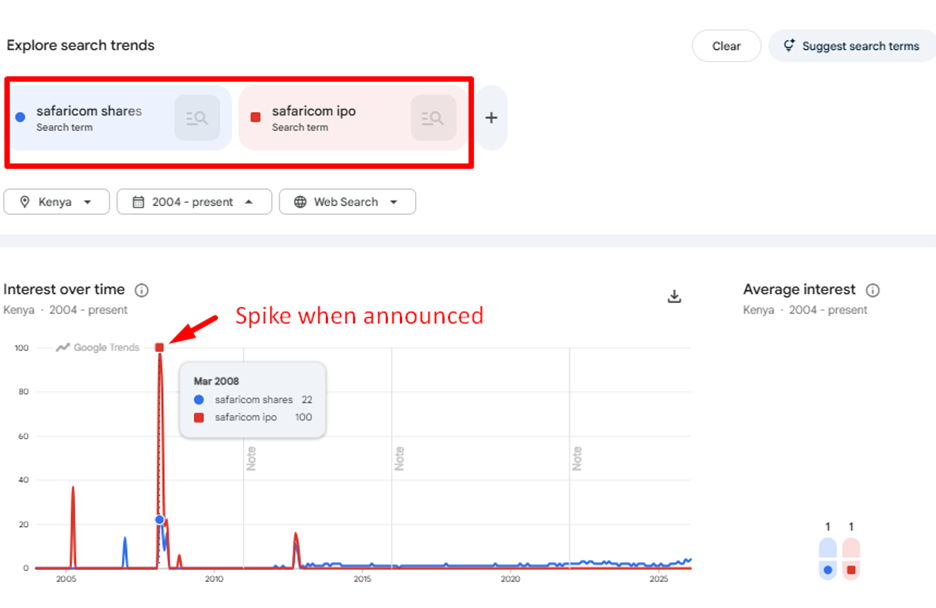
The concept was already established. The 2008 audience knew what they were buying and wanted in on this specific deal.
KPC attracted a different cohort.
First-time investors who needed more than a subscription window. They needed enough time to understand what they were participating in.
This is the data evidence behind Kenya Pipeline’s decision to extend the closing date by five days.
The argument that the extension signalled weak demand misreads what the search behavior actually showed.
KEY INSIGHT
When a major market event drives financial literacy searches alongside itself, the participation pool is wider than analysts projected. And the demand is genuine rather than speculative. The education spike is a bullish signal, not a bearish one.
The Extension and the Second Wave
When Kenya Pipeline announced on February 19 that the IPO closing date would be extended by five days to February 24, something measurable happened: a second search spike.
It is smaller than the January 19 announcement spike. But it is clearly visible and distinct.
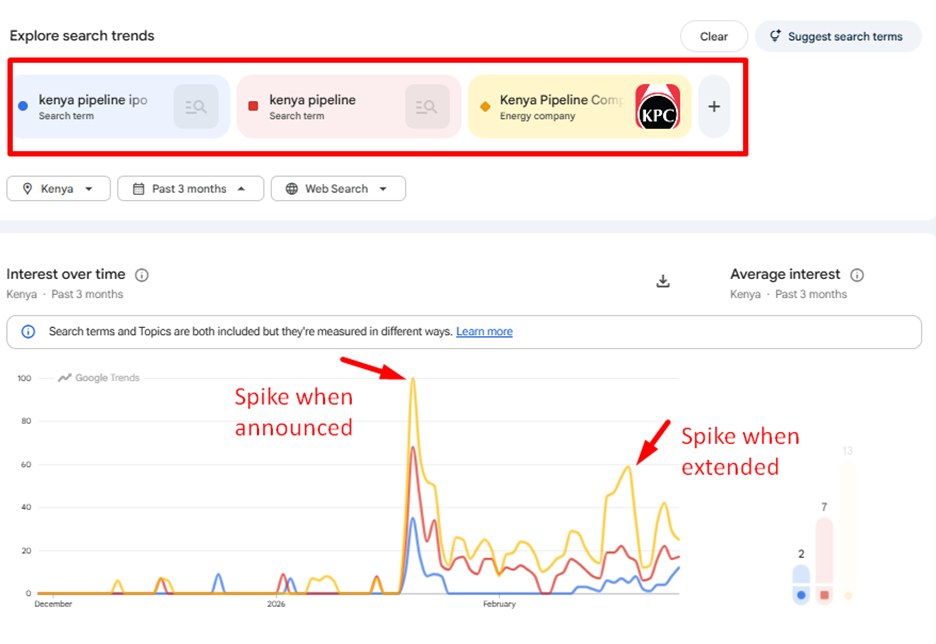
People who had not yet applied went back to research. The data gives a more direct answer to the ‘was the extension a sign of weak demand?’ question than any regulator statement could.
If demand had genuinely collapsed, search interest would have flatlined after the initial spike. Instead, it bounced. Re-engagement, not disengagement.
KEY INSIGHT
In market events, a second search spike after a procedural change, an extension, a court ruling, a regulatory announcement, is a proxy for active re-engagement. It tells you the audience is reconsidering, not checked out.
The 18-Year Maturity Curve: What Safaricom Teaches Us About March 9
This is where the comparison becomes genuinely useful for KPC investors.
Eighteen years after the Safaricom IPO, these are the search numbers:
- ‘Safaricom ipo’ records 70 monthly searches in Kenya.
- ‘Safaricom share price’ records 4,400.
- ‘Safaricom shares price today’ records 3,200.
That gap, from IPO curiosity to daily price checking, is what 18 years of successful retail ownership look like in search data.
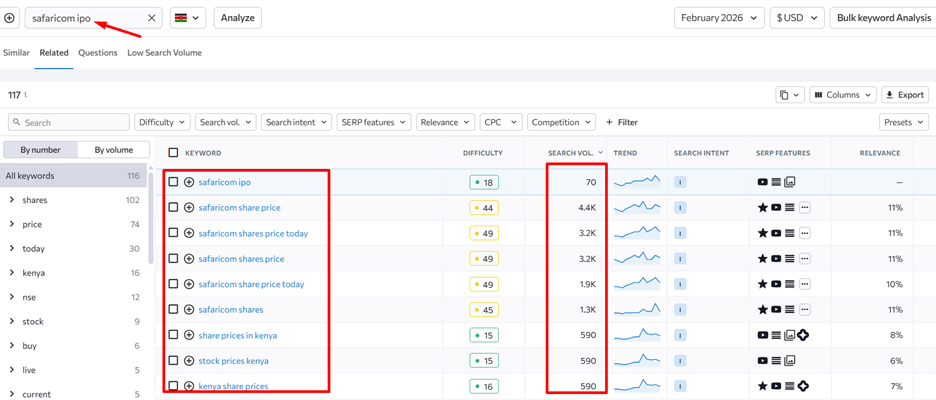
Safaricom’s 18-year maturity gap between IPO interest and active shareholder engagement
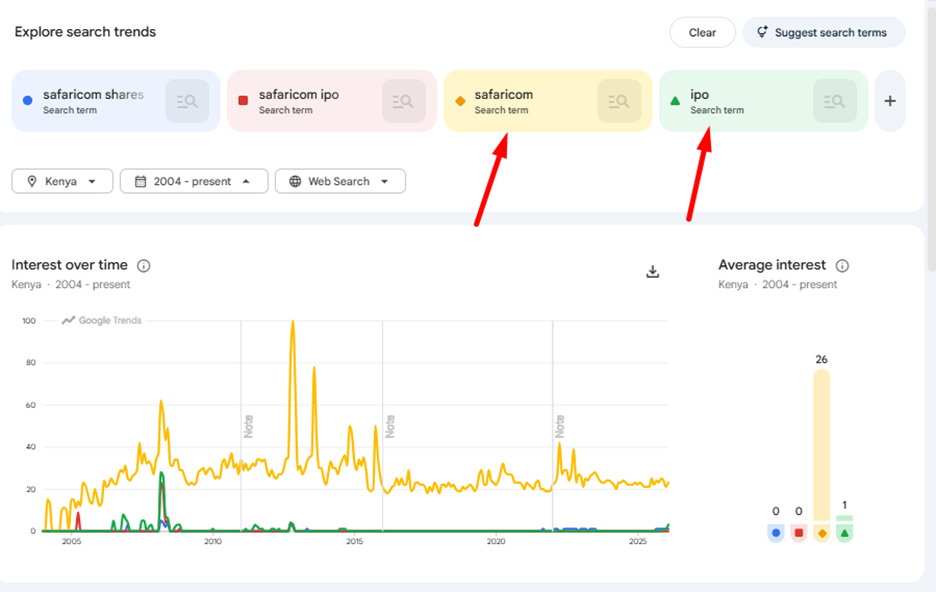
The Safaricom Google Trends history adds another layer. Look at what happened in November 2012, four years after the IPO.
The general ‘Safaricom’ search term spiked to 100 again. But it was not triggered by a new share offer.
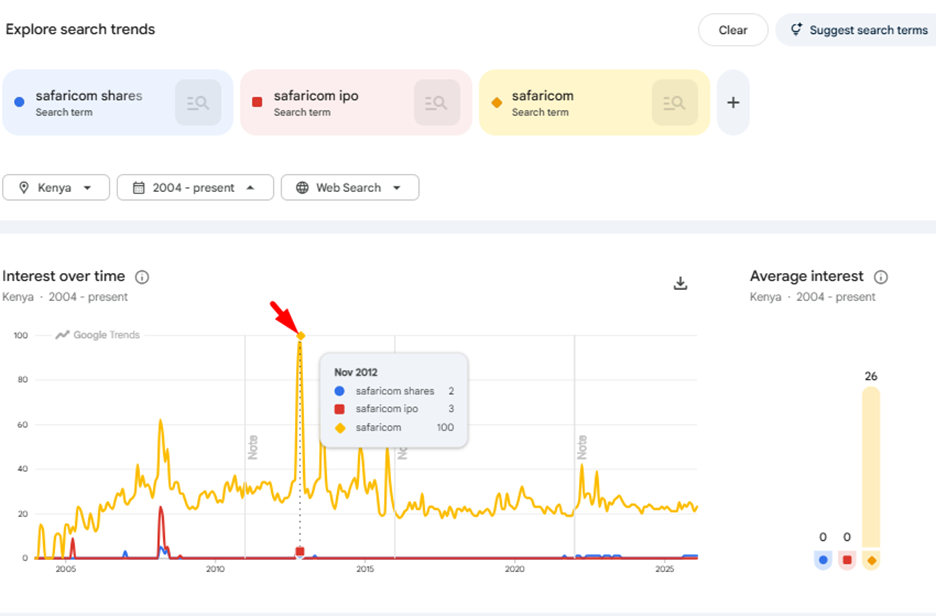
Google Trends: ‘safaricom shares’ + ‘safaricom ipo’ + ‘safaricom’ brand, 2004 to present, showing March 2008 IPO spike and November 2012 earnings-driven spike. Annotated with both events.
The November 2012 spike was driven by Safaricom’s impressive half-year results, 38 percent profit growth announced that month.
This triggered a share price recovery from a 2012 low.
Kenyans had stopped asking ‘what is the Safaricom IPO?’ and started asking ‘what are Safaricom’s results today?’
That transition, from transactional curiosity to ongoing ownership engagement, is what a successful listing actually looks like.
What to Watch for KPC After March 9
The IPO search terms will fall. That is expected and healthy.
‘Kenya Pipeline IPO’ will record near-zero monthly searches by mid-2026 as the transaction closes in public memory.
The metric that matters is what replaces it. Watch for ‘KPC share price,’ ‘Kenya Pipeline Company shares today,’ and ‘KPC dividend’ to emerge and grow.
If those terms build consistent monthly volume over the next 12 to 18 months, you are watching the same transition Safaricom made after 2008.
From a deal that Kenyans subscribed to, into a company that Kenyans own.
KEY INSIGHT
The Safaricom data sets a benchmark: 4,400 monthly searches for a live share price 18 years post-IPO. If KPC’s retail participation is as broad as the subscription data suggests, a similar trajectory is plausible. If search interest drops to near zero within 6 months, that signals early speculative exit rather than long-term holding.
A Repeatable Framework for the Next NSE Listing
The SEO tools used in this analysis are free. The methodology takes 15 minutes.
Before the next major NSE listing or investment opportunity, here is how to apply the same approach.
Step 1: Watch the ranking competition, not the volume number
Search the company or deal name in any keyword tool. Ignore the monthly volume figure.
Look at who is suddenly writing about this topic and how fast they moved from obscurity to position 1.
When Bloomberg, Business Daily and Citizen TV race simultaneously for the same term, that is institutional positioning ahead of retail demand, exactly the pattern that preceded the KPC spike.
Step 2: Check for education search co-movement on Google Trends
Add both the specific term and the general concept to Google Trends. If ‘next big IPO Kenya’ and ‘what is an IPO’ spike together, you are looking at a genuinely new investor cohort entering the market.
This shows wider participation, more retail depth, longer holding horizon. If only the specific term spikes, it is an existing investor base rotating into a new deal.
Step 3: Track the post-listing search evolution
After listing day, monitor whether searches shift from the IPO term to the company name and live price queries.
The Safaricom data suggests this transition takes 12 to 24 months in a healthy scenario.
A rapid shift signals engaged shareholders. A flat or declining curve signals speculative flipping with limited long-term participation.
KEY INSIGHT
These are not stock-picking tools. They do not tell you whether to buy or sell. What they tell you is the shape of public attention. How wide, how deep, and how durable the retail interest is. In a market where information asymmetry remains significant, that is a genuinely useful edge.
Beyond the IPO: Why Every Kenyan Business Owner Should Read Search Data the Way Investors Do
Most Kenyan business owners think of Google search data as something that belongs to the marketing department.
That it is only relevant after you have already decided what to sell, who to sell it to, and where to operate. The KPC IPO data suggests a different possibility.
The search behavior we tracked across this IPO, the latent demand that keyword tools missed, the education searches that revealed a new investor cohort, and the second spike that confirmed re-engagement after the extension, is not unique to capital markets.
It is the same pattern that plays out every time a new market opportunity emerges in Kenya. The tools are free. The signals are public. Most businesses never look.
Three Applications for Kenyan Businesses
Real estate development: A developer tracking search volume for ‘apartments Syokimau’ and ‘two bedroom Westlands’ before committing to land acquisition in a new corridor.
The search trend does not tell you whether to build. It tells you whether potential buyers are already looking, and whether that interest is growing or contracting before the first brick is laid.
Healthcare expansion: A hospital group monitoring ‘specialist doctor Nairobi’ and ‘oncologist Kenya’ searches before deciding where to open a new clinic.
Patient search behavior reveals both the volume of unmet demand and the specific specialties Kenyans are struggling to find, intelligence that no market research firm is selling affordably to Kenyan healthcare operators.
Logistics and services: A logistics company reading ‘cold chain Kenya’ and ‘refrigerated transport Nairobi’ search trends before pitching a new service line to FMCG clients.
If searches for that capability are growing month on month, that is third-party validation of market need, the kind of evidence that changes a pitch from an opinion to a data-backed proposition.
In each case, the skill is identical: reading public digital behavior as a market research instrument before making an operational or financial commitment.
The KPC IPO was visible enough for everyone to see the pattern clearly. In most industries, the same signals exist, but nobody is reading them.
This is the work AM Digital KE does for Kenyan businesses, translating search data into strategic decisions about visibility, timing, and market positioning.
If you want to learn more about how to take advantage of search data, they have an SEO FAQs page with over 50 terms to help you understand better.
What the Data Leaves Us With
Monthly search volume measures the average. It does not measure the moment.
The KPC IPO was a moment, one that compressed years of latent public interest into six weeks of explosive search activity.
It drew in a new generation of first-time investors who were learning and subscribing simultaneously. Plus, it produced a second engagement wave when regulators responded to what the data was already showing.
The March 9 listing is not the end of the KPC story. It is the beginning of an 18-year data trail that future digital analysts will be able to read, just as we can now read Safaricom’s journey from a 2008 IPO spike, through a 2012 earnings surge.
Whether KPC follows that trajectory depends on more than search data. But search data will be one of the earliest and most honest indicators of which way it is heading.
By Alvin Munene, Founder, AM Digital KE

About Soko Directory Team
Soko Directory is a Financial and Markets digital portal that tracks brands, listed firms on the NSE, SMEs and trend setters in the markets eco-system.Find us on Facebook: facebook.com/SokoDirectory and on Twitter: twitter.com/SokoDirectory

- January 2026 (220)
- February 2026 (248)
- March 2026 (287)
- April 2026 (207)
- May 2026 (192)
- June 2026 (238)
- July 2026 (279)
- August 2026 (223)
- September 2026 (134)
- January 2025 (119)
- February 2025 (191)
- March 2025 (212)
- April 2025 (193)
- May 2025 (161)
- June 2025 (157)
- July 2025 (227)
- August 2025 (211)
- September 2025 (267)
- October 2025 (297)
- November 2025 (230)
- December 2025 (220)
- January 2024 (238)
- February 2024 (227)
- March 2024 (190)
- April 2024 (133)
- May 2024 (157)
- June 2024 (145)
- July 2024 (136)
- August 2024 (154)
- September 2024 (212)
- October 2024 (255)
- November 2024 (196)
- December 2024 (143)
- January 2023 (182)
- February 2023 (203)
- March 2023 (322)
- April 2023 (297)
- May 2023 (267)
- June 2023 (214)
- July 2023 (212)
- August 2023 (257)
- September 2023 (237)
- October 2023 (264)
- November 2023 (286)
- December 2023 (177)
- January 2022 (293)
- February 2022 (329)
- March 2022 (358)
- April 2022 (292)
- May 2022 (271)
- June 2022 (232)
- July 2022 (278)
- August 2022 (253)
- September 2022 (246)
- October 2022 (196)
- November 2022 (232)
- December 2022 (167)
- January 2021 (182)
- February 2021 (227)
- March 2021 (325)
- April 2021 (259)
- May 2021 (285)
- June 2021 (272)
- July 2021 (277)
- August 2021 (232)
- September 2021 (271)
- October 2021 (303)
- November 2021 (364)
- December 2021 (249)
- January 2020 (272)
- February 2020 (310)
- March 2020 (390)
- April 2020 (321)
- May 2020 (335)
- June 2020 (327)
- July 2020 (333)
- August 2020 (276)
- September 2020 (214)
- October 2020 (233)
- November 2020 (242)
- December 2020 (187)
- January 2019 (251)
- February 2019 (215)
- March 2019 (283)
- April 2019 (254)
- May 2019 (269)
- June 2019 (249)
- July 2019 (335)
- August 2019 (292)
- September 2019 (306)
- October 2019 (313)
- November 2019 (362)
- December 2019 (318)
- January 2018 (291)
- February 2018 (213)
- March 2018 (275)
- April 2018 (223)
- May 2018 (235)
- June 2018 (176)
- July 2018 (256)
- August 2018 (247)
- September 2018 (255)
- October 2018 (282)
- November 2018 (282)
- December 2018 (184)
- January 2017 (183)
- February 2017 (194)
- March 2017 (207)
- April 2017 (104)
- May 2017 (169)
- June 2017 (205)
- July 2017 (189)
- August 2017 (195)
- September 2017 (186)
- October 2017 (235)
- November 2017 (253)
- December 2017 (266)
- January 2016 (164)
- February 2016 (165)
- March 2016 (189)
- April 2016 (143)
- May 2016 (245)
- June 2016 (182)
- July 2016 (271)
- August 2016 (247)
- September 2016 (233)
- October 2016 (191)
- November 2016 (243)
- December 2016 (153)
- January 2015 (1)
- February 2015 (4)
- March 2015 (164)
- April 2015 (107)
- May 2015 (116)
- June 2015 (119)
- July 2015 (145)
- August 2015 (157)
- September 2015 (186)
- October 2015 (169)
- November 2015 (173)
- December 2015 (205)
- March 2014 (2)
- March 2013 (10)
- June 2013 (1)
- March 2012 (7)
- April 2012 (15)
- May 2012 (1)
- July 2012 (1)
- August 2012 (4)
- October 2012 (2)
- November 2012 (2)
- December 2012 (1)