
A Hungry Republic: How Kenya’s Leadership Turned Hunger Into a National Policy

The data on food poverty in Kenya is not just a set of numbers—it is a mirror reflecting the country’s chronic inequality, failed planning, and hollow leadership. In 2022, 31.7% of Kenyans were unable to meet their minimum food needs. That is not a statistic; it’s an indictment. It tells a story of a government that spends billions on luxury motorcades while citizens starve in the plains of Turkana, the deserts of Mandera, and the forgotten corners of West Pokot.
Turkana’s 64.3% food poverty rate is not accidental. It’s structural violence. For decades, that region has been reduced to a charity project—permanently photographed but never developed. Billions in donor funds for drought resilience have been siphoned through NGOs and ministries, but the people remain emaciated, dependent, and voiceless. Hunger has become a weapon of control, ensuring that votes in such regions are easily bought with sacks of maize.
Meanwhile, Nairobi, sitting at 15.8%, boasts of economic vitality and urban consumption patterns that could feed entire counties. Yet even in the capital, slums stretch endlessly, and behind the average income hides a disturbing divide—where 20% of residents dine on imported sushi while millions scavenge for leftovers in Dandora. Poverty in Kenya is not about scarcity—it’s about deliberate distribution failures.

Counties like Mandera, Samburu, and Marsabit, with over 50% food poverty, exist in a cycle of marginalization. They have been turned into political commodities—areas that are useful only for census numbers and voting blocs. Development projects there are often ghost programs: endless road tenders, unbuilt dams, and hollow irrigation dreams. Hunger has become an economy; feeding programs are budget lines, not solutions.
Garissa’s 51.2% poverty rate and West Pokot’s 49.3% reveal that even counties with natural wealth are victims of governance theft. The land is fertile, the livestock abundant, but corruption corrodes everything. Where there should be granaries, there are warehouses for political campaign materials. The political elite feeds on contracts while citizens feed on promises.
Read Also: Vote Out These Hungry Hyenas And Stop Whining
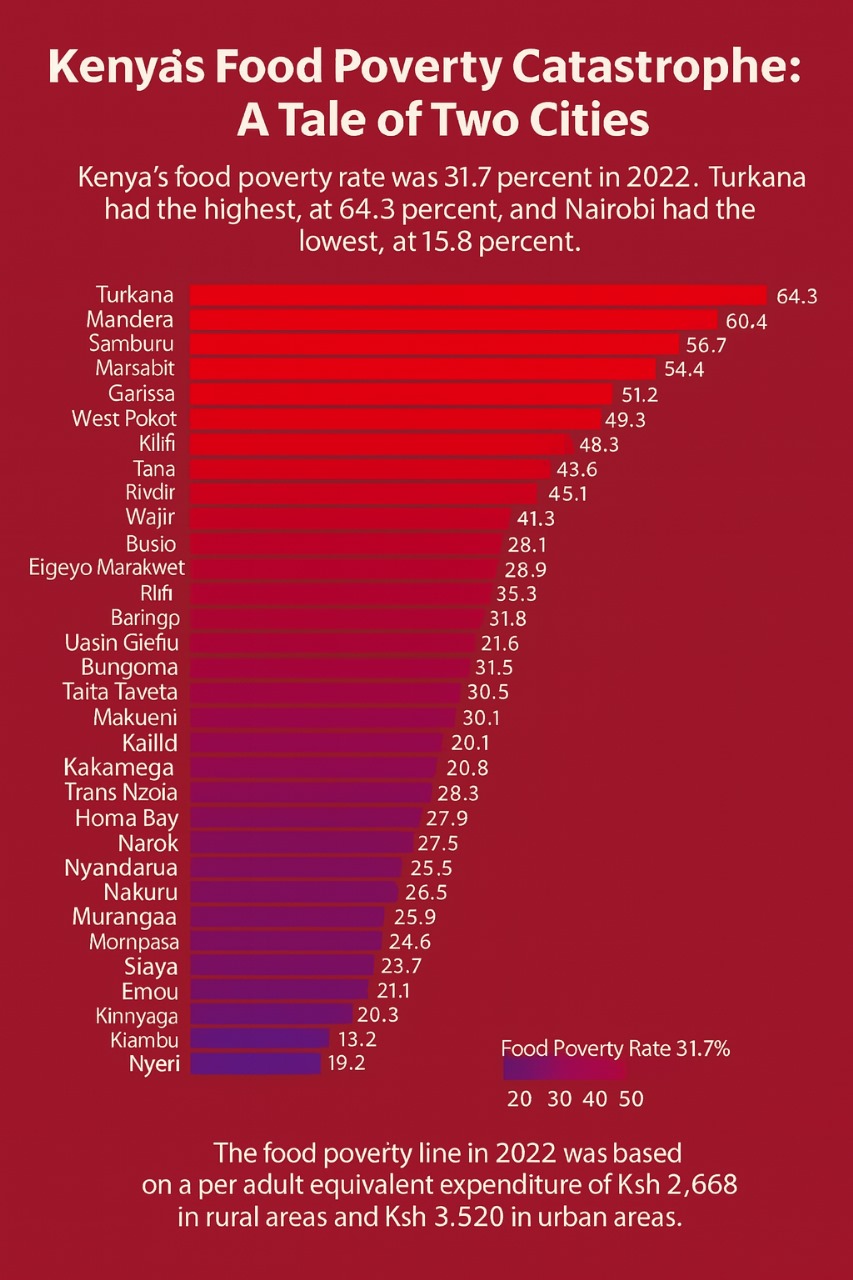
Counties like Kilifi, Tana River, and Wajir—each above 45%—are a haunting reminder that coastal beauty hides inland despair. The same government that builds tourist resorts in Watamu cannot build irrigation canals for local farmers. The result: endless hunger seasons, rising food prices, and children dropping out of school because hunger eats concentration.
When Busia and Vihiga appear at 45.1% and 41.3%, it proves that even agriculturally rich counties are starving. Western Kenya has fertile soils, reliable rainfall, and resilient people—but markets are broken, middlemen thrive, and smallholder farmers are trapped in low-value crop cycles. Hunger here is not natural; it’s imposed by bad policies and predatory trade systems.
As we move toward central counties like Kitui, Elgeyo Marakwet, and Kwale—hovering around 36%—the narrative shifts from aridity to apathy. These are places with potential, yet government investment is absent. It’s easier for politicians to blame drought than admit mismanagement. It’s easier to distribute relief food than to build silos, irrigation, and agro-industrial systems.
Counties between 33% and 31%, like Makueni, Kajiado, and Tharaka-Nithi, represent the national average but tell a deeper truth: even the “better off” regions cannot meet their food needs without borrowing. The middle-class illusion of stability in these counties hides growing debt, dependency on remittances, and unsustainable urban migration.
Urban counties like Kisumu, Nakuru, and Machakos, though below 32%, are not free from hunger either. Rising inflation, fuel costs, and joblessness have redefined urban food insecurity. It’s no longer about starvation—it’s about silent malnutrition. Kenyans are eating, yes, but they are eating emptiness: starch, sugar, and salt masquerading as meals.
The irony of Kenya’s hunger crisis lies in its geography. A nation blessed with arable land, rivers, and multiple climate zones cannot feed itself. The reason is political—food production is not profitable for those in power. Importation earns kickbacks. Hunger justifies foreign aid. Drought is a campaign platform.
When we see Meru, Kirinyaga, Kiambu, and Nyeri with rates below 21%, it is not because they are superior. It’s because of historical advantage, infrastructure, and access to markets. The tragedy is that the same national policies that protect these countries suffocate others. Kenya’s food system is rigged in favor of a few.
Nairobi’s low rate of 15.8% exposes the moral contradiction of a capital city surrounded by starvation. It is the heart of policy but the graveyard of empathy. Every government announcement about “ending hunger by 2030” is an insult when children in Turkana still die under acacia trees.
The national food poverty line—KSh 2,668 in rural areas and KSh 3,520 in urban areas—shows how absurdly low our expectations are. We are not measuring prosperity; we are measuring survival. A nation that sets such a bar is not fighting poverty—it is institutionalizing it.
The larger tragedy is that Kenya has normalized hunger. Drought alerts are issued like weather forecasts. Hunger is televised, not solved. Politicians eat five-course meals at relief distribution ceremonies. NGOs hold summits in hotels about “sustainable food systems” while the poor drink muddy water.
Averaging 31.7% means one in three Kenyans is hungry, yet the government celebrates GDP growth. That growth is meaningless if it doesn’t fill stomachs. Kenya’s economic model rewards consumption, not production. It builds malls, not mills. It imports maize instead of empowering farmers.
If the Constitution guarantees the right to food, then hunger is unconstitutional. Yet no one is ever prosecuted for it. When a nation tolerates hunger, it kills hope. It tells its citizens that life is negotiable, that survival depends on who is in power, not what you produce.
The truth is that Kenya doesn’t lack food—it lacks justice. Farmers are exploited, markets are manipulated, and national reserves are politicized. Every hunger crisis is a theft crisis. Every relief donation is an election rehearsal.
Until Kenya redefines governance from privilege to service, food poverty will remain our national shame. Turkana will still be hungry in 2030, and Nairobi will still pretend to care. Because in Kenya, hunger feeds politics more than food feeds people.
And that is why, beneath the glossy graphs and statistics, lies the real story: Kenya is not a hungry nation by fate—it is one starved by design.
Read Also: In Hungry Horn Of Africa, Ethiopia Bets The House On Wheat

About Steve Biko Wafula
Steve Biko is the CEO OF Soko Directory and the founder of Hidalgo Group of Companies. Steve is currently developing his career in law, finance, entrepreneurship and digital consultancy; and has been implementing consultancy assignments for client organizations comprising of trainings besides capacity building in entrepreneurial matters.He can be reached on: +254 20 510 1124 or Email: info@sokodirectory.com

- January 2026 (220)
- February 2026 (243)
- March 2026 (62)
- January 2025 (119)
- February 2025 (191)
- March 2025 (212)
- April 2025 (193)
- May 2025 (161)
- June 2025 (157)
- July 2025 (227)
- August 2025 (211)
- September 2025 (270)
- October 2025 (297)
- November 2025 (230)
- December 2025 (219)
- January 2024 (238)
- February 2024 (227)
- March 2024 (190)
- April 2024 (133)
- May 2024 (157)
- June 2024 (145)
- July 2024 (136)
- August 2024 (154)
- September 2024 (212)
- October 2024 (255)
- November 2024 (196)
- December 2024 (143)
- January 2023 (182)
- February 2023 (203)
- March 2023 (322)
- April 2023 (297)
- May 2023 (267)
- June 2023 (214)
- July 2023 (212)
- August 2023 (257)
- September 2023 (237)
- October 2023 (264)
- November 2023 (286)
- December 2023 (177)
- January 2022 (293)
- February 2022 (329)
- March 2022 (358)
- April 2022 (292)
- May 2022 (271)
- June 2022 (232)
- July 2022 (278)
- August 2022 (253)
- September 2022 (246)
- October 2022 (196)
- November 2022 (232)
- December 2022 (167)
- January 2021 (182)
- February 2021 (227)
- March 2021 (325)
- April 2021 (259)
- May 2021 (285)
- June 2021 (272)
- July 2021 (277)
- August 2021 (232)
- September 2021 (271)
- October 2021 (304)
- November 2021 (364)
- December 2021 (249)
- January 2020 (272)
- February 2020 (310)
- March 2020 (390)
- April 2020 (321)
- May 2020 (335)
- June 2020 (327)
- July 2020 (333)
- August 2020 (276)
- September 2020 (214)
- October 2020 (233)
- November 2020 (242)
- December 2020 (187)
- January 2019 (251)
- February 2019 (215)
- March 2019 (283)
- April 2019 (254)
- May 2019 (269)
- June 2019 (249)
- July 2019 (335)
- August 2019 (293)
- September 2019 (306)
- October 2019 (313)
- November 2019 (362)
- December 2019 (318)
- January 2018 (291)
- February 2018 (213)
- March 2018 (275)
- April 2018 (223)
- May 2018 (235)
- June 2018 (176)
- July 2018 (256)
- August 2018 (247)
- September 2018 (255)
- October 2018 (282)
- November 2018 (282)
- December 2018 (184)
- January 2017 (183)
- February 2017 (194)
- March 2017 (207)
- April 2017 (104)
- May 2017 (169)
- June 2017 (205)
- July 2017 (189)
- August 2017 (195)
- September 2017 (186)
- October 2017 (235)
- November 2017 (253)
- December 2017 (266)
- January 2016 (164)
- February 2016 (165)
- March 2016 (189)
- April 2016 (143)
- May 2016 (245)
- June 2016 (182)
- July 2016 (271)
- August 2016 (247)
- September 2016 (233)
- October 2016 (191)
- November 2016 (243)
- December 2016 (153)
- January 2015 (1)
- February 2015 (4)
- March 2015 (164)
- April 2015 (107)
- May 2015 (116)
- June 2015 (119)
- July 2015 (145)
- August 2015 (157)
- September 2015 (186)
- October 2015 (169)
- November 2015 (173)
- December 2015 (205)
- March 2014 (2)
- March 2013 (10)
- June 2013 (1)
- March 2012 (7)
- April 2012 (15)
- May 2012 (1)
- July 2012 (1)
- August 2012 (4)
- October 2012 (2)
- November 2012 (2)
- December 2012 (1)