
When Influence Meets Education: The Battle for Africa’s Digital Future

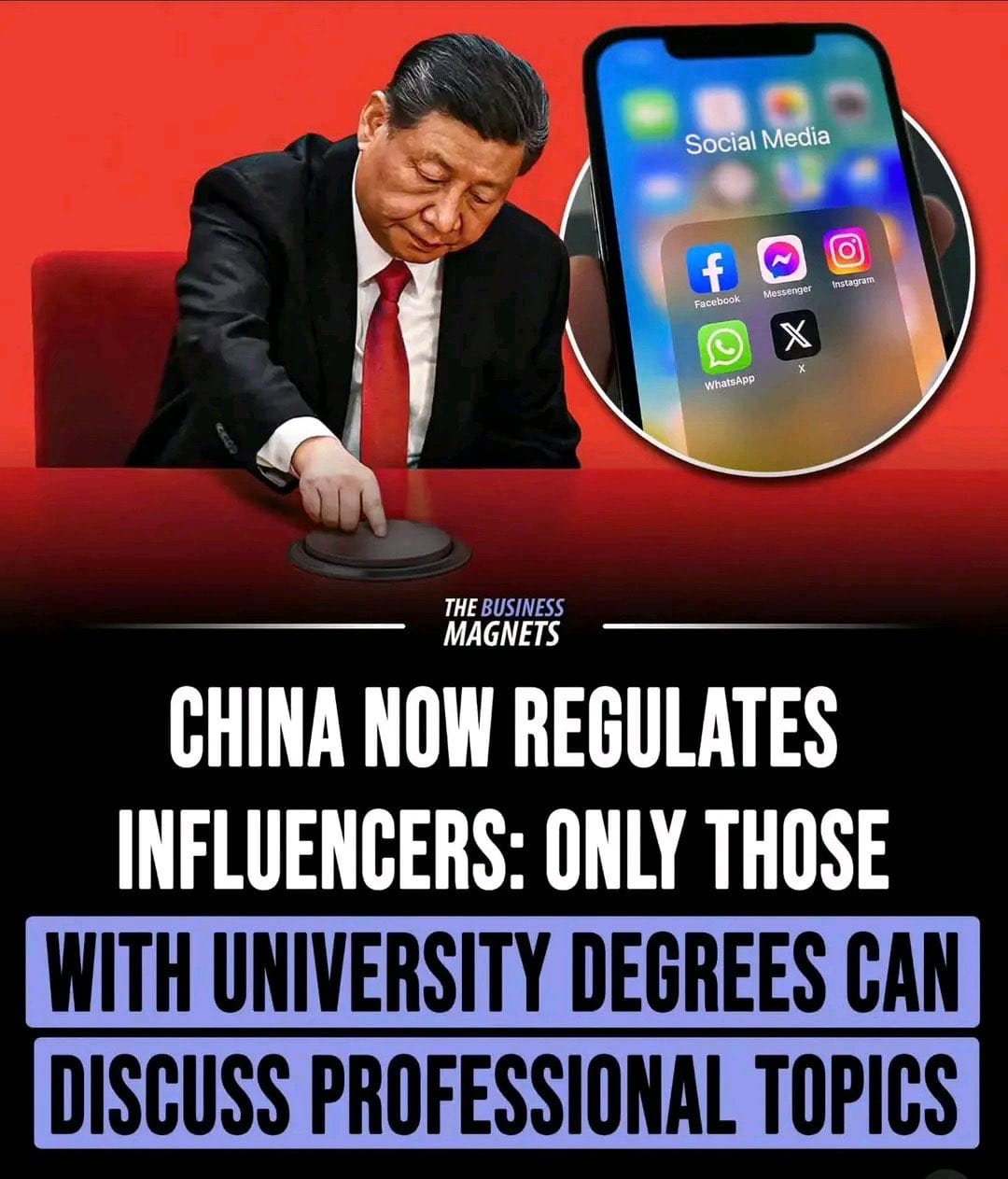
The digital revolution has democratized voice, giving ordinary youth the same power once reserved for the elite. Platforms like X, YouTube, TikTok, and Instagram have turned smartphones into studios and ideas into incomes. Yet, China’s move to regulate influencers based on qualifications signals a looming global debate: should influence require credentials?
Africa’s youth economy thrives on content creation. From Nairobi to Lagos, millions earn from brand partnerships, YouTube revenue, and digital storytelling. Their creativity drives culture and markets. But if Kenya or Nigeria were to emulate China’s rule, millions would be silenced, their income streams dismantled overnight.
This debate touches on more than entertainment—it questions who gets to define authority in the age of democratized information. For decades, education systems across Africa lagged behind the realities of new economies. Now, social media has given birth to an informal but powerful classroom where experience often outweighs certificates.

In Kenya, 75% of the population is under 35, yet youth unemployment remains above 35%. Influencing has become a survival mechanism, not just a career. A 23-year-old TikToker earns through storytelling, a photographer through reels, and a comedian through skits. Should a lack of a degree strip them of legitimacy?
Legally, Kenya’s 2019 Data Protection Act and 2022 ICT policy framework already hint at the need for responsible digital behavior. However, they do not regulate who can speak about what. If such policies were to mirror China’s, they would likely face constitutional challenges under freedom of expression provisions.
Education remains a societal benchmark for credibility, but formal schooling is not the only path to knowledge. Africa’s most powerful voices—musicians, entrepreneurs, and activists—often rose from experience, not degrees. Their insights are born from lived realities, not lecture halls.
Read Also: Here Is Why IT Burnout A “Personal Price” In Education’s Ransomware Fight
The digital economy blurs the lines between expertise and experience. A content creator may not hold an economics degree, but can explain inflation in relatable ways that reach millions. Their influence democratizes complex topics and humanizes learning beyond classroom walls.
Market trends show that global brands increasingly value authenticity over formality. Data from Influencer Marketing Hub (2025) shows micro-influencers outperforming celebrities in engagement by 300%. Education credentials rarely determine reach; relatability does.
However, misinformation remains a real concern. From health hoaxes to financial scams, unverified influencers have misled millions. This gives policymakers ammunition to argue for regulation. The question is not whether oversight is needed, but who defines expertise in an evolving knowledge economy.
Africa’s labor markets are already strained. According to the African Development Bank, the continent adds 12 million job seekers yearly but creates only 3 million formal jobs. The influencer economy absorbs part of this gap, functioning as a digital informal sector.
If governments restrict this space through education-based qualifications, they risk deepening poverty. Such a rule would not just silence creators—it would criminalize creativity. Youth without degrees would lose a key path to economic participation.
Legal scholars argue that freedom of speech under African constitutions includes digital spaces. Restricting commentary based on academic credentials would likely be unconstitutional unless justified as a matter of public safety or professional ethics.
Yet, balance is needed. Medicine, law, and finance carry consequences that go beyond opinion. A content creator offering investment advice or medical guidance without competence endangers lives and wealth. Here, regulation could serve protection, not censorship.
Kenya’s legal system could draw from global precedents. In the European Union, digital service regulations require platforms to curb misinformation but stop short of banning creators by qualification. This approach safeguards both expression and accountability.
The education sector must also evolve. Universities and TVET institutions can integrate digital literacy, ethics, and influencer marketing into their curricula. Instead of excluding creators, education can empower them with better tools for responsible influence.
The labor market must recognize content creation as legitimate work. Platforms like NCBA’s Loop or Safaricom’s Hustler Fund could extend financial products to influencers, acknowledging their revenue as income. Formal recognition bridges the gap between creativity and creditworthiness.
Africa’s creative economy is projected to reach $15 billion by 2030, according to UNESCO. The key to unlocking this potential lies in policy frameworks that support—not stifle—digital creators. Regulations must protect consumers without suffocating innovation.
If Kenya were to follow China’s lead, its enforcement capacity would face serious challenges. Determining who qualifies to discuss politics, economics, or religion would invite state overreach and bias. It would weaponize education as a tool for censorship.
Technological disruption will only accelerate. AI tools now help creators script, edit, and translate. Tomorrow’s influencers might not even be human. Will we also demand degrees from algorithms? Regulation must be forward-looking, not nostalgic.
At the core of influence lies trust. Audiences follow creators because they resonate, not because of titles. Education can deepen that trust, but it should not be the gatekeeper. Africa’s strength lies in diverse voices that speak from lived experience.
Still, policymakers cannot ignore the danger of digital illiteracy. Fake investment schemes and health misinformation cost Africans billions annually. A middle path exists—mandatory certification for sensitive niches without silencing broader content.
Kenya’s future policy could adopt a layered model. Creators discussing health, finance, or law could undergo short professional verification courses through the Kenya Institute of Mass Communication or related bodies. This empowers rather than excludes.
Economic data underscores the stakes. The influencer economy contributes over $100 million annually to Kenya’s GDP, directly employing editors, videographers, marketers, and data analysts. Regulation must nurture, not disrupt, this multiplier effect.
Across Africa, governments often lag behind digital realities. Most labour laws still define employment through contracts and offices, ignoring freelancers and digital creators. Modern reforms must redefine “work” to include monetized influence.
From a cultural lens, African societies value wisdom from elders, experience, and community knowledge. Influence has never been about degrees—it’s about credibility earned through life and contribution. Social media simply amplifies that tradition.
The danger lies in elitism disguised as regulation. When only degree holders can speak, society re-creates colonial hierarchies of knowledge, dismissing grassroots innovation. Africa’s progress depends on dismantling, not reinforcing, such barriers.
Digital markets show no sign of slowing. Influencer earnings in Kenya grew by 38% in 2024, while youth interest in online entrepreneurship tripled. Regulation that ignores this momentum risks economic backlash and social unrest.
Private-sector collaboration offers better solutions. Banks, tech firms, and universities can create hybrid learning programs, blending creativity with compliance. This builds competence without censorship.
Education itself must be redefined. In the 21st century, it extends beyond classrooms into podcasts, tutorials, and open-source learning. Recognizing informal education legitimizes those who self-taught their skills through practice and persistence.
For the legal system, the challenge will be enforcement fairness. Any licensing regime must be transparent, inclusive, and appealable. Otherwise, it becomes another tool for political silencing under the guise of professionalism.
Kenya’s 2025-2030 digital economy blueprint emphasizes innovation and youth empowerment. Restricting influencers contradicts that vision. Instead, laws should focus on transparency, tax compliance, and consumer protection.
African policymakers should study China’s motives but not mirror its methods. China’s goal is ideological control; Africa’s challenge is economic empowerment. Regulation here must liberate creativity, not subordinate it.
Future labor markets will value adaptability over credentials. The World Economic Forum projects that 40% of future jobs will require no traditional degree. Africa’s youth are already living that reality through content entrepreneurship.
If governments invest in digital education instead of restrictions, they can harness influence for nation-building—turning creators into educators, advocates, and innovators who drive public awareness and economic participation.
Social media is now the continent’s largest classroom. Banning voices without degrees would dim that light. Instead, mentorship programs and verified creator registries can encourage accuracy without exclusion.
In the long term, Africa’s prosperity will depend on how it treats its digital storytellers. They are the new journalists, marketers, and educators shaping global perceptions. Silencing them is silencing the continent’s most dynamic voices.
The future holds two paths: one of restriction, where education becomes a weapon of silence; and another of empowerment, where education becomes an open invitation to learn, share, and grow. Kenya must choose the latter.
Ultimately, education should refine influence—not define it. Knowledge is broader than academia, and Africa’s digital destiny depends on allowing every informed, creative, and passionate voice to speak, teach, and inspire without walls.

About Steve Biko Wafula
Steve Biko is the CEO OF Soko Directory and the founder of Hidalgo Group of Companies. Steve is currently developing his career in law, finance, entrepreneurship and digital consultancy; and has been implementing consultancy assignments for client organizations comprising of trainings besides capacity building in entrepreneurial matters.He can be reached on: +254 20 510 1124 or Email: info@sokodirectory.com

- January 2026 (220)
- February 2026 (248)
- March 2026 (287)
- April 2026 (207)
- May 2026 (192)
- June 2026 (238)
- July 2026 (279)
- August 2026 (224)
- September 2026 (50)
- January 2025 (119)
- February 2025 (191)
- March 2025 (212)
- April 2025 (193)
- May 2025 (161)
- June 2025 (157)
- July 2025 (227)
- August 2025 (211)
- September 2025 (267)
- October 2025 (297)
- November 2025 (230)
- December 2025 (220)
- January 2024 (238)
- February 2024 (227)
- March 2024 (190)
- April 2024 (133)
- May 2024 (157)
- June 2024 (145)
- July 2024 (136)
- August 2024 (154)
- September 2024 (212)
- October 2024 (255)
- November 2024 (196)
- December 2024 (143)
- January 2023 (182)
- February 2023 (203)
- March 2023 (322)
- April 2023 (297)
- May 2023 (267)
- June 2023 (214)
- July 2023 (212)
- August 2023 (257)
- September 2023 (237)
- October 2023 (264)
- November 2023 (286)
- December 2023 (177)
- January 2022 (293)
- February 2022 (329)
- March 2022 (358)
- April 2022 (292)
- May 2022 (271)
- June 2022 (232)
- July 2022 (278)
- August 2022 (253)
- September 2022 (246)
- October 2022 (196)
- November 2022 (232)
- December 2022 (167)
- January 2021 (182)
- February 2021 (227)
- March 2021 (325)
- April 2021 (259)
- May 2021 (285)
- June 2021 (272)
- July 2021 (277)
- August 2021 (232)
- September 2021 (271)
- October 2021 (303)
- November 2021 (364)
- December 2021 (249)
- January 2020 (272)
- February 2020 (310)
- March 2020 (390)
- April 2020 (321)
- May 2020 (335)
- June 2020 (327)
- July 2020 (333)
- August 2020 (276)
- September 2020 (214)
- October 2020 (233)
- November 2020 (242)
- December 2020 (187)
- January 2019 (251)
- February 2019 (215)
- March 2019 (283)
- April 2019 (254)
- May 2019 (269)
- June 2019 (249)
- July 2019 (335)
- August 2019 (292)
- September 2019 (306)
- October 2019 (313)
- November 2019 (362)
- December 2019 (318)
- January 2018 (291)
- February 2018 (213)
- March 2018 (275)
- April 2018 (223)
- May 2018 (235)
- June 2018 (176)
- July 2018 (256)
- August 2018 (247)
- September 2018 (255)
- October 2018 (282)
- November 2018 (282)
- December 2018 (184)
- January 2017 (183)
- February 2017 (194)
- March 2017 (207)
- April 2017 (104)
- May 2017 (169)
- June 2017 (205)
- July 2017 (189)
- August 2017 (195)
- September 2017 (186)
- October 2017 (235)
- November 2017 (253)
- December 2017 (266)
- January 2016 (164)
- February 2016 (165)
- March 2016 (189)
- April 2016 (143)
- May 2016 (245)
- June 2016 (182)
- July 2016 (271)
- August 2016 (247)
- September 2016 (233)
- October 2016 (191)
- November 2016 (243)
- December 2016 (153)
- January 2015 (1)
- February 2015 (4)
- March 2015 (164)
- April 2015 (107)
- May 2015 (116)
- June 2015 (119)
- July 2015 (145)
- August 2015 (157)
- September 2015 (186)
- October 2015 (169)
- November 2015 (173)
- December 2015 (205)
- March 2014 (2)
- March 2013 (10)
- June 2013 (1)
- March 2012 (7)
- April 2012 (15)
- May 2012 (1)
- July 2012 (1)
- August 2012 (4)
- October 2012 (2)
- November 2012 (2)
- December 2012 (1)