
A Hospital Cannot Grow on Good Intentions Alone
KEY POINTS
In healthcare, the need often arrives before the money does. Family Bank’s Imarisha Hospitali long-term financing speaks directly to that gap — helping healthcare businesses think beyond survival and plan for the next ward, the next diagnostic unit, the next piece of land, and ultimately the next patient who needs care closer to home.
A hospital can be full every day and still be struggling to grow. The waiting room may be crowded, the doctor may know exactly what the community needs, and the management team may already have plans for another ward, a bigger laboratory, or a new diagnostic wing. But between the idea and the building stands one stubborn question: where will the capital come from?
That is the quiet reality behind many healthcare businesses in Kenya. Growth is expensive. Land is expensive. Medical equipment is expensive. Construction is expensive. And unlike an ordinary business expansion, a delayed healthcare investment is not only a missed commercial opportunity. It can mean longer queues, patients travelling farther for treatment, or families postponing care because the service they need is not available nearby.
“When a healthcare facility expands, the benefit is measured in more than square metres. It can be measured in shorter journeys, faster diagnosis and more people receiving care when they need it.” 
|
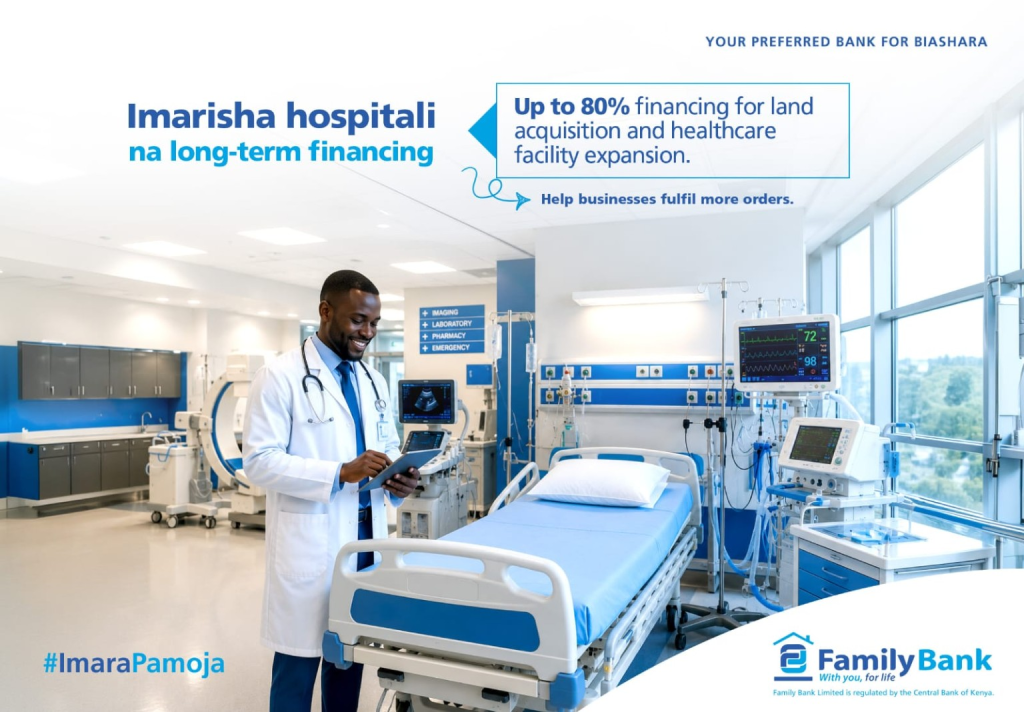
This is where long-term financing becomes more than a banking product. It becomes part of the infrastructure of care. Family Bank’s Imarisha Hospitali proposition, as highlighted in the campaign, offers up to 80% financing for land acquisition and healthcare facility expansion. Put simply, it is designed for healthcare businesses that have outgrown their current space and need room to serve more people.
Picture a small but busy hospital in a growing Kenyan town. The maternity wing is stretched. The laboratory handles more samples than it was designed for. Patients are referred elsewhere for imaging. Management has identified a neighbouring parcel of land and already knows what should be built there. The problem is that paying for the land and expansion entirely from operating cash would take years — and the patients are already arriving today.
Access to structured, long-term financing can change that conversation. Instead of asking, “Can we afford to grow at all?”, the hospital can begin asking more practical questions: What should we build first? How much patient capacity will the expansion add? Which services are most urgently needed? What repayment structure can the business sustain without starving daily operations of cash?
That distinction matters. Healthcare facilities need working capital for salaries, medicines, consumables, utilities, maintenance, and emergencies. Draining all available cash into land or construction can leave a hospital with a beautiful new building but a stressed operating account. Financing can help separate the long-term investment from the day-to-day cash needed to keep the doors open.
BUILDING CAPACITY, NOT JUST BUILDINGS
And expansion is not only about adding beds. A healthcare facility may need space for a modern laboratory, imaging services, a pharmacy, theatre capacity, outpatient clinics, a maternity wing, specialist rooms, rehabilitation services, or better emergency care. Each investment can strengthen both the medical capability of the institution and the economics of the business.
There is also a deeply human side to the numbers. For a parent with a sick child, a new diagnostic unit means fewer hours spent travelling to another county. For an expectant mother, a stronger maternity wing means care is available closer to home. For a doctor, better space and equipment means more can be done before a patient has to be referred elsewhere. For the hospital owner, expansion can mean serving the community better while building a more resilient institution.
That is why the phrase “long-term financing” matters. Healthcare projects do not produce their full value overnight. A new wing needs to be built, equipped, staffed, and gradually integrated into the hospital’s operations. The financing supporting such a project should therefore be considered alongside realistic cash flows, patient volumes, service demand, and the facility’s ability to repay over time.
Family Bank enters this story naturally because its Imarisha Hospitali proposition is framed around the actual growth needs of healthcare enterprises. The campaign focuses on financing land acquisition and facility expansion rather than treating every business as if it has the same capital requirements. That sector-specific thinking is important: a hospital’s growth cycle is very different from that of a retail shop or a trading business.
| UP TO 80% | FINANCING HIGHLIGHT For land acquisition and healthcare facility expansion under Family Bank’s Imarisha Hospitali long-term financing campaign. |
For healthcare entrepreneurs, the bigger lesson is simple: growth should not be postponed until every shilling can be raised internally. A viable expansion can be planned, financed and phased in a way that allows the institution to keep serving patients while building for the future. The key is discipline — borrowing for productive capacity, matching repayments to realistic cash flows, and ensuring the expansion solves a genuine healthcare need.
Kenya does not only need more hospitals. It needs stronger hospitals: facilities that can diagnose earlier, treat more conditions, absorb more patients, and remain financially healthy enough to keep investing in people, equipment, and infrastructure. That requires doctors and nurses, yes. It also requires entrepreneurs, planners, builders — and financial partners willing to understand what healthcare growth actually looks like.
Sometimes the next chapter of a hospital begins with a very ordinary decision: buying the plot next door, adding one more floor, expanding a laboratory, creating a new ward or finally building the unit that patients have been asking for. The building may be made of concrete and steel, but what it really creates is capacity — capacity to treat, to employ, to respond and to care.
And that is the real promise behind financing healthcare expansion: not simply helping a business become bigger, but helping care move closer to the people who need it.
Read Also: When the Sun Starts Paying the School Bill

About Soko Directory Team
Soko Directory is a Financial and Markets digital portal that tracks brands, listed firms on the NSE, SMEs and trend setters in the markets eco-system.Find us on Facebook: facebook.com/SokoDirectory and on Twitter: twitter.com/SokoDirectory

- January 2026 (220)
- February 2026 (248)
- March 2026 (287)
- April 2026 (207)
- May 2026 (192)
- June 2026 (238)
- July 2026 (279)
- August 2026 (223)
- September 2026 (66)
- January 2025 (119)
- February 2025 (191)
- March 2025 (212)
- April 2025 (193)
- May 2025 (161)
- June 2025 (157)
- July 2025 (227)
- August 2025 (211)
- September 2025 (267)
- October 2025 (297)
- November 2025 (230)
- December 2025 (220)
- January 2024 (238)
- February 2024 (227)
- March 2024 (190)
- April 2024 (133)
- May 2024 (157)
- June 2024 (145)
- July 2024 (136)
- August 2024 (154)
- September 2024 (212)
- October 2024 (255)
- November 2024 (196)
- December 2024 (143)
- January 2023 (182)
- February 2023 (203)
- March 2023 (322)
- April 2023 (297)
- May 2023 (267)
- June 2023 (214)
- July 2023 (212)
- August 2023 (257)
- September 2023 (237)
- October 2023 (264)
- November 2023 (286)
- December 2023 (177)
- January 2022 (293)
- February 2022 (329)
- March 2022 (358)
- April 2022 (292)
- May 2022 (271)
- June 2022 (232)
- July 2022 (278)
- August 2022 (253)
- September 2022 (246)
- October 2022 (196)
- November 2022 (232)
- December 2022 (167)
- January 2021 (182)
- February 2021 (227)
- March 2021 (325)
- April 2021 (259)
- May 2021 (285)
- June 2021 (272)
- July 2021 (277)
- August 2021 (232)
- September 2021 (271)
- October 2021 (303)
- November 2021 (364)
- December 2021 (249)
- January 2020 (272)
- February 2020 (310)
- March 2020 (390)
- April 2020 (321)
- May 2020 (335)
- June 2020 (327)
- July 2020 (333)
- August 2020 (276)
- September 2020 (214)
- October 2020 (233)
- November 2020 (242)
- December 2020 (187)
- January 2019 (251)
- February 2019 (215)
- March 2019 (283)
- April 2019 (254)
- May 2019 (269)
- June 2019 (249)
- July 2019 (335)
- August 2019 (292)
- September 2019 (306)
- October 2019 (313)
- November 2019 (362)
- December 2019 (318)
- January 2018 (291)
- February 2018 (213)
- March 2018 (275)
- April 2018 (223)
- May 2018 (235)
- June 2018 (176)
- July 2018 (256)
- August 2018 (247)
- September 2018 (255)
- October 2018 (282)
- November 2018 (282)
- December 2018 (184)
- January 2017 (183)
- February 2017 (194)
- March 2017 (207)
- April 2017 (104)
- May 2017 (169)
- June 2017 (205)
- July 2017 (189)
- August 2017 (195)
- September 2017 (186)
- October 2017 (235)
- November 2017 (253)
- December 2017 (266)
- January 2016 (164)
- February 2016 (165)
- March 2016 (189)
- April 2016 (143)
- May 2016 (245)
- June 2016 (182)
- July 2016 (271)
- August 2016 (247)
- September 2016 (233)
- October 2016 (191)
- November 2016 (243)
- December 2016 (153)
- January 2015 (1)
- February 2015 (4)
- March 2015 (164)
- April 2015 (107)
- May 2015 (116)
- June 2015 (119)
- July 2015 (145)
- August 2015 (157)
- September 2015 (186)
- October 2015 (169)
- November 2015 (173)
- December 2015 (205)
- March 2014 (2)
- March 2013 (10)
- June 2013 (1)
- March 2012 (7)
- April 2012 (15)
- May 2012 (1)
- July 2012 (1)
- August 2012 (4)
- October 2012 (2)
- November 2012 (2)
- December 2012 (1)