
Why the New Electricity Charges are Exorbitant and Ridiculous

The public outcry over the increased cost of electricity for domestic users was certainly answered with a billing system that stirred many heads. According to an announcement made by the Energy Regulatory Commission (ERC) on July 30, 2018, the new billing system would lower the amount households spent on buying tokens. Here is how everything is ridiculous.
For one, the new billing process scrapped off the standing charges of 150 shillings a month, which was ideally what Kenyans wanted. Then it got worse. Contrary to what consumers hoped would be a reduction in bills after the exemption of the charges, they now pay more!
Customers who bought tokens from August 1st were left with frustration after receiving an unrealistically negligible number of units for the same amount of money as before.

The fixed charge might have been exempted, but the cost of each unit increased tremendously. For a consumption of up to 10kW, the price of one unit rose from 2.50 shillings to 12 shillings! As if that isn’t enough, the price of 10kW to 50kW increased from 2.50 shillings to 15.80 shillings.
Let’s do a little illustration using someone who bought tokens on two different occasions.
The first purchase he made was in March 3rd, 2018 and with 500 shillings, the number of tokens or units he received was 32.1. Then, there was no breakdown of the other charges on the message but the new change details how the billing process works. This amount was after he had paid the standing charges of 150 shillings.
In his second purchase, which was on August 8, for 500 shillings, he received 22.53 units. Here is why:
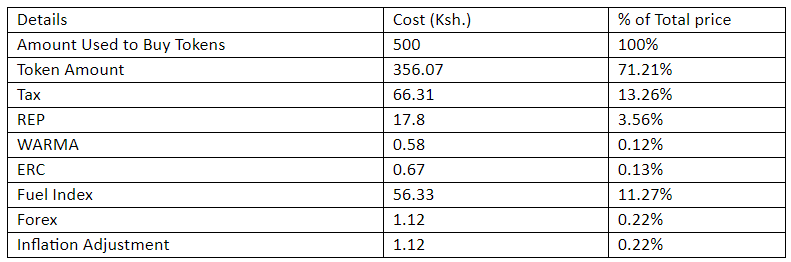
The table shows how the 22.53 units were arrived at. Apparently, the tokens are considerably less compared to the 32.1 he got before! Even if he still added the 150 shillings paid before as standing charges, he still would have gotten lesser units.
The change, based on the 10kW to 50kW process is as depicted below:
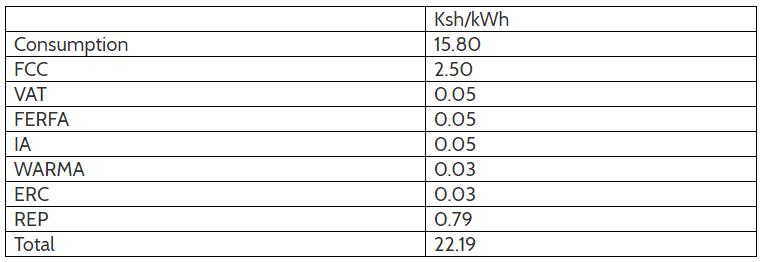
Key
REP – This is a 5% levy on the cost of the units of power consumed by a customer. Mostly, the levy is passed on to the Rural Electrification Authority (REA) for implementation of the rural electrification projects.
WARMA – This is the levy of energy purchased from hydropower plants.
ERC – It is passed on to the Energy Regulatory Commission (ERC), the regulatory arm of the energy sector.
FUEL COST CHARGE (FCC) – This charge is the added cost or rebates to the consumers as a result of fluctuations in world prices as well as fluctuations in the quantity of oil consumed by electricity generation. The fuel cost charge lags one month behind the actual the actual price of the fuel. This money is collected by KPLC and all of it is passed on directly to electricity generation companies, who in turn pay fuel suppliers.
FOREX ADJUSTMENT (FOREX) – The foreign exchange component is related to the fluctuation of hard currencies against the Kenya Shilling for expenditure related to the power sector such as project loan repayments.
INFLATION ADJUSTMENT – These are the real prices that show the trends in the commodity price after removing the effect of general inflation.
TAX – This statutory levy of the total amount that is passed on to the Kenya Revenue Authority (KRA).
The billing process might seem comprehensive now, but it certainly isn’t as friendly as Kenyans wanted it to be. In fact, some of the concerns raised were that the KPLC and ERC have no constitutional mandate to review the tariff. Nonetheless, one thing remains clear for consumers, the charges are high.

About Soko Directory Team
Soko Directory is a Financial and Markets digital portal that tracks brands, listed firms on the NSE, SMEs and trend setters in the markets eco-system.Find us on Facebook: facebook.com/SokoDirectory and on Twitter: twitter.com/SokoDirectory

- January 2026 (216)
- February 2026 (90)
- January 2025 (119)
- February 2025 (191)
- March 2025 (212)
- April 2025 (193)
- May 2025 (161)
- June 2025 (157)
- July 2025 (227)
- August 2025 (211)
- September 2025 (270)
- October 2025 (297)
- November 2025 (230)
- December 2025 (219)
- January 2024 (238)
- February 2024 (227)
- March 2024 (190)
- April 2024 (133)
- May 2024 (157)
- June 2024 (145)
- July 2024 (136)
- August 2024 (154)
- September 2024 (212)
- October 2024 (255)
- November 2024 (196)
- December 2024 (143)
- January 2023 (182)
- February 2023 (203)
- March 2023 (322)
- April 2023 (297)
- May 2023 (267)
- June 2023 (214)
- July 2023 (212)
- August 2023 (257)
- September 2023 (237)
- October 2023 (264)
- November 2023 (286)
- December 2023 (177)
- January 2022 (293)
- February 2022 (329)
- March 2022 (358)
- April 2022 (292)
- May 2022 (271)
- June 2022 (232)
- July 2022 (278)
- August 2022 (253)
- September 2022 (246)
- October 2022 (196)
- November 2022 (232)
- December 2022 (167)
- January 2021 (182)
- February 2021 (227)
- March 2021 (325)
- April 2021 (259)
- May 2021 (285)
- June 2021 (272)
- July 2021 (277)
- August 2021 (232)
- September 2021 (271)
- October 2021 (304)
- November 2021 (364)
- December 2021 (249)
- January 2020 (272)
- February 2020 (310)
- March 2020 (390)
- April 2020 (321)
- May 2020 (335)
- June 2020 (327)
- July 2020 (333)
- August 2020 (276)
- September 2020 (214)
- October 2020 (233)
- November 2020 (242)
- December 2020 (187)
- January 2019 (251)
- February 2019 (215)
- March 2019 (283)
- April 2019 (254)
- May 2019 (269)
- June 2019 (249)
- July 2019 (335)
- August 2019 (293)
- September 2019 (306)
- October 2019 (313)
- November 2019 (362)
- December 2019 (318)
- January 2018 (291)
- February 2018 (213)
- March 2018 (275)
- April 2018 (223)
- May 2018 (235)
- June 2018 (176)
- July 2018 (256)
- August 2018 (247)
- September 2018 (255)
- October 2018 (282)
- November 2018 (282)
- December 2018 (184)
- January 2017 (183)
- February 2017 (194)
- March 2017 (207)
- April 2017 (104)
- May 2017 (169)
- June 2017 (205)
- July 2017 (189)
- August 2017 (195)
- September 2017 (186)
- October 2017 (235)
- November 2017 (253)
- December 2017 (266)
- January 2016 (164)
- February 2016 (165)
- March 2016 (189)
- April 2016 (143)
- May 2016 (245)
- June 2016 (182)
- July 2016 (271)
- August 2016 (247)
- September 2016 (233)
- October 2016 (191)
- November 2016 (243)
- December 2016 (153)
- January 2015 (1)
- February 2015 (4)
- March 2015 (164)
- April 2015 (107)
- May 2015 (116)
- June 2015 (119)
- July 2015 (145)
- August 2015 (157)
- September 2015 (186)
- October 2015 (169)
- November 2015 (173)
- December 2015 (205)
- March 2014 (2)
- March 2013 (10)
- June 2013 (1)
- March 2012 (7)
- April 2012 (15)
- May 2012 (1)
- July 2012 (1)
- August 2012 (4)
- October 2012 (2)
- November 2012 (2)
- December 2012 (1)