
Developed Markets Reports Slow Growth- Cytonn Report

Developed markets witnessed a slow growth of 1.8 percent per annum in the first half of the year due to low commodity prices negatively affecting commodity exporters in emerging markets as well as the weak global trade compared to a growth of 1.9 percent in 2015.
According to a report from Cytonn Investment, the sluggish start of the year resulted to a similar downward global economic growth revisions by the World Bank and IMF in July to 2.4 percent and 3.1 percent from earlier projections of 2.9 percent and 3.2 percent, respectively at the start of the year.
In addition, the World Trade Organization (WTO) downgraded their outlook forecast for world trade growth in 2016 to 1.7 percent from 2.8 percent in April, citing a slowdown in China and falling import levels in the United States. This is the first time in 15 years that international commerce is seen to lag GDP growth of the world economy, having grown 1.5x faster than GDP in the long term, and 2.0x as fast since globalization picked up in the 1990s.

The report further stated that in terms of the four key economic regions:
US: The US Fed kept the Federal Funds rate constant in the 0.25 percent – 0.5 percent band. This is despite noting that economic conditions as well as the labor market, had improved, with the total number of jobs created increasing by 150,000 in August, and the unemployment rate remaining at a low of 4.9 percent, which is considered as full employment in the US economy. The main concern that the Fed had was the status of the other world economies, which are weaker, and their possible impact on the US economy
Europe: The region has slowed this quarter growing at 0.3%, following “Brexit”. Despite an aggressive quantitative easing programme of Euro 80.0 bn per month, which is aimed at stimulating the economy and increasing GDP growth, the region still suffers from low growth and low inflation
Asia: Concerns remain over economic growth in Asia, especially given the slowdown in China, and its wide-reaching effects on emerging markets, which depend on China as a key export destination for their raw materials
Emerging Markets: The regions are expected to grow at 3.5 percent, compared to 3.4 percent in 2015, with the commodity importers expected to do much better than commodity exporters. Concerns in this economic block remain the impact that global economic trends will have on these economies.
United States
The United States economic growth advanced by 1.4 percent in the second quarter, higher than the previously estimated 1.1 percent for Q2’2016. The upward revision was due to higher exports and higher consumption.
The US Federal Reserve left the Federal Funds rate unchanged at its meeting in September 2016 despite earlier expectations that it could raise the rates from the current band of 0.25 percent to 0.5 percent. The Fed noted that the case for an increase in interest rates had strengthened in recent months, but decided to wait for further evidence of continued progress towards its objectives. While most indicators point to a pickup in economic activity, including an improving labour market with rising job gains, strong household spending, and improvements in the housing sector; low levels of business fixed investments and persistently low inflation continue to necessitate caution.
The stock market performance improved on account of the extended accommodative policy by the Fed, with the S&P 500 having gained 6.2 percent since the start of the year, despite corporate earnings falling by 4.3 percent y/y, marking the 5th consecutive decline in quarterly earnings. In terms of valuations, the Cyclically Adjusted Price/Earnings (CAPE) ratio is currently near historical highs at 26.8x, far above the historical average of 16.7x, indicating an overvaluation of the market.
Cytonn Investments noted that they expects the US market to remain volatile with possibilities of a decline in equities market from the current levels owing to the upcoming presidential elections in November and the possibility of a rate hike by the Fed in December.
Eurozone
The Eurozone experienced a slowed economic growth at 0.3 percent in Q2’2016 down from the 0.5 percent growth experienced in Q1’2016. This was mainly attributed to the poor performance of major economies such as France and Italy which realized almost flat GDP growth. Manufacturing activity in the Eurozone remains strong, measured by the Purchasing Managers Index, which was at 52.6 in Q3’2016, similar to the 52.6 recorded at the end of Q2’2016. The market expectation for Eurozone Q3’2016 GDP growth stands at 0.4 percent for the quarter, and a y/y projection of 1.7 percent, which is pegged on improved consumer spending.
The European Central Bank (ECB) met in September and maintained the base lending rate at 0.0 percent, and the rates on the marginal lending facility and deposit facility at 0.25 percent and -0.4 percent, respectively. However, the ECB reaffirmed its plans to run quantitative easing to March 2017 or beyond if needed, calling on Eurozone governments to step up their structural reforms and fiscal policies in order to collectively achieve their goals. The inflation rate remains low at 0.2 percent, which is quite low compared to the ECB target of 2 percent.
The Euro Stoxx 300 has been on a downward trend, losing 12.2 percent YTD due to the uncertainty surrounding “Brexit”, the inability of Eurozone to stimulate inflation back to the target of 2.0 percent and the announcement of no additional stimulus which has further rattled the markets.
The company expects the ECB to continue their QE programme, and possibly even extend the Programme beyond March 2017 in case the uncertainty following the Brexit dents the Eurozone recovery and the low inflationary environment persists.
China
The Chinese economy experienced a growth rate of 6.7 percent in Q2’2016 which was unchanged from Q1’2016 and against an estimate of 6.6 percent. This could be attributed to the stimulus measures put in place by the Government and the Peoples Bank of China to add more liquidity to the economy and spur bank lending.
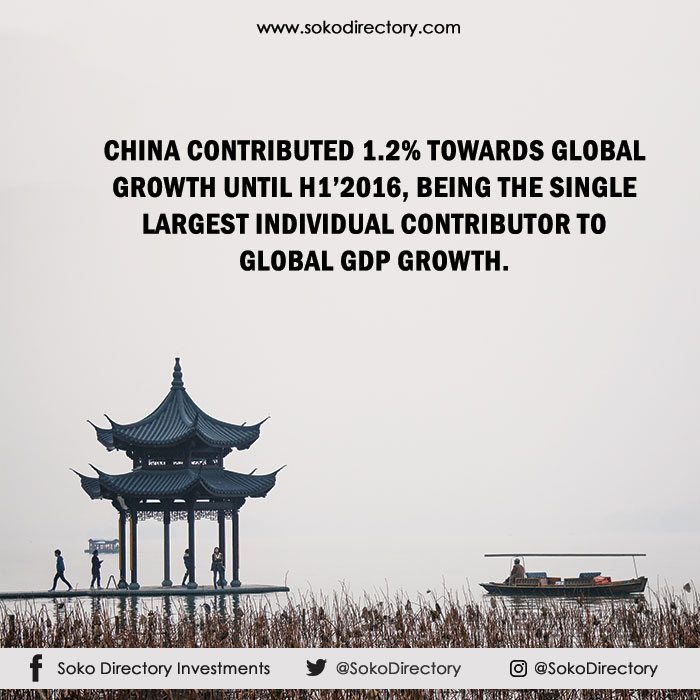
China still managed to contribute 1.2 percent towards global growth until H1’2016, being the single largest individual contributor to global GDP growth. The first half performance in 2016 was supported by increased government infrastructure spending, accommodative monetary policy, and an increase in consumer spending. The continued implementation of structural reforms should help China overcome risks that include weak export demand, falling manufacturing investment and a slowdown in credit growth.
China experienced increased level of imports in the month of August, rising 1.5 percent for the first time in two years’ time while exports declined by 2.8 percent. This was mainly as a result of sluggish world demand on China’s exports. The Shanghai Composite Index, however, remains one of the worst performing indices having lost 18.3 percent year to date.
China’s economy is showing fresh signs of strength, from increased business confidence to an expansionary factory gauge reading, according to the earliest private indicators for September. We expect to see the Chinese economy growing within the government targets of 6.5 percent – 7 percent for the rest of the year amidst the shift to a service-based economy from manufacturing and export based.
Read: Trade ties with Japan crucial for Kenya’;s prosperity

About Soko Directory Team
Soko Directory is a Financial and Markets digital portal that tracks brands, listed firms on the NSE, SMEs and trend setters in the markets eco-system.Find us on Facebook: facebook.com/SokoDirectory and on Twitter: twitter.com/SokoDirectory

- January 2026 (220)
- February 2026 (246)
- March 2026 (286)
- April 2026 (123)
- January 2025 (119)
- February 2025 (191)
- March 2025 (212)
- April 2025 (193)
- May 2025 (161)
- June 2025 (157)
- July 2025 (227)
- August 2025 (211)
- September 2025 (270)
- October 2025 (297)
- November 2025 (230)
- December 2025 (219)
- January 2024 (238)
- February 2024 (227)
- March 2024 (190)
- April 2024 (133)
- May 2024 (157)
- June 2024 (145)
- July 2024 (136)
- August 2024 (154)
- September 2024 (212)
- October 2024 (255)
- November 2024 (196)
- December 2024 (143)
- January 2023 (182)
- February 2023 (203)
- March 2023 (322)
- April 2023 (297)
- May 2023 (267)
- June 2023 (214)
- July 2023 (212)
- August 2023 (257)
- September 2023 (237)
- October 2023 (264)
- November 2023 (286)
- December 2023 (177)
- January 2022 (293)
- February 2022 (329)
- March 2022 (358)
- April 2022 (292)
- May 2022 (271)
- June 2022 (232)
- July 2022 (278)
- August 2022 (253)
- September 2022 (246)
- October 2022 (196)
- November 2022 (232)
- December 2022 (167)
- January 2021 (182)
- February 2021 (227)
- March 2021 (325)
- April 2021 (259)
- May 2021 (285)
- June 2021 (272)
- July 2021 (277)
- August 2021 (232)
- September 2021 (271)
- October 2021 (304)
- November 2021 (364)
- December 2021 (249)
- January 2020 (272)
- February 2020 (310)
- March 2020 (390)
- April 2020 (321)
- May 2020 (335)
- June 2020 (327)
- July 2020 (333)
- August 2020 (276)
- September 2020 (214)
- October 2020 (233)
- November 2020 (242)
- December 2020 (187)
- January 2019 (251)
- February 2019 (215)
- March 2019 (283)
- April 2019 (254)
- May 2019 (269)
- June 2019 (249)
- July 2019 (335)
- August 2019 (293)
- September 2019 (306)
- October 2019 (313)
- November 2019 (362)
- December 2019 (318)
- January 2018 (291)
- February 2018 (213)
- March 2018 (275)
- April 2018 (223)
- May 2018 (235)
- June 2018 (176)
- July 2018 (256)
- August 2018 (247)
- September 2018 (255)
- October 2018 (282)
- November 2018 (282)
- December 2018 (184)
- January 2017 (183)
- February 2017 (194)
- March 2017 (207)
- April 2017 (104)
- May 2017 (169)
- June 2017 (205)
- July 2017 (189)
- August 2017 (195)
- September 2017 (186)
- October 2017 (235)
- November 2017 (253)
- December 2017 (266)
- January 2016 (164)
- February 2016 (165)
- March 2016 (189)
- April 2016 (143)
- May 2016 (245)
- June 2016 (182)
- July 2016 (271)
- August 2016 (247)
- September 2016 (233)
- October 2016 (191)
- November 2016 (243)
- December 2016 (153)
- January 2015 (1)
- February 2015 (4)
- March 2015 (164)
- April 2015 (107)
- May 2015 (116)
- June 2015 (119)
- July 2015 (145)
- August 2015 (157)
- September 2015 (186)
- October 2015 (169)
- November 2015 (173)
- December 2015 (205)
- March 2014 (2)
- March 2013 (10)
- June 2013 (1)
- March 2012 (7)
- April 2012 (15)
- May 2012 (1)
- July 2012 (1)
- August 2012 (4)
- October 2012 (2)
- November 2012 (2)
- December 2012 (1)