
Moody’s set to downgrade KCB, Equity and Co-op bank

Global ratings agency Moody’s Investors Service has warned of a likely downgrade of credit of KCB Bank Kenya Limited (KCB Bank), Equity Bank Kenya Limited (Equity Bank), and Co-operative Bank of Kenya Limited (Co-op Bank).
“Today’s rating action is driven primarily by a potential weakening of the Kenyan government’s credit profile, in particular in the country’s fiscal strength and liquidity risk, as captured by Moody’s recent decision to place Kenya’s B1 government ratings on review for downgrade,” says Moody’s.
“The banks’ sizable holdings of sovereign debt securities inevitably link their creditworthiness to that of the national government. To a lesser extent, today’s rating action also captures pressures on Kenya’s macro profile, in light of the currently challenging operating conditions, which are in turn weighing on the banks’ asset quality profiles. For further information, refer to the sovereign press release “Moody’s places Kenya’s B1 rating on review for downgrade”.”
Read: Moody’s assigns first-time ratings to Kenya’s Equity Bank and Coop Bank

KCB Bank Kenya Limited
As part of its review of KCB Bank, Moody’s will assess the interlinkages of the bank’s credit profile to that of the sovereign, given its high exposures to government securities at 1.3x its tangible common equity, as of June 2017. In addition, Moody’s will assess the impact of a potentially deteriorating operating environment and macro profile on KCB’s own credit profile. While KCB Bank’s asset quality has been broadly stable during 2017, despite the challenging conditions, its problem loans remain above its rated domestic peers at 6.8% (excluding interest in suspense) of gross loans as of June 2017, which includes a few large construction sector borrowers affected by government arrears. In turn, the collateralised nature of these exposures leads to a weak provisioning coverage at 26% of problem loans. However, the rating agency notes the bank’s regulatory provisioning reserves that form part of equity (in line with the Central Bank of Kenya regulation), which brings the total coverage up to 71%.
At the same time, Moody’s acknowledges the bank’s currently strong profitability and capital metrics. Although KCB Bank’s lending margins have been impacted by the regulatory lending rate cap, its profitability remains strong with net income at 3.6% of tangible assets (during the first half of 2017). In addition, KCB Bank’s overall solvency is supported by its high tangible common equity of 14.6% its total assets as of June 2017, which strengthens its ability to withstand unexpected losses.
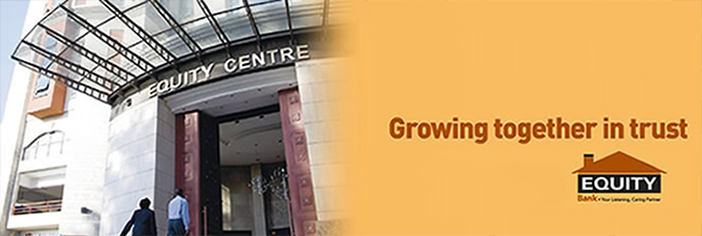
Equity Bank Kenya Limited
In terms of its review of Equity Bank, Moody’s will assess the interlinkages of the bank’s credit profile to that of the sovereign, given its high exposures to government securities at 1.9x its tangible common equity, as of June 2017. In addition, Moody’s will assess the impact of a potentially deteriorating operating environment and macro profile on Equity Bank’s own credit profile. Equity Group’s asset quality metrics (a good proxy for Equity Bank’s ratios) have weakened over the past 18 months, with problem loans (excluding interest in suspense) to gross loans weakening to 6.4% as of June 2017, from 2.7% as of end-2015. Moody’s expects further asset quality strain in the small and medium sized enterprise (SME) segment in particular — which accounts for over 50% of Equity Bank’s loans — given increasing stress from lower consumer disposable income and tighter credit conditions.
Despite Equity Bank’s high SME exposure, Moody’s notes that the bank is well placed to withstand the particular challenges it faces by reducing risk-taking, maintaining strong profitability metrics and solid capital buffers. Equity Bank’s net income stood at 4.1% of tangible assets during the first half of 2017, with its tangible common equity at 13.8% of total assets.

