
Kenya Listed Banks Q1’2020: I&M The Most Attractive Bank In Kenya

Cytonn Investments has today released its Q1’2020 Banking Sector Report, which ranks I&M Holdings as the most attractive bank in Kenya, supported by a strong franchise value and intrinsic value score.
The franchise score measures the broad and comprehensive business strength of a bank across 13 different metrics, while the intrinsic score measures the investment return potential.
Asset quality deteriorated in Q1’2020 with the gross NPL ratio increasing by 0.9 percentage points to 11.3 percent from 10.4 percent in Q1’2019. This was high compared to the 5-year average of 8.5 percent.

In accordance with IFRS 9, banks are expected to provide both for the incurred and expected credit losses. Consequently, this saw the NPL coverage increase to 57.4 percent in Q1’2020 from 54.5 percent in Q1’2019 as banks adopted a cautious stance on the back of the expected impact of the COVID-19 pandemic.
The report themed “Deteriorating Asset Quality amid the COVID-19 Operating Environment”, analyzed the Q1’2020 results of the listed banks.
“On the regulatory front, The Central Bank of Kenya on March 27th, 2020 provided commercial banks and mortgage finance companies with guidelines on loan reclassification, and provisioning of extended and restructured loans as per the Banking Circular No 3 of 2020.
The Central Bank stipulated that banks would be allowed to extend loan repayments for their customers for a period not more than one year, the cost of restructuring and extension of loans would be met by the banks and the banks would have to report any restructuring in relation to the COVID-19 pandemic to the Central Bank monthly”, said MaryAnne Ng’ang’a, Analyst at Cytonn Investments.
I&M Holdings took the top position in the weighted score of both franchise and future growth opportunity perspective having a better capacity to generate profits from its core business.
Diamond Trust Bank Kenya took the top position from a future growth opportunity perspective; however, it had a weak franchise score moving it to position 5 on the weighted score.
HF came in 10th position on the back of weak franchise rankings scores as well as a non-promising future growth opportunity perspective as a result of a lack of proper cost-efficiency structure.

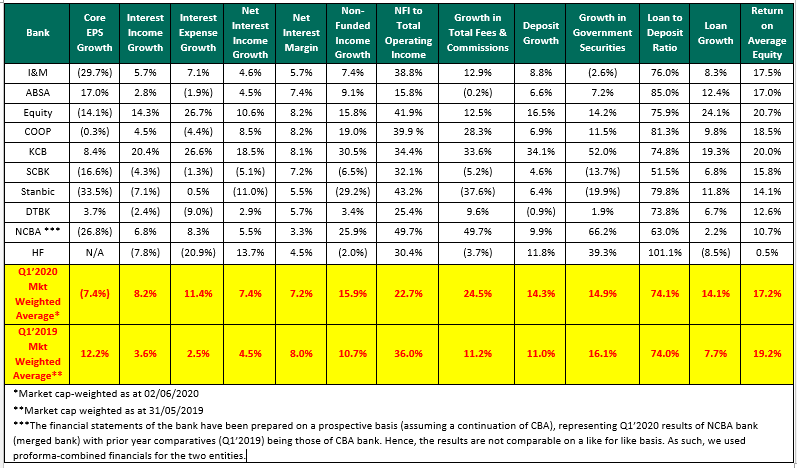
The above ten listed Kenyan banks recorded a 7.4 percent average decline in core Earnings per Share (EPS) compared to a growth of 12.2 percent in Q1’2019.
The depressed earnings recorded in the listed banking sector is partly attributed to the tough operating environment occasioned by the ongoing Coronavirus pandemic.
This saw total operating expenses increase by 25.6 percent, outpacing the 10.3 percent increase recorded on total operating income.
The 10 listed Banks, recorded a deposit growth of 14.3 percent, faster than the 11.0 percent growth recorded in Q1’2019.
Interest expenses on the other hand rose by 11.4 percent, faster than 2.5 percent, recorded in Q1’2019.
The cost of funds, however, declined to come in at a weighted average of 3.1 percent in Q1’2020 down from 3.5 percent in Q1’2019 owing to the faster 12.2 percent growth average interest-bearing liabilities indicating that the listed banks were able to mobilize cheaper deposits.
Average loan growth came in at 14.1 percent, which was faster than the 7.7 percent recorded in Q1’2019, with the growth in loans being accelerated following the repeal of interest rate cap in November 2019, coupled with increased demand in funding, as businesses demand working capital to operate in the tough operating environment as a result of the pandemic.
As of May 2020, the key sectors that had received funding by banks were tourism and hospitality sector, transport and communication sector, trade sector, real estate sector, and the manufacturing sector which received 34.5, 13.8%, 12.4, 12.4, and 11.8 percent respectively of the total funding by banks.
Government securities, on the other hand, recorded a growth of 14.9 percent y/y, which was faster compared to the loans, albeit slower than the 16.1% growth recorded in Q1’2019. This highlights banks’ continued preference towards investing in government securities, which offer better risk-adjusted returns.
Interest income rose by 8.2 percent, compared to a growth of 3.6 percent recorded in Q1’2019. The faster growth in interest income may be attributable to the 14.1 percent growth in loans and increased allocation to government securities.
The net interest income increased by 7.4 percent slower than the 10.7 percent rise in average interest-earning assets. Consequently, the Net Interest Margin (NIM) declined to 7.2 percent, compared to the 8.0 percent recorded in Q1’2019 for the whole listed banking sector.
Non-Funded Income grew by 15.9 percent y/y, faster than 10.7 percent recorded in Q1’2019. The growth in NFI was supported by the 24.5 percent average increase in total fee and commission income, which was faster than the 11.2 percent growth recorded in Q1’2019.
The report is available online: (here)

- January 2026 (220)
- February 2026 (248)
- March 2026 (287)
- April 2026 (208)
- May 2026 (191)
- June 2026 (238)
- July 2026 (279)
- August 2026 (174)
- January 2025 (119)
- February 2025 (191)
- March 2025 (212)
- April 2025 (193)
- May 2025 (161)
- June 2025 (157)
- July 2025 (227)
- August 2025 (211)
- September 2025 (267)
- October 2025 (297)
- November 2025 (230)
- December 2025 (220)
- January 2024 (238)
- February 2024 (227)
- March 2024 (190)
- April 2024 (133)
- May 2024 (157)
- June 2024 (145)
- July 2024 (136)
- August 2024 (154)
- September 2024 (212)
- October 2024 (255)
- November 2024 (196)
- December 2024 (143)
- January 2023 (182)
- February 2023 (203)
- March 2023 (322)
- April 2023 (297)
- May 2023 (267)
- June 2023 (214)
- July 2023 (212)
- August 2023 (257)
- September 2023 (237)
- October 2023 (264)
- November 2023 (286)
- December 2023 (177)
- January 2022 (293)
- February 2022 (329)
- March 2022 (358)
- April 2022 (292)
- May 2022 (271)
- June 2022 (232)
- July 2022 (278)
- August 2022 (253)
- September 2022 (246)
- October 2022 (196)
- November 2022 (232)
- December 2022 (167)
- January 2021 (182)
- February 2021 (227)
- March 2021 (325)
- April 2021 (259)
- May 2021 (285)
- June 2021 (272)
- July 2021 (277)
- August 2021 (232)
- September 2021 (271)
- October 2021 (303)
- November 2021 (364)
- December 2021 (249)
- January 2020 (272)
- February 2020 (310)
- March 2020 (390)
- April 2020 (321)
- May 2020 (335)
- June 2020 (327)
- July 2020 (333)
- August 2020 (276)
- September 2020 (214)
- October 2020 (233)
- November 2020 (242)
- December 2020 (187)
- January 2019 (251)
- February 2019 (215)
- March 2019 (283)
- April 2019 (254)
- May 2019 (269)
- June 2019 (249)
- July 2019 (335)
- August 2019 (292)
- September 2019 (306)
- October 2019 (313)
- November 2019 (362)
- December 2019 (318)
- January 2018 (291)
- February 2018 (213)
- March 2018 (275)
- April 2018 (223)
- May 2018 (235)
- June 2018 (176)
- July 2018 (256)
- August 2018 (247)
- September 2018 (255)
- October 2018 (282)
- November 2018 (282)
- December 2018 (184)
- January 2017 (183)
- February 2017 (194)
- March 2017 (207)
- April 2017 (104)
- May 2017 (169)
- June 2017 (205)
- July 2017 (189)
- August 2017 (195)
- September 2017 (186)
- October 2017 (235)
- November 2017 (253)
- December 2017 (266)
- January 2016 (164)
- February 2016 (165)
- March 2016 (189)
- April 2016 (143)
- May 2016 (245)
- June 2016 (182)
- July 2016 (271)
- August 2016 (247)
- September 2016 (233)
- October 2016 (191)
- November 2016 (243)
- December 2016 (153)
- January 2015 (1)
- February 2015 (4)
- March 2015 (164)
- April 2015 (107)
- May 2015 (116)
- June 2015 (119)
- July 2015 (145)
- August 2015 (157)
- September 2015 (186)
- October 2015 (169)
- November 2015 (173)
- December 2015 (205)
- March 2014 (2)
- March 2013 (10)
- June 2013 (1)
- March 2012 (7)
- April 2012 (15)
- May 2012 (1)
- July 2012 (1)
- August 2012 (4)
- October 2012 (2)
- November 2012 (2)
- December 2012 (1)