
Aga Khan University Hosts Africa’s First Sustainable Journalism Conference
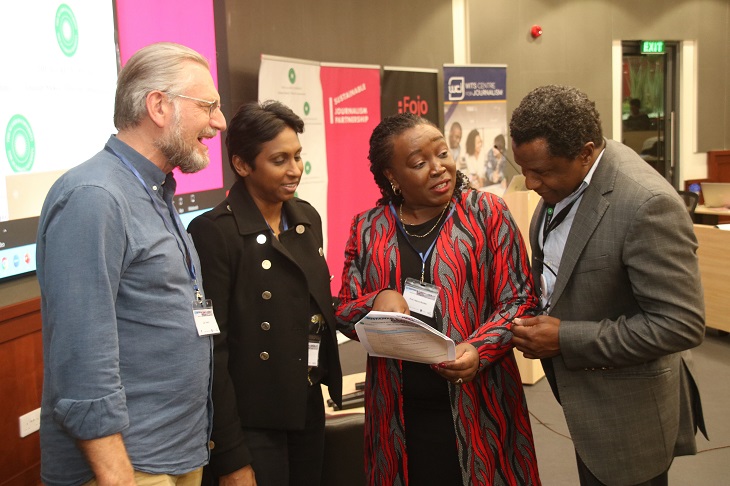
The world is facing increasing environmental, social, and economic changes thus creating the need for journalism that addresses the sustainability challenges faced by society. It is in this regard that the Aga Khan University’s Graduate School of Media and Communications (GSMC) co-convened Africa’s first Sustainable Journalism in Practice Conference. The conference brought together global and local professionals, policymakers, civil society, and scholars to discuss new ways of practicing journalism that is constructive, sustainable, and grounded in an African context.
Prof. Nancy Booker, Interim Dean, GSMC, in her opening remarks noted that the conference was an opportune time to ask what journalism should be in the current era of immense environmental, social, political, and economic challenges being experienced at the local, regional, and global arena. She also said it was important for journalism to be inclusive and diverse and to create content that contributes to sustainable societies.
“Journalism today cannot afford to be blind to the realities of environment and climate change and it has a role to play in shaping public discourse about climate change and how society responds to it. That shaping power can usefully build public support to accelerate climate mitigation,” she said.

Expounding on this, Dr. Dinesh Balliah, Director of Wits Centre of Journalism challenged the media to practice engaged journalism by listening to the issues of the day. “This will ensure that it becomes socially sustainable and impacts the plant and daily human activity.”
The Kenya Editors Guild President, Churchill Otieno, using Kenya as an industry example, said that the biggest symbol of the state of the health of the industry which is in decline could be summarized by the human resource capabilities of newsrooms. He also expressed the need for credible media sources to distinguish journalism from other content producers.
“There has been the proposal that the key benefit for investors should be profits but it is time that we also found ways to make sure that those journalism entities that deliver more to the citizens can use that same benefit to grow and become more attractive,” he said.
The President of the Sustainable Journalism Project and Senior Advisor at Fojo/Linnaeus University, Lars Tallert, advised that the definition of sustainability in journalism should focus on news as a product that influences sustainability in society as opposed to viewing the concept through the prism of stable profits.
Dr. Alexandra Borchardt, Senior Research Associate at the Reuters Institute for the Study of Journalism at the University of Oxford, noted that all of journalism could profit from great climate journalism by learning to be constructive and solutions-oriented. She challenged journalism practitioners to become creative in finding formats that work with different audiences and adopting a learning mindset that reflects its practices.
While delivering the keynote address, Prof. Bruce Mutsvairo, Professor at Utrecht University added that the citizens have a crucial role to play in promoting sustainable journalism. “Without ordinary people, there can be no sustainable journalism and there is a need to avail new spaces for discussion and debate at the local journalism level.”
Other presenters at the conference included the Media Council of Kenya CEO, David Omwoyo, Royal Media Services Director, Strategy and Innovation, Linus Kaikai, Nation Media Group’s Editorial Director, Joe Ageyo and Climate Editor Zeynab Wandati and the Deputy Digital Editor and President of the Standard Group Women, Queenter Mbori.
GSMC partnered with Wits Centre for Journalism and Fojo Media Institute to plan and host the conference which was convened at a time when climate change and gender conversations are taking shape globally. The conference, hosted at the University Centre in Nairobi, provided an opportunity for GSMC to position itself as a thought leader in sustainable journalism in practice. It brought together over 140 delegates from more than ten different countries, including Kenya, Uganda, Rwanda, Botswana, Zimbabwe, Ethiopia, Tanzania, Ghana, South Africa, Finland, the Netherlands and Sweden.
The conference presented an opportunity for synergy between practicing journalists and academics studying the industry as both parties participated in conversations to find solutions towards a media ecosystem that contributes to sustainable societies. GSMC sees the conference as a starting point for several initiatives towards this and as an example, the school is working on a GAC-funded project to support media houses by strengthening their gender desks and training journalists on gender-sensitive reporting. This will address the need to build the capacity of journalists to practice sustainable journalism.

About Soko Directory Team
Soko Directory is a Financial and Markets digital portal that tracks brands, listed firms on the NSE, SMEs and trend setters in the markets eco-system.Find us on Facebook: facebook.com/SokoDirectory and on Twitter: twitter.com/SokoDirectory

- January 2026 (220)
- February 2026 (248)
- March 2026 (287)
- April 2026 (208)
- May 2026 (75)
- January 2025 (119)
- February 2025 (191)
- March 2025 (212)
- April 2025 (193)
- May 2025 (161)
- June 2025 (157)
- July 2025 (227)
- August 2025 (211)
- September 2025 (270)
- October 2025 (297)
- November 2025 (230)
- December 2025 (220)
- January 2024 (238)
- February 2024 (227)
- March 2024 (190)
- April 2024 (133)
- May 2024 (157)
- June 2024 (145)
- July 2024 (136)
- August 2024 (154)
- September 2024 (212)
- October 2024 (255)
- November 2024 (196)
- December 2024 (143)
- January 2023 (182)
- February 2023 (203)
- March 2023 (322)
- April 2023 (297)
- May 2023 (267)
- June 2023 (214)
- July 2023 (212)
- August 2023 (257)
- September 2023 (237)
- October 2023 (264)
- November 2023 (286)
- December 2023 (177)
- January 2022 (293)
- February 2022 (329)
- March 2022 (358)
- April 2022 (292)
- May 2022 (271)
- June 2022 (232)
- July 2022 (278)
- August 2022 (253)
- September 2022 (246)
- October 2022 (196)
- November 2022 (232)
- December 2022 (167)
- January 2021 (182)
- February 2021 (227)
- March 2021 (325)
- April 2021 (259)
- May 2021 (285)
- June 2021 (272)
- July 2021 (277)
- August 2021 (232)
- September 2021 (271)
- October 2021 (304)
- November 2021 (364)
- December 2021 (249)
- January 2020 (272)
- February 2020 (310)
- March 2020 (390)
- April 2020 (321)
- May 2020 (335)
- June 2020 (327)
- July 2020 (333)
- August 2020 (276)
- September 2020 (214)
- October 2020 (233)
- November 2020 (242)
- December 2020 (187)
- January 2019 (251)
- February 2019 (215)
- March 2019 (283)
- April 2019 (254)
- May 2019 (269)
- June 2019 (249)
- July 2019 (335)
- August 2019 (292)
- September 2019 (306)
- October 2019 (313)
- November 2019 (362)
- December 2019 (318)
- January 2018 (291)
- February 2018 (213)
- March 2018 (275)
- April 2018 (223)
- May 2018 (235)
- June 2018 (176)
- July 2018 (256)
- August 2018 (247)
- September 2018 (255)
- October 2018 (282)
- November 2018 (282)
- December 2018 (184)
- January 2017 (183)
- February 2017 (194)
- March 2017 (207)
- April 2017 (104)
- May 2017 (169)
- June 2017 (205)
- July 2017 (189)
- August 2017 (195)
- September 2017 (186)
- October 2017 (235)
- November 2017 (253)
- December 2017 (266)
- January 2016 (164)
- February 2016 (165)
- March 2016 (189)
- April 2016 (143)
- May 2016 (245)
- June 2016 (182)
- July 2016 (271)
- August 2016 (247)
- September 2016 (233)
- October 2016 (191)
- November 2016 (243)
- December 2016 (153)
- January 2015 (1)
- February 2015 (4)
- March 2015 (164)
- April 2015 (107)
- May 2015 (116)
- June 2015 (119)
- July 2015 (145)
- August 2015 (157)
- September 2015 (186)
- October 2015 (169)
- November 2015 (173)
- December 2015 (205)
- March 2014 (2)
- March 2013 (10)
- June 2013 (1)
- March 2012 (7)
- April 2012 (15)
- May 2012 (1)
- July 2012 (1)
- August 2012 (4)
- October 2012 (2)
- November 2012 (2)
- December 2012 (1)