Why Silence Online is Suicide for Brands, Celebrities, and Government

“If your business is not on the internet, then your business will be out of business.” – SokoAnalyst. The reality is simple: Kenya is already a digital nation. With Nairobi at 67.7% mobile ownership, Kirinyaga at 65%, and more than half the counties above 50%, the mobile phone is no longer a luxury—it is the bloodstream of information, commerce, and culture. Yet too many brands, celebrities, and government agencies remain silent or half-hearted online, behaving as if this is still the age of posters and press releases. This is not just poor strategy, it is suicide.
The numbers should shock every leader who still clings to old methods of communication. Nairobi at 67.7% means two out of every three residents own a phone. That is millions of voters, shoppers, and fans living online daily. Kirinyaga at 65% and Nyandarua at 63.9% prove that even rural counties are no longer in the dark. The age of digital exclusion is gone. Today, ignoring social media in these countries is like ignoring water in a desert—you cannot survive without it.
Central Kenya is fully awake to digital adoption. Murang’a at 62.3%, Kiambu at 62.1%, and Nyeri at 61% show a region that has crossed the digital majority. These numbers reflect not just access but influence. If over 60% of households have mobile phones, they consume information, shop, and engage online first. Brands selling sugar, soap, or services must recognize this. Government programs like SHA or Huduma are doomed if they do not move onto the digital platforms where their citizens already live.

The Eastern region tells the same story. Machakos at 60.9%, Taita Taveta at 60.3%, and Embu at 60% show counties past the tipping point. Tharaka Nithi at 59.3% is close. The mobile phone is no longer elitist; it is mainstream. Politicians traveling to these regions for rallies should remember: more people will read their tweets than hear their speeches. Corporations hoping to sell to these markets should remember: customers here research, compare, and shop via their phones first.
Urban counties reinforce this reality. Mombasa at 58.5% and Nakuru at 58.4% are major hubs of commerce, tourism, and education. Both are above 58% penetration. That means the millions living here are primarily digital consumers. A hotel in Mombasa not optimize Instagram will fail. A school in Nakuru ignoring Facebook campaigns will lag. Tourism boards and county governments must recognize that their citizens and potential visitors live on social media.
Read Also: SHIFT By Belva Digital: Where Bold Brands Go To Play, Connect, And Win
Laikipia at 57.9%, Nyamira at 57.4%, and Uasin Gishu at 57.2% further push the case. Eldoret, the capital of Uasin Gishu, brands itself as the city of champions. Yet its champions today are not only athletes; they are influencers who command millions online. Data showing more than half of residents own phones demonstrates that the influencer economy is not a Nairobi-only phenomenon. It is a national movement, and brands failing to embrace it will be swept aside.
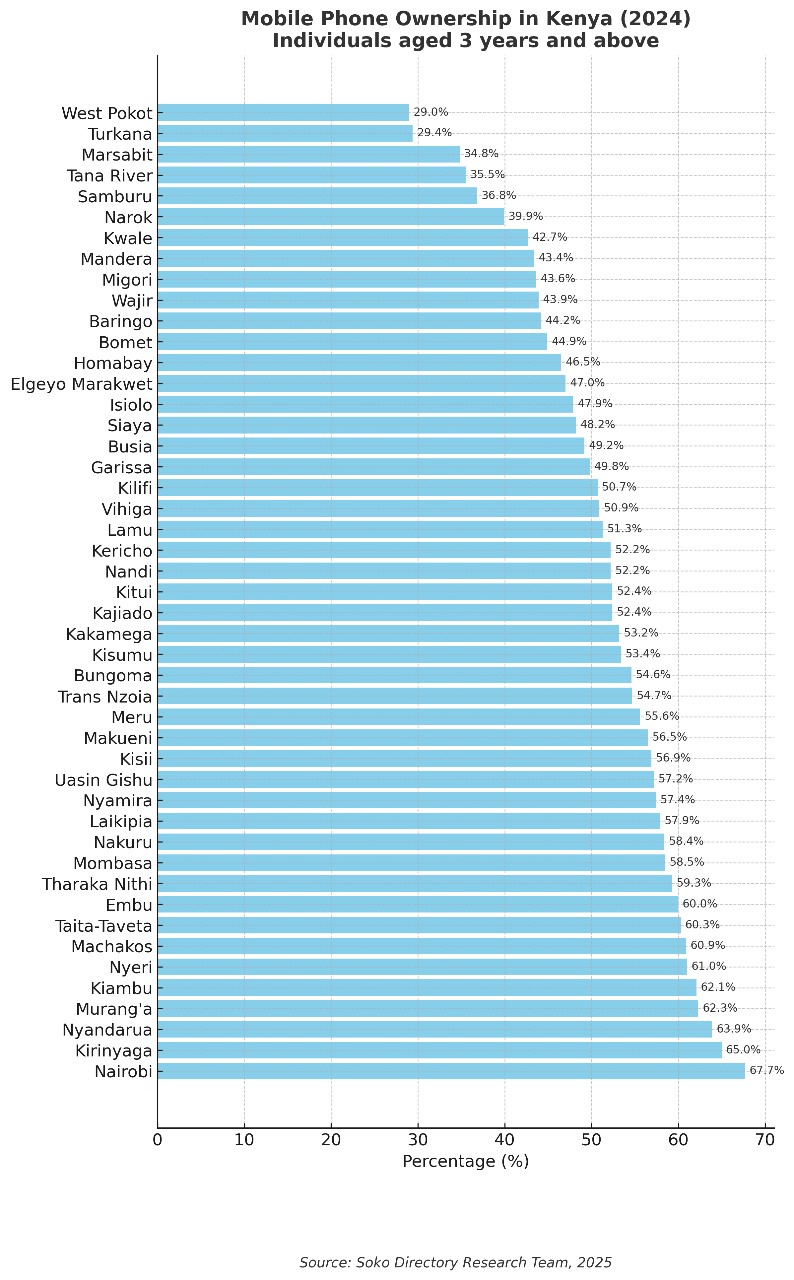
The Western and Nyanza belt is equally alive. Kisii at 56.6%, Makueni at 56.5%, Meru at 55.4%, Trans Nzoia at 54.7%, and Bungoma at 54.6% are not small margins. Kisumu at 53.4% and Kakamega at 53.2% add even more weight. These are millions of young, hungry, connected Kenyans. Every protest, every product launch, every campaign that gains traction online is amplified here. Celebrities from these regions can dominate nationally if they understand digital. Governments can build trust—or lose it—depending on their online credibility.
Kitui at 52.4%, Kajiado at 52.4%, Nandi at 52.2%, and Kericho at 52.2% demonstrate the breadth of adoption. Over half of households in these counties have phones. These are regions where agriculture is critical. Digital platforms could be used for weather alerts, price discovery, and farmer education. Yet government agencies still rely on archaic notices. Private innovators are moving faster than ministries. This gap is widening distrust between citizens and the state.
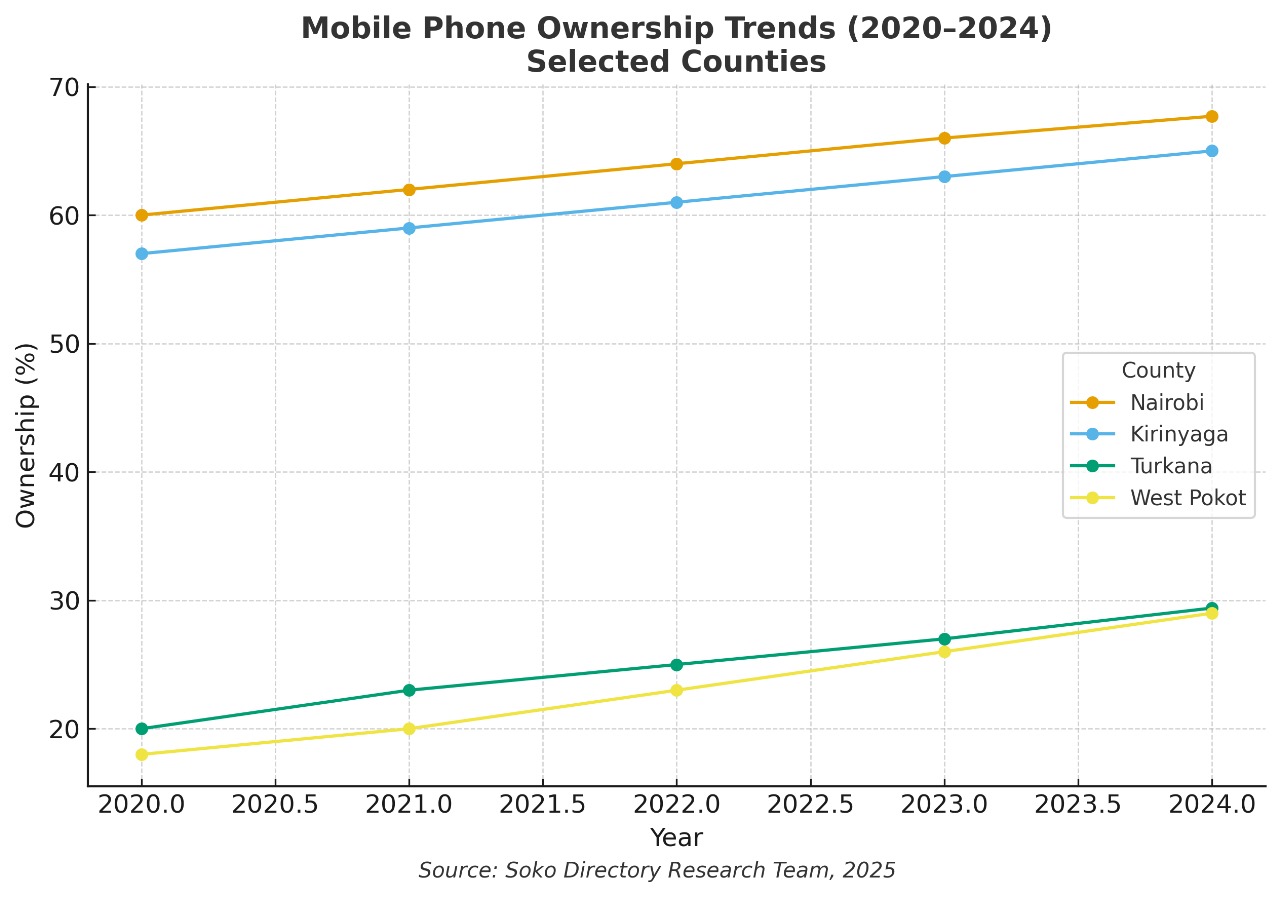
Even the coastal belt proves the point. Lamu at 51.3%, Vihiga at 50.9%, and Kilifi at 50.7% show coastal residents are digitally alive. Fishermen in Lamu can access prices, health workers in Kilifi can share alerts, and small traders in Vihiga can sell on WhatsApp. But for this potential to be realized, leaders must take digital seriously. Treating it as optional is to deny these communities the tools they already own and the opportunities they already deserve.
Counties just below 50% are also not laggards. Garissa at 49.8%, Busia at 49.2%, and Siaya at 48.2% show nearly half their populations connected. Isiolo at 47.9% and Elgeyo Marakwet at 47% are similar. These figures are not failures; they are signs of rapid growth. With falling smartphone prices and expanding connectivity, these counties will cross 50% soon. Smart brands should position themselves early, build loyalty now, and reap later. Those waiting for perfection will be too late.
Homabay at 46.5%, Bomet at 44.9%, and Baringo at 44.2% prove the lower-middle range of adoption is still critical. Nearly one in two residents in these regions are online. That is still millions of eyeballs, millions of votes, millions of customers. A government ignoring this audience is ignoring its citizens. A celebrity ignoring this audience is rejecting fans. A brand ignoring this audience is throwing money away. These percentages are more than numbers—they are power.
Northern counties demonstrate the challenge but also opportunity. Wajir at 43.9%, Migori at 43.5%, and Mandera at 43.4% represent tens of thousands connected despite infrastructure challenges. Kwale at 42.7%, Narok at 39.3%, and Samburu at 36.8% continue the same pattern. Even Tana River at 35.5% and Marsabit at 34.8% show one in three residents connected. These are millions of people reachable with a single campaign. The question is why leaders refuse to leverage this.
Turkana at 29.4% and West Pokot at 29% sit at the bottom, but these numbers are not irrelevant—they are resilience. In regions long forgotten by development, three in ten residents still own phones. That means opportunity for e-health, for mobile education, for e-commerce. A government that fails to build digital outreach in these regions is committing cruelty, leaving its most marginalized people in the dark despite them owning the light in their hands.
The conclusion is unavoidable. Kenya is a mobile-first country. Over half the population in most counties owns a mobile phone. Digital platforms are the new battlegrounds for politics, commerce, and culture. Safaricom knew this when they launched M-PESA. Equity Bank knew this with Eazzy Banking. NCBA knows this with Loop. Yet too many government agencies, brands, and celebrities continue to live in denial. This denial is not ignorance—it is arrogance.
For brands, digital is not just about advertising; it is about survival. A supermarket not on WhatsApp will miss customers. A bank not optimizing TikTok will fail to reach youth. A clothing store not leveraging Instagram will lose to international fast fashion brands. Social media is no longer optional; it is the marketplace itself. As Jeff Bezos said, “In the old world, you devoted 30% of your time to building a great service and 70% to shouting. In the new world, that’s reversed.”
Celebrities who think radio and TV are enough will vanish. Fame is now measured in retweets, likes, and followers. TikTok has birthed global stars overnight. Instagram has monetized fashion models without catwalks. YouTube has created comedians richer than stage actors. Kenyan celebrities must adapt or fade. A singer in Kisumu can reach New York with one viral video. A comedian in Embu can make Nairobi laugh in seconds. The stage is global, but only for those online.
Government arrogance is the most dangerous. Ministries cling to outdated PDFs and boring speeches, while citizens live on X, TikTok, and WhatsApp. Nairobi’s 67.7% penetration means the capital is digitally awake. Yet government still communicates as if citizens must travel to offices for information. Why not send bursary results via SMS? Why not use TikTok explainers for SHA? Why not livestream county budgets? The failure is not resources—it is leadership.
Kenyan youth have already proven the power of digital. Protests organized on X, petitions trending on TikTok, and campaigns amplified by influencers have shaken the state. If citizens can move mountains online, why does government resist? Because it fears transparency. Yet ignoring the digital tide will not stop it. It will only deepen mistrust, leaving government chasing shadows while citizens find truth elsewhere.
Globally, the evidence is overwhelming. Obama’s 2008 campaign rewrote political strategy using social media. Nigeria’s #EndSARS movement showed digital could shake governments. India’s Aadhaar program used mobile connectivity to reach hundreds of millions. Kenya’s own M-PESA showed the phone could transform banking. Every example screams the same truth: digital is not the future—it is the present. To ignore it is to embrace irrelevance.
The inclusivity argument is equally powerful. Counties above 60% prove urban-rural parity. Counties around 40% show rapid adoption even in hard-to-reach places. A mobile phone in Turkana may mean school lessons, a medical alert, or access to markets. Yet government agencies fail to invest in digital-first policies. This is not inefficiency; it is injustice. Citizens own the devices but remain cut off from leadership that refuses to adapt.
Youth, the majority of Kenya’s population, cannot be ignored. With a median age of 19, this is a generation born into digital culture. They do not wait for newspapers or 9PM news. They consume information in real-time, in video, in memes. A politician ignoring TikTok is ignoring an entire generation of voters. A brand ignoring Instagram is ignoring tomorrow’s loyal customers. A celebrity ignoring YouTube is ignoring their own survival.
The advertising industry must also face reality. Spending billions on print and radio while consumers live on their phones is financial malpractice. Nyeri at 61% and Laikipia at 57.9% show counties where print is secondary. Nairobi at 67.7% makes it obvious. Yet corporates continue to waste budgets on channels with declining influence. Digital is not just cheaper; it is smarter. And Kenyans are smarter than the brands trying to fool them.
The opportunity is massive. Imagine a campaign targeting the top 20 counties above 50% ownership—tens of millions reached instantly. No billboard can match that, no rally can equal that. Yet leaders continue to play safe, clinging to old channels. Safe is expensive. Safe is irrelevant. Safe is suicide. Only risk-takers who embrace digital will survive the next decade.
Richard Branson once said, “Business opportunities are like buses; there’s always another one coming.” In Kenya, those buses are mobile phones. Nairobi at 67.7% shows the bus is here. Kirinyaga at 65% shows it has reached rural towns. Even Turkana at 29.4% shows it is driving through deserts. The question is: will brands, celebrities, and government agencies board—or will they be left behind, watching competitors ride into the future?
The hypocrisy is staggering. Politicians use digital to win elections, then abandon it in office. Celebrities trend online when desperate, then disappear when satisfied. Brands launch flashy ads but fail to build meaningful engagement. This inconsistency creates mistrust. Kenyans are not fooled. They expect dialogue, transparency, and consistency. Social media is not a billboard—it is a relationship.
Ultimately, Kenya’s failure to embrace digital fully is not about infrastructure—it is about imagination. The numbers prove connectivity is here. The tools exist. The audience are waiting. What is missing is the will to adapt. Brands must innovate, celebrities must engage, gand overnment must lead. Those who refuse will not just lag; they will vanish. The phone is the stage, the market, and the battlefield. Digitize or perish—that is the only choice.
Read Also: Africa Must Defend Its Digital Turf If Local Media Are To Benefit from the Social Media Boom
About Steve Biko Wafula
Steve Biko is the CEO OF Soko Directory and the founder of Hidalgo Group of Companies. Steve is currently developing his career in law, finance, entrepreneurship and digital consultancy; and has been implementing consultancy assignments for client organizations comprising of trainings besides capacity building in entrepreneurial matters.He can be reached on: +254 20 510 1124 or Email: info@sokodirectory.com
- January 2026 (220)
- February 2026 (248)
- March 2026 (287)
- April 2026 (208)
- May 2026 (144)
- January 2025 (119)
- February 2025 (191)
- March 2025 (212)
- April 2025 (193)
- May 2025 (161)
- June 2025 (157)
- July 2025 (227)
- August 2025 (211)
- September 2025 (270)
- October 2025 (297)
- November 2025 (230)
- December 2025 (220)
- January 2024 (238)
- February 2024 (227)
- March 2024 (190)
- April 2024 (133)
- May 2024 (157)
- June 2024 (145)
- July 2024 (136)
- August 2024 (154)
- September 2024 (212)
- October 2024 (255)
- November 2024 (196)
- December 2024 (143)
- January 2023 (182)
- February 2023 (203)
- March 2023 (322)
- April 2023 (297)
- May 2023 (267)
- June 2023 (214)
- July 2023 (212)
- August 2023 (257)
- September 2023 (237)
- October 2023 (264)
- November 2023 (286)
- December 2023 (177)
- January 2022 (293)
- February 2022 (329)
- March 2022 (358)
- April 2022 (292)
- May 2022 (271)
- June 2022 (232)
- July 2022 (278)
- August 2022 (253)
- September 2022 (246)
- October 2022 (196)
- November 2022 (232)
- December 2022 (167)
- January 2021 (182)
- February 2021 (227)
- March 2021 (325)
- April 2021 (259)
- May 2021 (285)
- June 2021 (272)
- July 2021 (277)
- August 2021 (232)
- September 2021 (271)
- October 2021 (304)
- November 2021 (364)
- December 2021 (249)
- January 2020 (272)
- February 2020 (310)
- March 2020 (390)
- April 2020 (321)
- May 2020 (335)
- June 2020 (327)
- July 2020 (333)
- August 2020 (276)
- September 2020 (214)
- October 2020 (233)
- November 2020 (242)
- December 2020 (187)
- January 2019 (251)
- February 2019 (215)
- March 2019 (283)
- April 2019 (254)
- May 2019 (269)
- June 2019 (249)
- July 2019 (335)
- August 2019 (292)
- September 2019 (306)
- October 2019 (313)
- November 2019 (362)
- December 2019 (318)
- January 2018 (291)
- February 2018 (213)
- March 2018 (275)
- April 2018 (223)
- May 2018 (235)
- June 2018 (176)
- July 2018 (256)
- August 2018 (247)
- September 2018 (255)
- October 2018 (282)
- November 2018 (282)
- December 2018 (184)
- January 2017 (183)
- February 2017 (194)
- March 2017 (207)
- April 2017 (104)
- May 2017 (169)
- June 2017 (205)
- July 2017 (189)
- August 2017 (195)
- September 2017 (186)
- October 2017 (235)
- November 2017 (253)
- December 2017 (266)
- January 2016 (164)
- February 2016 (165)
- March 2016 (189)
- April 2016 (143)
- May 2016 (245)
- June 2016 (182)
- July 2016 (271)
- August 2016 (247)
- September 2016 (233)
- October 2016 (191)
- November 2016 (243)
- December 2016 (153)
- January 2015 (1)
- February 2015 (4)
- March 2015 (164)
- April 2015 (107)
- May 2015 (116)
- June 2015 (119)
- July 2015 (145)
- August 2015 (157)
- September 2015 (186)
- October 2015 (169)
- November 2015 (173)
- December 2015 (205)
- March 2014 (2)
- March 2013 (10)
- June 2013 (1)
- March 2012 (7)
- April 2012 (15)
- May 2012 (1)
- July 2012 (1)
- August 2012 (4)
- October 2012 (2)
- November 2012 (2)
- December 2012 (1)
