
LIXIL’s SATO Reaches 103 Million People, Accelerates Sanitation Revolution in Kenya and Beyond
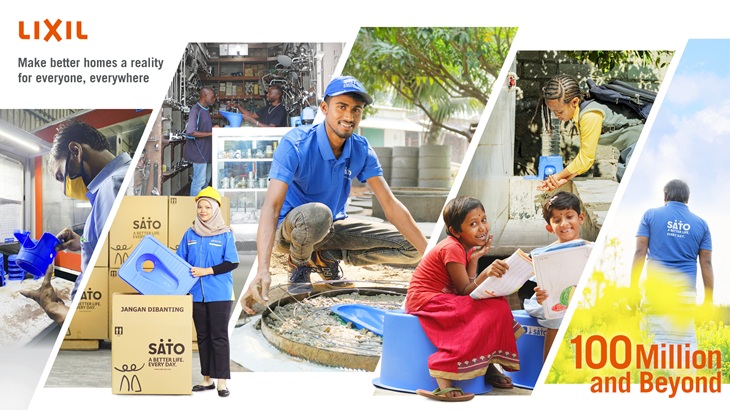
LIXIL Corporation, maker of pioneering water and housing products, today announced that it has achieved its ambitious goal of improving sanitation and hygiene for 103 million people through its social business, SATO, with significant progress made in Kenya.
Safe sanitation and hygiene remain among the most urgent global challenges, particularly in rural parts of Africa. In Kenya, more than 23 million people in rural communities – or nearly 40% of the national population – have limited, unimproved sanitation, or practice open defecation1. This creates huge health, social and ecological issues. Globally, more than 1,000 children under the age of five die each day from diseases spread by unsafe drinking water, poor sanitation and inadequate hygiene, resulting in hundreds of billions of dollars in annual losses from reduced productivity and higher healthcare costs.
To address this issue, LIXIL has created and scaled SATO, its social business that designs water-saving and affordable sanitation and hygiene solutions, with Kenya one of its key markets. Its award-winning range of products includes the SATO Pan – an innovative solution that closes open pit latrines to create a more hygienic sanitation experience; and the SATO Tap – a portable handwashing solution that needs just 100ml of water for an effective handwash.

As a business, SATO works with a diverse range of partners — including manufacturers, distributors, retailers, governments, international organisations, NGOs, and private sector players — to create resilient and sustainable sanitation markets in rural communities. This focuses on addressing the barriers to sanitation and hygiene adoption – from awareness and local entrepreneurship to product availability and microfinancing – to move communities away from open defecation and basic sanitation towards safely managed sanitation.
In Kenya, SATO has made significant progress by establishing local manufacturing and distribution. In addition, with UNICEF Kenya and the Ministry of Health, it has introduced and scaled sanitation solutions in regions like Kitui and Siaya Counties, developing supply chains and offering communities affordable solutions to away from open defecation.
Globally, its market-focused model has been highly effective. To date, SATO has reached more than 103 million people through its sanitation and hygiene solutions. This has not only created a better day-to-day for the end users who have access to improved sanitation but has also contributed to the direct and indirect creation of new jobs within rural communities. Achieving this milestone, the primary target of the Global Sanitation and Hygiene pillar of LIXIL’s Impact Strategy since 2013, reinforces LIXIL’s commitment to further accelerating sanitation and hygiene access worldwide.
Kinya Seto, CEO of LIXIL, said: “Reaching 103 million people is not a finish line, but powerful proof that the private sector plays a critical role in addressing an urgent global issue. By establishing a social business, we are addressing the sanitation and hygiene challenges at scale, not only improving health, but empowering families with the security and peace of mind they deserve to build their livelihoods and prosper. Our journey is one of learning and partnership. We are grateful to the families and partners who have welcomed our solutions into their homes and communities. Seeing first-hand how simple, safe toilets can restore dignity and improve quality of life deepens our commitment. Our role is to serve as a catalyst, supporting the resilience and potential of every community we reach.”
Erin McCusker, Leader of SATO, said: “Reaching 100 million people is a significant milestone, representing the impact on individuals and communities, and it is also a vital transition point. The global goal of universal access to safe sanitation and hygiene by 2030 demands unprecedented acceleration. We see sanitation as a foundation for the achievement of many other development goals. LIXIL’s upcoming 2030 targets will reinforce our commitment to deliver private-sector innovation and market-driven models essential to making better homes a reality for everyone, everywhere.”
Read Also: Hygiene Initiative Brings Sanitation Relief To Nyahururu Women’s Prison

About Soko Directory Team
Soko Directory is a Financial and Markets digital portal that tracks brands, listed firms on the NSE, SMEs and trend setters in the markets eco-system.Find us on Facebook: facebook.com/SokoDirectory and on Twitter: twitter.com/SokoDirectory

- January 2026 (220)
- February 2026 (246)
- March 2026 (286)
- April 2026 (119)
- January 2025 (119)
- February 2025 (191)
- March 2025 (212)
- April 2025 (193)
- May 2025 (161)
- June 2025 (157)
- July 2025 (227)
- August 2025 (211)
- September 2025 (270)
- October 2025 (297)
- November 2025 (230)
- December 2025 (219)
- January 2024 (238)
- February 2024 (227)
- March 2024 (190)
- April 2024 (133)
- May 2024 (157)
- June 2024 (145)
- July 2024 (136)
- August 2024 (154)
- September 2024 (212)
- October 2024 (255)
- November 2024 (196)
- December 2024 (143)
- January 2023 (182)
- February 2023 (203)
- March 2023 (322)
- April 2023 (297)
- May 2023 (267)
- June 2023 (214)
- July 2023 (212)
- August 2023 (257)
- September 2023 (237)
- October 2023 (264)
- November 2023 (286)
- December 2023 (177)
- January 2022 (293)
- February 2022 (329)
- March 2022 (358)
- April 2022 (292)
- May 2022 (271)
- June 2022 (232)
- July 2022 (278)
- August 2022 (253)
- September 2022 (246)
- October 2022 (196)
- November 2022 (232)
- December 2022 (167)
- January 2021 (182)
- February 2021 (227)
- March 2021 (325)
- April 2021 (259)
- May 2021 (285)
- June 2021 (272)
- July 2021 (277)
- August 2021 (232)
- September 2021 (271)
- October 2021 (304)
- November 2021 (364)
- December 2021 (249)
- January 2020 (272)
- February 2020 (310)
- March 2020 (390)
- April 2020 (321)
- May 2020 (335)
- June 2020 (327)
- July 2020 (333)
- August 2020 (276)
- September 2020 (214)
- October 2020 (233)
- November 2020 (242)
- December 2020 (187)
- January 2019 (251)
- February 2019 (215)
- March 2019 (283)
- April 2019 (254)
- May 2019 (269)
- June 2019 (249)
- July 2019 (335)
- August 2019 (293)
- September 2019 (306)
- October 2019 (313)
- November 2019 (362)
- December 2019 (318)
- January 2018 (291)
- February 2018 (213)
- March 2018 (275)
- April 2018 (223)
- May 2018 (235)
- June 2018 (176)
- July 2018 (256)
- August 2018 (247)
- September 2018 (255)
- October 2018 (282)
- November 2018 (282)
- December 2018 (184)
- January 2017 (183)
- February 2017 (194)
- March 2017 (207)
- April 2017 (104)
- May 2017 (169)
- June 2017 (205)
- July 2017 (189)
- August 2017 (195)
- September 2017 (186)
- October 2017 (235)
- November 2017 (253)
- December 2017 (266)
- January 2016 (164)
- February 2016 (165)
- March 2016 (189)
- April 2016 (143)
- May 2016 (245)
- June 2016 (182)
- July 2016 (271)
- August 2016 (247)
- September 2016 (233)
- October 2016 (191)
- November 2016 (243)
- December 2016 (153)
- January 2015 (1)
- February 2015 (4)
- March 2015 (164)
- April 2015 (107)
- May 2015 (116)
- June 2015 (119)
- July 2015 (145)
- August 2015 (157)
- September 2015 (186)
- October 2015 (169)
- November 2015 (173)
- December 2015 (205)
- March 2014 (2)
- March 2013 (10)
- June 2013 (1)
- March 2012 (7)
- April 2012 (15)
- May 2012 (1)
- July 2012 (1)
- August 2012 (4)
- October 2012 (2)
- November 2012 (2)
- December 2012 (1)