
How Maria Mbeneka Mutua Is Reshaping Kenya’s Livestock Future
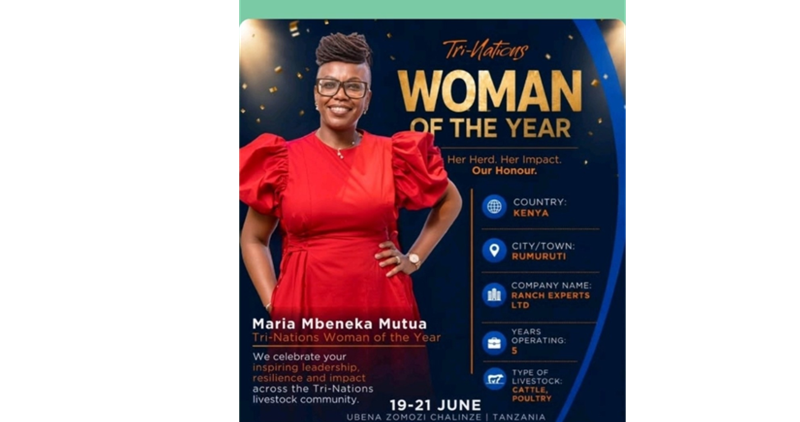
When Maria Mbeneka Mutua was named the 2026 Tri-Nations Livestock Expo & Sale Woman of the Year, the honour did more than place a trophy in the hands of a deserving Kenyan entrepreneur. It placed a bright regional spotlight on a form of leadership that Kenya urgently needs: leadership that converts difficult realities into practical systems, takes opportunity to communities that have long operated at the margins, and proves that agriculture can be modern, dignified, profitable and deeply transformative. Her victory is not merely a personal milestone. It is a national statement about the kind of people who are quietly rebuilding the productive foundations of the country.
The recognition, celebrated at the Tri-Nations livestock gathering in Chalinze, Tanzania, honours visionary women driving innovation, empowerment and sustainable impact across the livestock sector. Maria fits that description with unusual force. From Rumuruti, through Ranch Experts Ltd, she has built a women-led livestock enterprise around high-quality grass-fed and grain-finished beef. Yet the true measure of her achievement is not found only in the number of animals handled or the quality of meat produced. It is found in the human network around the enterprise: more than 4,500 pastoralists, women and young people who have gained access to markets, knowledge, opportunity and a more organised value chain.
That is why this award matters. Kenya has no shortage of livestock. What has too often been missing is the bridge between the farmer and the market, between traditional production and dependable commercial systems, and between rural effort and the full value that effort should command. Maria has positioned herself on that bridge. She is helping communities move from selling under pressure to participating with greater information, structure and negotiating power. In doing so, she is confronting one of the oldest injustices in agriculture: the producer doing the hardest work while remaining the least protected person in the chain.

Her influence becomes even more significant when one looks at Flockr, the technology platform at the heart of her innovation. By using USSD and SMS, Flockr is designed for the reality of remote communities rather than for an imagined world in which every farmer owns an expensive smartphone, enjoys constant internet access and speaks the language of complicated digital applications. This is innovation with empathy. It does not ask pastoralists to abandon their circumstances before they can benefit from technology. It takes technology to them in a form they can actually use. That single design choice reveals a leader who understands that inclusion is not a slogan; it is the discipline of building systems around the people most likely to be excluded.
Through Flockr, traditional pastoralism is being connected to a data-driven value chain. That shift is profound. Data can improve visibility, traceability, planning and market coordination. It can help transform livestock from an asset whose value is often realised only in moments of urgent need into part of a more predictable commercial system. It can create clearer records, stronger relationships and better decisions. For a sector where distance, fragmented information and informal transactions have historically limited opportunity, a simple USSD or SMS interaction can become a doorway into the formal economy.
Maria’s work also stands out because she has refused to treat women as a decorative part of agricultural development. Women occupy key roles in her enterprise, and her partnership with the Chui Mamas Group connects her work to approximately 1,000 women. The training delivered through that partnership in circular-economy practices and climate-resilient fodder production is not charity. It is productive investment. It equips women with knowledge that can strengthen household incomes, improve resilience and make livestock production more sustainable in a changing climate. When women are placed at the centre of production, training and enterprise, the benefits rarely stop with one individual; they spread through families and entire communities.
Her decision to sponsor women to international platforms, including the Dubai Food Festival and UNIDO study tours, is equally important. Exposure changes ambition. It allows people who may have spent years being described as beneficiaries to see themselves as experts, exporters, innovators, and global participants. It opens the imagination to standards, technologies, partnerships and markets beyond the familiar. Maria is therefore not only building an enterprise; she is building confidence and widening the horizon of what Kenyan women in agriculture believe they can become.
The award also challenges a narrow definition of influence in Kenya. Influence is too often measured by political visibility, social-media noise, celebrity, or proximity to power. Maria represents a more enduring kind of influence: the ability to change how people produce, earn, organise and imagine their future. A person who creates reliable market access for thousands, builds technology for remote communities, strengthens women’s participation and develops climate-conscious production systems is shaping the country at its foundations. That influence may begin far from television studios and city boardrooms, but its consequences are national.
Kenya’s future will be secured not only by the policies announced in Nairobi but also by the enterprises that make production work in places such as Rumuruti. The country needs leaders who understand that food security, employment, technology, climate adaptation and rural prosperity are not separate conversations. They are one conversation. Maria’s model brings them together. Livestock creates value. Technology connects the chain. Women gain meaningful roles. Young people encounter a sector with a future. Pastoralists reach markets. Climate-resilient fodder protects production. Traceability builds confidence. Each piece strengthens the others.
Her vision confirms that she is not thinking in small increments. She intends to scale the operation to 1,000 cattle, finish 40 head each week with full traceability, and grow Flockr to two million users across Africa. Those are ambitious goals, but ambition is precisely what makes this moment compelling. Africa does not need its agricultural entrepreneurs to remain permanently small in order to be considered authentic. It needs them to grow, standardise, employ, export, innovate and compete. Maria’s plans speak to a new generation of African agribusiness leadership that respects local knowledge while building institutions capable of continental scale.
Full traceability is especially powerful because the future of food markets will increasingly reward trust. Consumers, buyers and institutions want to know where food comes from, how it was produced and whether quality can be verified. By making traceability part of her growth vision, Maria is moving beyond trading animals toward building a credible, transparent and modern livestock system. This is how Kenyan producers can move from being price takers at the end of fragmented chains to becoming trusted suppliers in higher-value markets.
Her work is also a reminder that the livestock sector is not a relic of the past. It is a frontier of technology, finance, logistics, climate innovation, food processing, and employment. For young Kenyans who have been taught to view agriculture as a last resort, Maria offers a different picture. She shows that a herd can be connected to data, a feedlot can become a platform for inclusion, and a rural enterprise can carry continental ambition. She makes agriculture intellectually exciting and commercially serious. That cultural shift may be one of her most valuable contributions.
The Tri-Nations Woman of the Year award, therefore, belongs not only to Maria but also to every pastoralist who has waited for a fairer market, every woman who has wanted to be recognised as a producer and decision-maker, and every young person who needs proof that innovation does not begin and end in a city technology hub. It belongs to the communities whose knowledge has sustained livestock production for generations and who now deserve tools that protect and multiply the value of that knowledge. Maria’s success tells them that their sector is visible, their contribution matters and their future can be larger than their past.
What makes her one of the most influential figures in Kenya today is not simply that she has won a regional title. It is that her work sits at the intersection of the country’s most urgent priorities. She is creating market access where exclusion once prevailed. She is using accessible technology where distance created isolation. She is opening doors for women where leadership was often male-dominated. She is giving young people a reason to see livestock as a serious profession. She is advancing climate resilience in a sector exposed to environmental pressure. She is building toward traceability and scale at a time when African food systems must become more efficient, credible and competitive.
This kind of influence is practical. It can be counted in people reached, markets opened, women trained, technologies adopted and livelihoods strengthened. It can also be felt in something less visible but equally important: the restoration of dignity. When a pastoralist is connected to a market rather than left at the mercy of desperation, dignity grows. When a woman is trained, employed and given a platform beyond her community, dignity grows. When a young person sees an African enterprise using technology to solve an African problem, dignity grows. Maria’s leadership turns that dignity into an economic force.
Her achievement should also compel institutions, investors and policymakers to pay attention. Enterprises that combine commercial discipline with broad social impact should not be left to struggle alone. They deserve patient capital, supportive regulation, dependable infrastructure, research partnerships and access to larger markets. Celebrating Maria must mean more than applauding her after she succeeds. It should mean creating an environment in which more women like her can build, scale and endure. A country that claims to value agriculture must learn to recognise and support the people modernising it from the ground up.
For Maria herself, the award is both affirmation and assignment. It confirms that her work has crossed borders and earned regional respect, but it also raises the expectations around what comes next. The target of two million Flockr users across Africa represents more than expansion. It represents the possibility of a connected livestock community in which data, markets and opportunity can travel farther than geography once allowed. The planned scale of the feedlot represents more than bigger numbers. It represents jobs, standards, supply, learning, and the demonstration effect that strong African enterprises create for others.
Kenya should celebrate Maria Mbeneka Mutua loudly. Her story is the story of the country at its best: resilient, inventive, community-rooted, and unwilling to accept that old problems must have permanent control over the future. She has shown that leadership can wear gumboots, study data, build markets, train women, speak to pastoralists and still carry a continental vision. She has shown that agriculture can be both deeply local and boldly global. She has shown that purpose and profit do not have to be enemies when an enterprise is designed to create value throughout the chain.
The 2026 Tri-Nations Livestock Expo & Sale Woman of the Year title is therefore richly deserved. It honours Maria’s courage, but it also honours the architecture of her impact: a women-led feedlot, thousands connected to opportunity, an accessible technology platform, climate-resilient training, international exposure for women, and a vision for transparent growth across Africa. In an age when influence is often loud but empty, Maria’s influence is visible in systems that work and lives that move forward.
Her herd is more than livestock. It is a movement of people, information, dignity, and possibility. Her award is more than a crown. It is evidence that the future of African agriculture is already being built by women who understand both the land and the power of innovation. And her name, Maria Mbeneka Mutua, now stands as a powerful reminder that when leadership, technology, and purpose come together, an entire sector can begin to see a new horizon.
Read Also: A Sit Down With Maria Mbeneka On Her Vision For LSK Once Elected

About Steve Biko Wafula
Steve Biko is the CEO OF Soko Directory and the founder of Hidalgo Group of Companies. Steve is currently developing his career in law, finance, entrepreneurship and digital consultancy; and has been implementing consultancy assignments for client organizations comprising of trainings besides capacity building in entrepreneurial matters.He can be reached on: +254 20 510 1124 or Email: info@sokodirectory.com

- January 2026 (220)
- February 2026 (248)
- March 2026 (287)
- April 2026 (208)
- May 2026 (191)
- June 2026 (222)
- January 2025 (119)
- February 2025 (191)
- March 2025 (212)
- April 2025 (193)
- May 2025 (161)
- June 2025 (157)
- July 2025 (227)
- August 2025 (211)
- September 2025 (270)
- October 2025 (297)
- November 2025 (230)
- December 2025 (220)
- January 2024 (238)
- February 2024 (227)
- March 2024 (190)
- April 2024 (133)
- May 2024 (157)
- June 2024 (145)
- July 2024 (136)
- August 2024 (154)
- September 2024 (212)
- October 2024 (255)
- November 2024 (196)
- December 2024 (143)
- January 2023 (182)
- February 2023 (203)
- March 2023 (322)
- April 2023 (297)
- May 2023 (267)
- June 2023 (214)
- July 2023 (212)
- August 2023 (257)
- September 2023 (237)
- October 2023 (264)
- November 2023 (286)
- December 2023 (177)
- January 2022 (293)
- February 2022 (329)
- March 2022 (358)
- April 2022 (292)
- May 2022 (271)
- June 2022 (232)
- July 2022 (278)
- August 2022 (253)
- September 2022 (246)
- October 2022 (196)
- November 2022 (232)
- December 2022 (167)
- January 2021 (182)
- February 2021 (227)
- March 2021 (325)
- April 2021 (259)
- May 2021 (285)
- June 2021 (272)
- July 2021 (277)
- August 2021 (232)
- September 2021 (271)
- October 2021 (304)
- November 2021 (364)
- December 2021 (249)
- January 2020 (272)
- February 2020 (310)
- March 2020 (390)
- April 2020 (321)
- May 2020 (335)
- June 2020 (327)
- July 2020 (333)
- August 2020 (276)
- September 2020 (214)
- October 2020 (233)
- November 2020 (242)
- December 2020 (187)
- January 2019 (251)
- February 2019 (215)
- March 2019 (283)
- April 2019 (254)
- May 2019 (269)
- June 2019 (249)
- July 2019 (335)
- August 2019 (292)
- September 2019 (306)
- October 2019 (313)
- November 2019 (362)
- December 2019 (318)
- January 2018 (291)
- February 2018 (213)
- March 2018 (275)
- April 2018 (223)
- May 2018 (235)
- June 2018 (176)
- July 2018 (256)
- August 2018 (247)
- September 2018 (255)
- October 2018 (282)
- November 2018 (282)
- December 2018 (184)
- January 2017 (183)
- February 2017 (194)
- March 2017 (207)
- April 2017 (104)
- May 2017 (169)
- June 2017 (205)
- July 2017 (189)
- August 2017 (195)
- September 2017 (186)
- October 2017 (235)
- November 2017 (253)
- December 2017 (266)
- January 2016 (164)
- February 2016 (165)
- March 2016 (189)
- April 2016 (143)
- May 2016 (245)
- June 2016 (182)
- July 2016 (271)
- August 2016 (247)
- September 2016 (233)
- October 2016 (191)
- November 2016 (243)
- December 2016 (153)
- January 2015 (1)
- February 2015 (4)
- March 2015 (164)
- April 2015 (107)
- May 2015 (116)
- June 2015 (119)
- July 2015 (145)
- August 2015 (157)
- September 2015 (186)
- October 2015 (169)
- November 2015 (173)
- December 2015 (205)
- March 2014 (2)
- March 2013 (10)
- June 2013 (1)
- March 2012 (7)
- April 2012 (15)
- May 2012 (1)
- July 2012 (1)
- August 2012 (4)
- October 2012 (2)
- November 2012 (2)
- December 2012 (1)