
Kenya’s Sovereign Wealth Fund Is Now Law: The National Savings Account That Must Outlive Politics
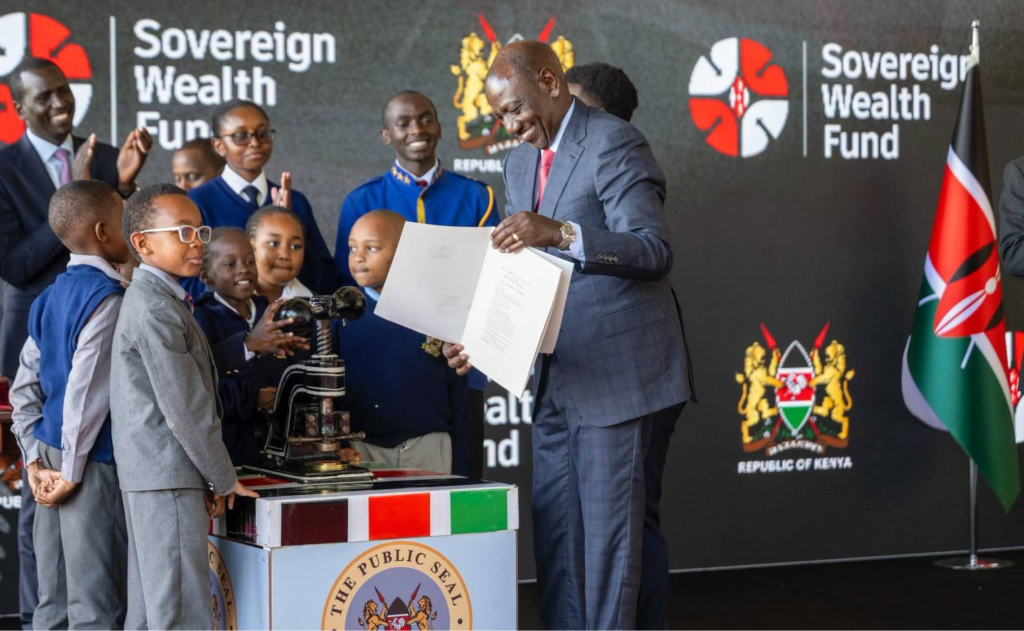
Kenya has created a legal vehicle to save part of its mineral and petroleum wealth, cushion the economy during shocks, and finance strategic infrastructure. The promise is powerful. The test will be discipline, transparency, and whether the money is protected from the appetite of today’s politics.
Kenya has finally placed one of the most important public finance ideas into law: a Sovereign Wealth Fund. On paper, this is not just another government fund. It is a national savings and investment account meant to help the country do three difficult things at once: protect the economy when shocks come, fund strategic infrastructure without leaning too heavily on debt, and save a share of natural resource wealth for Kenyans who are not yet born.
For ordinary Kenyans, the idea can sound technical. It is not. A sovereign wealth fund is simply a disciplined way for a country to avoid eating everything it earns today. It is the national equivalent of a family saying: when income comes in, some will be used to solve current needs, some will be invested in assets that make tomorrow easier, and some will be kept away so that the children do not inherit only bills, broken systems, and speeches.

The Sovereign Wealth Fund Act, 2026 creates Kenya’s fund around three main components. The first is the Stabilisation Fund. This is the country’s emergency cushion. It is meant to give the national government resources when Kenya faces serious shocks that threaten economic stability. That could be a global oil supply disruption, a pandemic-style event, a commodity price shock, or any major crisis that squeezes government revenues and raises the cost of living. In simple terms, this is the rainy-day pocket.
The second is the Strategic Infrastructure Investment Fund. This component is designed to support infrastructure projects that are aligned with Kenya’s national development plan. Infrastructure is expensive, and Kenya has already learnt the hard way that building everything through debt can leave the country with beautiful projects on one side and painful repayments on the other. A properly run infrastructure investment window could help the country finance roads, energy, logistics, industrial parks, water systems and other long-term assets in a more structured way.
The third is the Future Generations Fund. This is the moral heart of the law. Kenya is saying that if minerals and petroleum resources are exploited today, the benefits should not be consumed by the current generation alone. A portion must be saved and invested so that future Kenyans can also benefit from resources that, once removed from the ground, cannot be put back.
This is why the 30 percent rule matters. Under the new law, 30 percent of total mineral and petroleum revenues will be ringfenced for the Future Generations Fund. That means nearly one shilling in every three from those resource revenues is supposed to be set aside for the long term. For a country where public money is often swallowed by recurrent expenditure, debt service, emergency procurement and political priorities, this provision is significant.
It is also a statement about national discipline. Natural resources can be a blessing or a curse. Countries that manage them well build buffers, industries, savings, and intergenerational wealth. Countries that manage them badly end up with conflict, waste, corruption, inequality and debt. The difference is rarely the resource itself. The difference is governance.
Kenya’s timing is important. The country is looking for new ways to finance development while reducing pressure on public borrowing. Debt has already become one of the heaviest items in the national budget. Every shilling spent on repayment is a shilling not fully available for classrooms, hospitals, agriculture, industrialisation, security, innovation, or county-level economic growth. A sovereign wealth fund will not solve this overnight, but it creates a framework for thinking beyond the next budget cycle.
The law also puts guardrails around how the money can be invested. This is one of the most important parts of the Act. The fund is prohibited from investing in speculative derivatives, unlisted assets, real estate located in Kenya, private equity, art, commodities, or securities issued by a Kenyan issuer. The purpose is clear: this money is not supposed to become a playground for politically connected deals, local asset bubbles, risky speculation, or opaque investments that ordinary Kenyans cannot trace.
That restriction is especially important because the history of public funds in Kenya has taught citizens to be cautious. The moment a large pool of money is created, the biggest question is not only how much will be collected. The bigger question is who will control it, where it will be invested, who will benefit, how returns will be reported, and what happens when political pressure rises. A sovereign wealth fund is only as strong as its governance architecture.
For investors, this law should be watched closely. A well-managed sovereign wealth fund can deepen fiscal stability, improve Kenya’s long-term investment credibility, and reduce panic-driven policy decisions when shocks hit. If the Stabilisation Fund works, the country may have a better buffer during difficult periods. If the infrastructure component works, strategic projects may be financed with better planning and stronger accountability. If the Future Generations Fund works, Kenya may begin building a pool of national wealth that compounds over time.
But the word “if” is doing a lot of work. Passing the law is the easy part. Building a fund that Kenyans trust will require full transparency, professional management, strong parliamentary oversight, independent audits, clear reporting, and consequences for misuse. Kenyans should be able to know how much money has entered the fund, where it is held, how it is invested, what returns have been earned, what fees have been paid, and whether the investment decisions are consistent with the law.
The biggest danger is political temptation. In difficult times, every government wants access to money. When revenue underperforms, when debt repayments rise, when elections approach, or when flagship projects need quick financing, the pressure to raid long-term savings becomes real. That is why the Future Generations Fund must be treated as sacred capital, not a convenient overdraft. A country that keeps borrowing from its children has no moral authority to claim it is building for them.
There is also a public education challenge. Kenyans must understand that a sovereign wealth fund is not a magic wallet. It will not immediately lower the cost of unga, reduce taxes, eliminate debt, or build every road in the country. It is a long-term tool. Its power comes from patience, compounding, discipline, and insulation from reckless politics. The benefits of such a fund are often felt over years, sometimes decades, not in one news cycle.
Done well, this law could mark a shift in how Kenya handles national wealth. Instead of waiting for crises and then borrowing expensively, the country can begin building buffers. Instead of spending resource revenues as quickly as they arrive, it can save and invest. Instead of treating mineral and petroleum wealth as today’s jackpot, it can treat it as national inheritance.
Done badly, it will become just another fund with a beautiful name and a painful story. Kenya has no shortage of institutions created with noble intentions. The country’s challenge has always been execution, integrity, and the ability to protect public money from private appetite. The Sovereign Wealth Fund must not become another cash drawer for the powerful. It must become a fortress for national wealth.
The signing of the Sovereign Wealth Fund Act, 2026 is therefore not the end of the story. It is the beginning of a much bigger test. Kenya has created the account. Now it must prove that it can keep its hands disciplined, its books open, its managers professional, and its eyes fixed on the future.
For the Kenyan taxpayer, the message is simple: this fund belongs to the people. It is not a political trophy. It is not a campaign tool. It is not a slush fund. It is a national promise that when Kenya earns from resources that cannot be replaced, part of that wealth will be protected, invested, and passed forward.
If that promise is honoured, the Sovereign Wealth Fund could become one of the most consequential public finance reforms in Kenya’s recent history. If it is betrayed, it will become another reminder that the problem in Kenya has never been a shortage of laws, but a shortage of faithful stewardship.
| The fund will only matter if Kenya treats it as protected national inheritance, not as another account waiting for political hands. |
Editorial Note
This story was prepared as a Soko Directory-style public finance and investor education feature based on the Sovereign Wealth Fund Act, 2026 details available at the time of writing, including the establishment of the three fund components, the 30 percent allocation to future generations, and the stated investment restrictions.
Read Also: What You Need To Know About Special Funds In Kenya

About Steve Biko Wafula
Steve Biko is the CEO OF Soko Directory and the founder of Hidalgo Group of Companies. Steve is currently developing his career in law, finance, entrepreneurship and digital consultancy; and has been implementing consultancy assignments for client organizations comprising of trainings besides capacity building in entrepreneurial matters.He can be reached on: +254 20 510 1124 or Email: info@sokodirectory.com

- January 2026 (220)
- February 2026 (248)
- March 2026 (287)
- April 2026 (207)
- May 2026 (192)
- June 2026 (238)
- July 2026 (279)
- August 2026 (190)
- January 2025 (119)
- February 2025 (191)
- March 2025 (212)
- April 2025 (193)
- May 2025 (161)
- June 2025 (157)
- July 2025 (227)
- August 2025 (211)
- September 2025 (267)
- October 2025 (297)
- November 2025 (230)
- December 2025 (220)
- January 2024 (238)
- February 2024 (227)
- March 2024 (190)
- April 2024 (133)
- May 2024 (157)
- June 2024 (145)
- July 2024 (136)
- August 2024 (154)
- September 2024 (212)
- October 2024 (255)
- November 2024 (196)
- December 2024 (143)
- January 2023 (182)
- February 2023 (203)
- March 2023 (322)
- April 2023 (297)
- May 2023 (267)
- June 2023 (214)
- July 2023 (212)
- August 2023 (257)
- September 2023 (237)
- October 2023 (264)
- November 2023 (286)
- December 2023 (177)
- January 2022 (293)
- February 2022 (329)
- March 2022 (358)
- April 2022 (292)
- May 2022 (271)
- June 2022 (232)
- July 2022 (278)
- August 2022 (253)
- September 2022 (246)
- October 2022 (196)
- November 2022 (232)
- December 2022 (167)
- January 2021 (182)
- February 2021 (227)
- March 2021 (325)
- April 2021 (259)
- May 2021 (285)
- June 2021 (272)
- July 2021 (277)
- August 2021 (232)
- September 2021 (271)
- October 2021 (303)
- November 2021 (364)
- December 2021 (249)
- January 2020 (272)
- February 2020 (310)
- March 2020 (390)
- April 2020 (321)
- May 2020 (335)
- June 2020 (327)
- July 2020 (333)
- August 2020 (276)
- September 2020 (214)
- October 2020 (233)
- November 2020 (242)
- December 2020 (187)
- January 2019 (251)
- February 2019 (215)
- March 2019 (283)
- April 2019 (254)
- May 2019 (269)
- June 2019 (249)
- July 2019 (335)
- August 2019 (292)
- September 2019 (306)
- October 2019 (313)
- November 2019 (362)
- December 2019 (318)
- January 2018 (291)
- February 2018 (213)
- March 2018 (275)
- April 2018 (223)
- May 2018 (235)
- June 2018 (176)
- July 2018 (256)
- August 2018 (247)
- September 2018 (255)
- October 2018 (282)
- November 2018 (282)
- December 2018 (184)
- January 2017 (183)
- February 2017 (194)
- March 2017 (207)
- April 2017 (104)
- May 2017 (169)
- June 2017 (205)
- July 2017 (189)
- August 2017 (195)
- September 2017 (186)
- October 2017 (235)
- November 2017 (253)
- December 2017 (266)
- January 2016 (164)
- February 2016 (165)
- March 2016 (189)
- April 2016 (143)
- May 2016 (245)
- June 2016 (182)
- July 2016 (271)
- August 2016 (247)
- September 2016 (233)
- October 2016 (191)
- November 2016 (243)
- December 2016 (153)
- January 2015 (1)
- February 2015 (4)
- March 2015 (164)
- April 2015 (107)
- May 2015 (116)
- June 2015 (119)
- July 2015 (145)
- August 2015 (157)
- September 2015 (186)
- October 2015 (169)
- November 2015 (173)
- December 2015 (205)
- March 2014 (2)
- March 2013 (10)
- June 2013 (1)
- March 2012 (7)
- April 2012 (15)
- May 2012 (1)
- July 2012 (1)
- August 2012 (4)
- October 2012 (2)
- November 2012 (2)
- December 2012 (1)