
Absa’s Net-Zero Push Is Already Changing How Kenyans Borrow and Pay for Credit
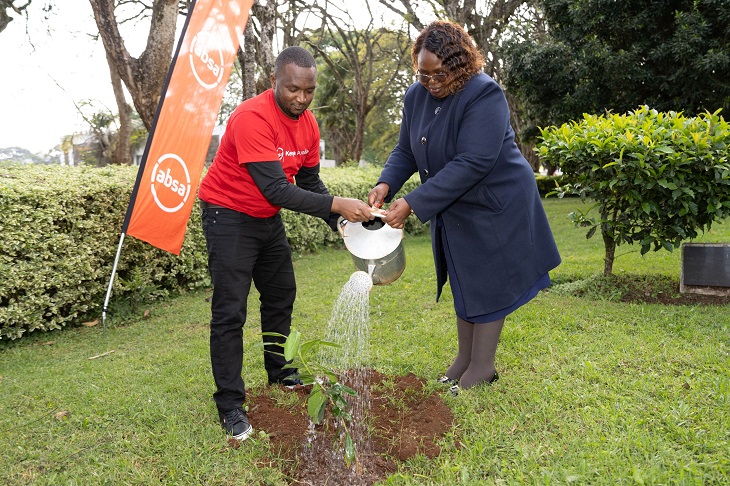
Every bank these days seems to be talking about “net zero.” It’s easy to hear the phrase, nod along, and move on with your banking. But buried in Absa Bank Kenya’s 2025 Sustainability and Climate Report is a target that will, whether customers notice it or not, start shaping the loans they get, the homes they can afford, and even the interest rates they pay in the years ahead. It’s worth unpacking what Absa is actually promising, and what it means for the ordinary customer.
Absa has committed to reaching net zero on its own operations, things like electricity use, fuel for its vehicle fleet, and generator diesel, by 2040. That’s the “easy” part, relatively speaking, because it’s mostly under the bank’s direct control. The harder, and arguably more consequential, commitment is to reach net zero on its financed emissions by 2050.
Financed emissions are the carbon footprint of everyone the bank lends to — from a manufacturer taking out a loan to a farmer financing new equipment. In other words, Absa isn’t just trying to green its own head office; it’s trying to green the businesses and households it funds.

To get there, the bank says it wants at least 30% of its total lending to qualify as “sustainable finance” by 2030, up from the roughly 30% of 2025’s loan disbursements already flowing that way. It has already put real money behind this: Shs 55.3 billion in sustainable finance and Shs 6.5 billion specifically in climate finance were disbursed in 2025 alone.
Is this just a corporate slogan?
First, Absa has started screening loans for climate and environmental risk. For its corporate and investment banking arm, 100% of transactions above USD 5 million now go through an environmental and social risk assessment. That means a business borrowing at that scale can expect its climate exposure to be part of the credit conversation, not an afterthought.
Second, the bank has begun running climate scenario analysis on its loan book, essentially stress-testing what happens to borrowers in agriculture, real estate, transport, and manufacturing if droughts, floods, or a disorderly shift away from fossil fuels hit harder than expected. Around 24% of the bank’s total loans sit in sectors it considers climate-sensitive, even after excluding ordinary home mortgages. That’s not a small slice of the business, it’s nearly a quarter.
Third, and most tellingly, the bank is embedding this into how it prices and designs products, not just how it manages risk.
What it means for you as a customer
If you’re buying or upgrading a home: Absa’s new Eco-Home Loan offers up to 110% financing, covering the property plus green upgrades like solar panels, water harvesting, and energy-efficient lighting, with repayment terms up to 25 years. If you were already planning to add solar or better insulation, this product effectively subsidises that decision rather than treating it as a discretionary extra.
If you run a business, especially in a “carbon-heavy” sector: Manufacturing, transport, and energy-intensive industries make up roughly 19% of Absa’s loan book. Expect more questions about your environmental footprint when you apply for financing, and potentially better terms if you’re already moving toward cleaner operations, or more scrutiny if you’re not.
If you’re a farmer, an SME owner, a woman entrepreneur, or a young person starting: The bank has tied its “sustainable finance” definition to financial inclusion as much as to solar panels. In 2025, it disbursed Shs 48.8 billion specifically for financial inclusion, reaching micro and small enterprises, women, youth, and underserved households. This is genuinely useful money, not just symbolic.
If none of this feels relevant to you today, it probably will eventually. As climate-related regulation from the Central Bank of Kenya tightens, and it is tightening, with new guidance on climate risk disclosure already shaping how banks lend, the cost and availability of credit across the whole economy will start reflecting climate exposure. A borrower whose business or home is more exposed to flooding or drought risk may, over time, face different terms than one who isn’t.
The honest caveat
Absa’s own numbers show climate finance disbursements dropped sharply from Shs 25 billion in 2022 to just Shs 4 billion in 2024, before recovering to Shs 6.5 billion in 2025. Targets and reality don’t always move in a straight line, and a 2050 promise is easy to make and hard to verify from the outside; the bank itself admits its sustainability disclosures haven’t yet been independently assured. Net zero, for now, is a direction of travel more than a guarantee. But for customers paying attention, it’s a direction worth watching, because it’s already showing up in the products on offer today.
Read Also: Airtel Money–Absa Partnership Unlocks Seamless Wallet-to-Bank Transfers For Kenyan SMEs
