Skip to content
Opinion

Kiambu Is Eating Its Future: Stop Burrying Kenya’s Food Security Beneath Concrete

BY Steve Biko Wafula · July 5, 2026 11:07 am

Kiambu is not just another county sitting next to Nairobi. For generations, it has been one of the capital city’s closest and most productive food sheds: a landscape of coffee, tea, dairy, poultry, vegetables, fruits and cereals that fed homes, sustained industries, earned export income and supported thousands of rural livelihoods.

Kiambu County’s own Annual Development Plan still describes agriculture as the backbone of rural livelihoods, anchored in coffee and tea farming, dairy production, horticulture and poultry. That is not sentimental history. It is an economic asset, a strategic advantage and a food-security shield located beside the country’s largest consumer market.

Yet we are steadily destroying that advantage with our own hands. Fertile farms are being subdivided into smaller plots, change-of-user approvals are opening agricultural zones to construction, and productive soil is being sealed beneath rows of apartments, shops, parking spaces and bed-sitters.

This is not an argument against housing, urban growth or the right of landowners to benefit from their property. People need homes and towns must expand. It is an argument against expansion without discipline, housing without spatial planning and short-term private gain being allowed to erase a long-term public necessity.

A bed-sitter can collect rent next month. A farm can feed families for generations. The first creates a private cash flow; the second creates food, jobs, raw materials, exports, ecological balance and national resilience. Responsible government must understand the difference and plan for both.

Once rich agricultural soil is covered by concrete, the loss is close to permanent. A demolished building can be rebuilt. A road can be redesigned. But an entire food-producing landscape fragmented by titles, access roads, septic tanks and dense settlement is extraordinarily difficult to restore.

The most disturbing part is that the danger is no longer hidden. Kiambu County’s latest planning documents openly list the conversion of agricultural land into commercial use, shrinking farm sizes caused by subdivision and real-estate development, and declining farmland as contributors to food insecurity. The county government knows the problem. The question is whether it has the political courage to stop enabling it.

Read Also: 6,000 Trees To Be Planted In Kiambu County Schools

Historical land-cover research in a defined northern Kiambu study area showed the direction of travel with frightening clarity. Agricultural land measured about 13,062 hectares in 1986 and 12,993 hectares in 2002, before falling to roughly 7,131 hectares by 2014. Over the same period, built-up land rose from only 281 hectares to approximately 8,718 hectares.
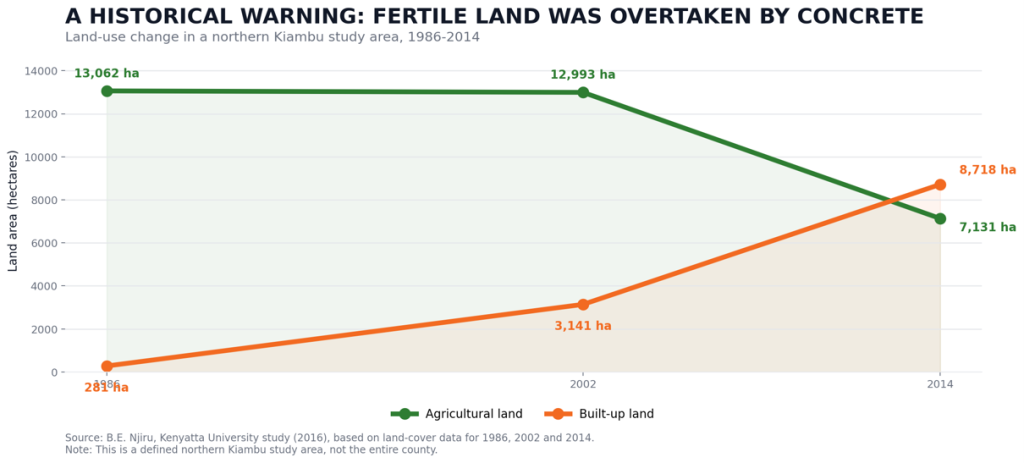
That study did not measure the entire county and its figures should not be misrepresented as present-day county totals. But the pattern is a powerful warning: when planning is weak, concrete does not merely surround farmland; it consumes it.

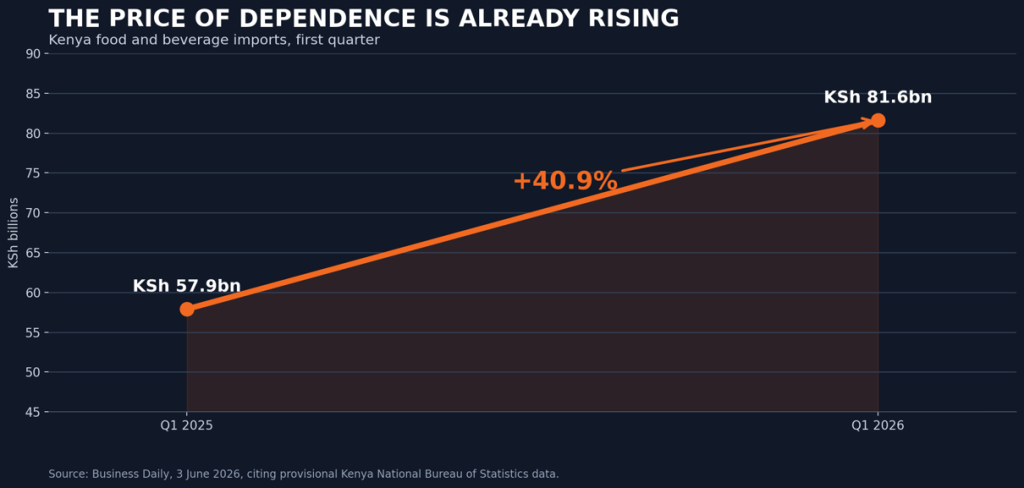
Today, the cost of that national neglect is becoming visible at the border and in the household budget. Provisional Kenya National Bureau of Statistics data reported in June 2026 showed that Kenya’s food and beverage import bill reached KSh 81.6 billion in the first quarter of 2026, up 40.9 per cent from KSh 57.9 billion in the same period of 2025.
Regional trade is not the enemy. Kenya should trade freely and productively with Uganda, Tanzania and the rest of Africa. But there is a dangerous difference between importing what we cannot efficiently produce and importing food because we deliberately destroyed the land that once produced it.

Food dependence is not development. It is vulnerability disguised as convenience. It exposes every Kenyan family to exchange-rate weakness, border disruptions, droughts in neighbouring countries, export restrictions, transport costs, fuel-price shocks and political disputes that are beyond our control.

A country that outsources an increasing share of its food while converting its best land into uncontrolled settlement is not modernising. It is consuming its future to finance the present.

The damage extends far beyond the price of unga, vegetables, milk or fruit. When farms disappear, farm workers lose jobs, cooperatives weaken, coffee factories lose volumes, milk coolers become underused, agro-dealers lose customers, transporters lose business, processors lose raw materials and young people lose an entire chain of possible livelihoods.

Kiambu’s political class must therefore stop treating every new building approval as automatic progress. A county is not developed merely because it has more concrete. Development means that people can live, work, eat, move and build wealth sustainably. Concrete without food, water, drainage, jobs and planning is not development; it is congestion with a title deed.

Landowners must also be treated fairly. Many sell or subdivide because farming has been made uncertain, expensive and unrewarding. Input prices are high, extension services are thin, markets are unreliable, post-harvest losses are painful and speculative property returns appear faster than agricultural income.

The answer is not to lecture farmers while abandoning them. The county and national governments must make productive agriculture commercially attractive through irrigation, aggregation, cold storage, extension services, affordable finance, crop insurance, processing, reliable markets and enforceable contracts.

But incentives alone will not be enough. Kiambu needs enforceable land-use boundaries. The law already empowers county governments to control land use and subdivision, regulate zoning and density, approve or reject developments, and reserve land for open spaces, urban forests and green belts. The Physical and Land Use Planning Act also demands the conservation of scarce land resources and the preservation of land with important functions.[4]

In other words, Kiambu’s leaders are not powerless. They are responsible. Every approval, subdivision and change of user is a policy choice. Every year without a credible agricultural-land protection regime is also a policy choice.

The county government should immediately place a temporary moratorium on new change-of-user approvals affecting mapped high-potential agricultural land until a transparent countywide audit is completed. That pause must not be used for extortion or selective enforcement; it must be rule-based, time-bound, public and subject to appeal.

Kiambu should publish a digital register of all agricultural parcels approved for subdivision or change of user, including the date, approving authority, planning justification and public-participation record. Secrecy is where poor planning, speculation and political favour thrive.

The county must establish protected agricultural zones and permanent green belts in areas whose soils, rainfall, water access and existing value chains make them strategically important. These zones should not be vague lines on a forgotten map. They must be backed by law, monitoring, satellite data, public reporting and consequences for unlawful development.

Housing demand should be directed toward already urbanised corridors, serviced centres and transport nodes, with higher-density vertical development where water, sewerage, roads and public transport can support it. The solution to population growth is not endless horizontal sprawl across productive farms.

Farmers who retain land in protected zones should receive something tangible in return: preferential rates, infrastructure, irrigation support, subsidised soil testing, aggregation services, guaranteed market linkages and access to county-backed value-addition facilities. Preservation cannot succeed if it becomes a financial punishment for the farmer.

Nairobi and Kiambu should also create a joint metropolitan food-shed strategy. Nairobi cannot plan housing, transport and markets as though the food supplying its millions of residents appears magically on supermarket shelves. The capital’s food security begins in the farms, roads, collection centres, cold rooms and water systems of neighbouring counties.

The Governor, County Executive, County Assembly, Members of Parliament, the Senate, the Ministry of Lands, the Ministry of Agriculture and the National Land Commission must stop passing responsibility around. Protecting productive land requires coordinated leadership, not speeches delivered after the damage is complete.

Citizens must demand an annual public account of how much agricultural land has been lost, how much has been protected, how many change-of-user applications were approved or rejected, and what impact those decisions are having on food production. What is not measured will be quietly destroyed.

This must become an election issue. Any leader seeking office in Kiambu should be asked a simple question: what exact land will you protect, what law will you enforce, how will you make farming profitable and how will you accommodate housing without sacrificing food security? General promises are no longer enough.

The political class must do the right thing now, not after the last coffee bush has been uprooted, the last dairy farm has been subdivided and the last vegetable field has become a parking lot. By then, press conferences, committees and emergency import waivers will not bring the soil back.

Kiambu can grow without committing agricultural self-destruction. It can build homes without erasing farms. It can create modern towns while protecting green belts. It can generate property wealth while preserving the food system that keeps Nairobi alive. But this balance will not happen by accident. It requires political courage, disciplined planning and a public willing to defend the future.

The warning is simple and urgent: concrete cannot be eaten. Titles cannot be boiled. Rent cannot replace a harvest when regional supplies fail and global prices rise. If Kiambu continues burying its most fertile land, Kenya will eventually discover that the most expensive food is the food a nation was once capable of producing for itself.

The time to act is not after the crisis. The time to act is before the next approval, before the next subdivision and before the next acre disappears forever.

Read Also: Kiambu Farmers Turn Dried Veggies into Global Business

Steve Biko is the CEO OF Soko Directory and the founder of Hidalgo Group of Companies. Steve is currently developing his career in law, finance, entrepreneurship and digital consultancy; and has been implementing consultancy assignments for client organizations comprising of trainings besides capacity building in entrepreneurial matters.He can be reached on: +254 20 510 1124 or Email: info@sokodirectory.com

Trending Stories
Related Articles
Explore Soko Directory
Soko Directory Archives