
When Africa Turns On Itself: Xenophobia Is The Fire, Failed Governance Is The Fire

There are moments when a continent must look into the mirror and refuse to lie to itself. The renewed xenophobic violence in South Africa is one of those moments. It is not merely a South African crisis. It is an African moral emergency, a political indictment and a warning about what happens when governments fail their people for too long and desperate citizens are taught to punish neighbours instead of confronting the systems that created their desperation.
It is devastating to see one African hunted, humiliated or attacked by another African because of an accent, a passport, a surname or a shop. The cruelty becomes even more painful when we remember that the borders separating us were largely drawn by colonial powers that did not ask our ancestors for permission. A person can cross a line on a map and suddenly be treated as an enemy by people who share the same history of conquest, extraction, poverty and resistance.
The latest violence cannot be dismissed as ordinary frustration. Human Rights Watch reported in May 2026 that vigilante groups had targeted African and Asian foreign nationals in several South African cities, sometimes violently and with an inadequate apparent response from authorities. The organisation also noted that migrants had been blocked from public services, including healthcare and education. This is not immigration enforcement. It is collective punishment carried out against vulnerable people whose guilt is often nothing more than being foreign and visible.[1]

South Africa has the sovereign right and duty to manage its borders, enforce immigration law and remove people who have no lawful status through due process. Every African state has that responsibility. But there is a moral and legal ocean between immigration administration and mob violence. A state governed by law cannot surrender its streets, clinics, schools and businesses to vigilantes who decide who deserves protection and who does not.
South Africa’s own constitutional order is built on human dignity, equality, freedom and the equal protection of the law. Its Bill of Rights repeatedly uses the word “everyone,” not “citizens only,” when protecting dignity, life and freedom from violence. Xenophobia therefore does not only betray African solidarity. It assaults the constitutional promise on which democratic South Africa was founded.[2]
The anger beneath the violence is real. Millions of South Africans are unemployed. Families are trapped between rising living costs, weak service delivery, insecurity and the humiliation of waking up every morning with no work to go to. Official unemployment stood at 32.7 percent in the first quarter of 2026. The broader measure of labour underutilisation was even more severe, reaching 46.3 percent. During that quarter alone, employment fell by 345,000 while the number of unemployed people increased by 301,000.
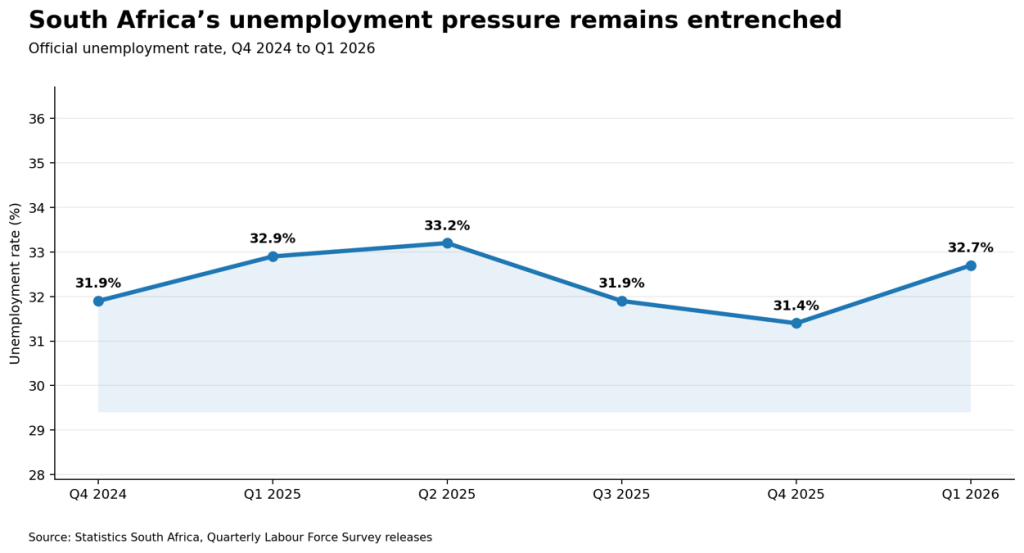
Figure 1: South Africa’s official unemployment rate remains above 30 percent, reinforcing the scale of the economic pressure confronting households.
Those numbers are not abstract. They mean empty kitchens, rent arrears, abandoned dreams, postponed marriages, children leaving school and adults losing faith in the promise that hard work will improve their lives. They create a society in which frustration can be manipulated. But hardship is an explanation for political volatility; it is never a licence to attack another human being.
The most dangerous political trick is to take a complicated national failure and give it a foreign face. It is easier to point at a migrant selling vegetables than to explain why industrial capacity has weakened, why local government is collapsing, why corruption survives, why electricity and logistics failures have constrained growth, why small businesses struggle for capital and why education often fails to connect young people to productive work.
A migrant did not design a failing municipality. A refugee did not loot a public procurement budget. A foreign-owned shop did not destroy a railway network, sabotage a power utility or approve a corrupt tender. When leaders encourage citizens to look downward at poorer outsiders instead of upward at institutions of power, xenophobia becomes a shield protecting failed governance from accountability.
The burden on South African youth is especially combustible. The official unemployment rate among people aged 15 to 34 rose to 45.8 percent in the first quarter of 2026. Almost one out of every two young people participating in the labour market could not find work. A generation without access to opportunity becomes vulnerable to despair, criminal recruitment, populism and political manipulation.
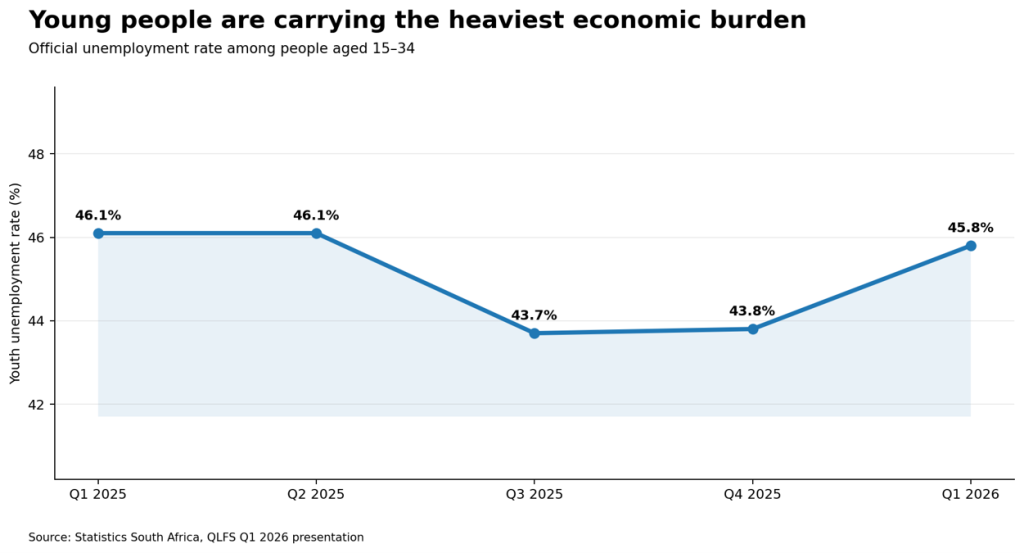
Figure 2: Youth unemployment remained above 43 percent throughout the period and reached 45.8 percent in Q1 2026.
This is why African governments must treat job creation as a national security obligation. A continent that produces millions of educated, energetic young people without creating productive pathways for them is manufacturing anger. Speeches about patriotism will not substitute for factories, functioning farms, affordable credit, reliable electricity, modern transport, accountable public institutions and markets that allow small enterprises to grow.
Yet even here, we must resist lazy causation. Unemployment does not automatically produce xenophobia, and migrants do not automatically produce unemployment. The relationship is political. Economic pain creates fear; opportunists then choose where to direct that fear. Responsible leadership directs it toward reform. Reckless leadership directs it toward scapegoats.
Crime is used in the same way. South Africa has a grave violent-crime problem, but crime is not a nationality. South African Police Service data recorded a steep rise in murders over the decade to 2022/23, from 17,023 in 2013/14 to 27,494 in 2022/23. More recently, 6,351 murders were recorded between October and December 2025. That was lower than the 6,953 recorded in the corresponding period a year earlier, but it still represented thousands of lives destroyed in only three months.
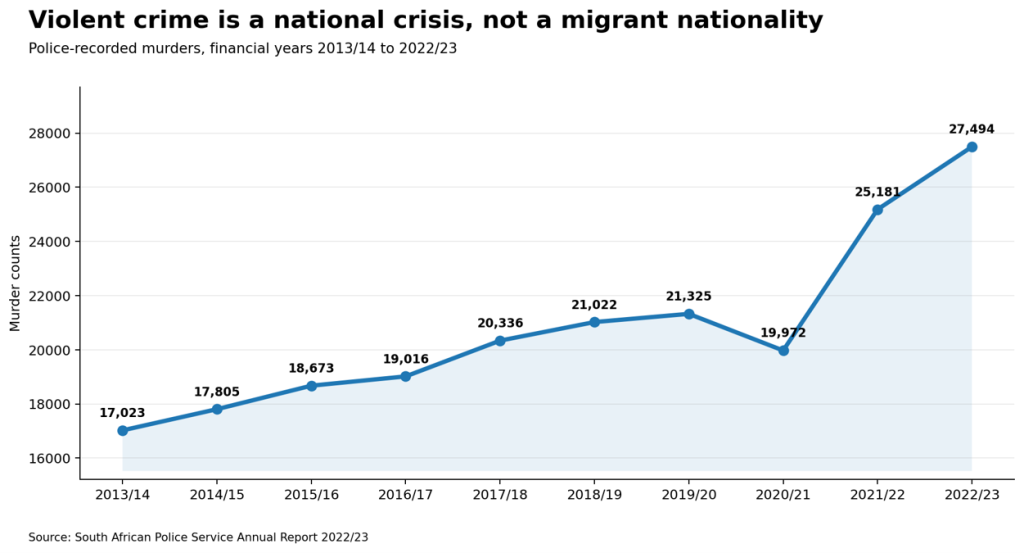
Figure 3: Police-recorded murders rose sharply over the decade to 2022/23, illustrating the depth of South Africa’s broader violence crisis.
Those figures demand a serious response: professional policing, intelligence-led investigations, functioning courts, community safety, control of illegal firearms, action against organised crime, and faster prosecution of violent offenders. They do not justify treating every foreigner as a criminal. Collective blame is not policing. It is prejudice wearing the uniform of public concern.
When a country blames foreigners for crime without evidence, real criminals benefit. Investigators stop asking who planned the robbery, who financed the syndicate, who protects the gang, who receives the bribe and who launders the proceeds. The conversation becomes emotionally satisfying but operationally useless. Fear receives a target while criminal networks continue functioning.
There is another painful contradiction. Democratic South Africa emerged from one of history’s most brutal systems of racial exclusion. Its liberation struggle inspired the world because it insisted that human dignity could not be restricted by race, origin or political power. Many African countries sheltered exiles, supported liberation movements and paid diplomatic, economic and human costs in solidarity with South Africans. That history does not give any African permanent ownership of South Africa, but it should make the dehumanisation of fellow Africans morally unbearable.
The correct lesson from this crisis is not that Africans must never move. Human mobility has always been part of African life. People migrate for work, education, marriage, safety, trade and ambition. The correct lesson is that African governments must make migration a choice rather than an escape route from unemployment, repression, corruption or collapsing public services.
Kenyans, Zimbabweans, Nigerians, Congolese, Mozambicans, Somalis and other Africans should be able to build dignified lives at home if they choose. That requires citizens to stop treating elections as tribal ceremonies or opportunities for short-term handouts. We must vote for competence, interrogate budgets, expose theft, demand functioning institutions and reject leaders who survive by dividing the poor.
Staying home cannot be preached as a duty while leaders steal the future. A young African cannot be lectured about patriotism by a political class that has exported its children, hidden wealth abroad, weakened local industry and left public hospitals without medicine. Government must earn belonging by making the nation livable.
South Africa must also confront xenophobia honestly rather than treating each outbreak as an isolated disturbance. The pattern has existed for years. In 2008, xenophobic violence killed 62 people, including South Africans and migrants. Further waves followed in 2015, 2019 and the early 2020s. When violence repeatedly returns, the problem is no longer spontaneous anger. It is an unresolved national vulnerability that requires law enforcement, civic education, political discipline and accountability.[1]
Political leaders must stop using migrants as campaign material. Words spoken from podiums travel into streets. When leaders describe whole communities as invaders, criminals or parasites, they create moral permission for ordinary people to commit extraordinary cruelty. Public office must never become a loudspeaker for dehumanisation.
The media also carries a duty. Every claim about migrants taking jobs, controlling crime or overwhelming services must be tested against evidence. Headlines must not convert rumours into facts or isolated crimes into ethnic indictments. Journalism should expose unlawful migration and government failure without turning an entire population into suspects.
African institutions must speak with greater courage. The African Union and regional bodies cannot celebrate integration in conference halls while Africans are attacked across borders. Continental unity is meaningless if it exists only in communiqués. Governments must protect their citizens abroad, cooperate on lawful migration systems and insist that attacks on foreigners are investigated and prosecuted.
This moment must awaken every African citizen. We cannot demand dignity in Europe, America or the Middle East while denying it to each other in Johannesburg, Nairobi, Lagos, Accra or Harare. We cannot condemn racism abroad and practise nationality-based hatred at home. Oppression does not become acceptable because the oppressor looks like us.
The enemy is not the struggling African next door. The enemy is corruption that steals hospitals, unemployment that kills hope, crime that empties homes, inequality that turns neighbourhoods into pressure cookers, and leadership that converts public failure into private hatred. The person running a small shop is not the architect of national decline. The politician who benefits from broken systems deserves more scrutiny than the migrant who is merely trying to survive them.
Africa must choose whether it will inherit the borders, prejudices and extraction systems imposed upon it, or build a future based on justice, productivity and shared humanity. Pan-Africanism cannot remain a slogan printed on conference banners. It must become protection for the vulnerable, opportunity for the young, lawful cooperation between states and accountability for leaders.
The answer to xenophobia is therefore both immediate and structural. Immediately, protect threatened communities, arrest attackers, prosecute organisers of violence, enforce immigration law lawfully and stop political incitement. Structurally, create jobs, rebuild institutions, punish corruption, strengthen local economies and give young people a genuine stake in society.
No African should have to die because another African has been failed by government. No leader should be allowed to hide incompetence behind a foreigner’s face. No citizen should confuse rage with justice. The day we begin attacking one another is the day those who benefit from our division win.
Ipo siku. A day will come when Africans understand that our future will not be secured by turning on each other, but by turning together against corruption, injustice, exclusion and failed governance. That awakening must begin now.
Read Also: The Secret in Helping Kenyan SMEs is Not in Xenophobia

About Steve Biko Wafula
Steve Biko is the CEO OF Soko Directory and the founder of Hidalgo Group of Companies. Steve is currently developing his career in law, finance, entrepreneurship and digital consultancy; and has been implementing consultancy assignments for client organizations comprising of trainings besides capacity building in entrepreneurial matters.He can be reached on: +254 20 510 1124 or Email: info@sokodirectory.com

- January 2026 (220)
- February 2026 (248)
- March 2026 (287)
- April 2026 (208)
- May 2026 (191)
- June 2026 (238)
- July 2026 (279)
- August 2026 (174)
- January 2025 (119)
- February 2025 (191)
- March 2025 (212)
- April 2025 (193)
- May 2025 (161)
- June 2025 (157)
- July 2025 (227)
- August 2025 (211)
- September 2025 (267)
- October 2025 (297)
- November 2025 (230)
- December 2025 (220)
- January 2024 (238)
- February 2024 (227)
- March 2024 (190)
- April 2024 (133)
- May 2024 (157)
- June 2024 (145)
- July 2024 (136)
- August 2024 (154)
- September 2024 (212)
- October 2024 (255)
- November 2024 (196)
- December 2024 (143)
- January 2023 (182)
- February 2023 (203)
- March 2023 (322)
- April 2023 (297)
- May 2023 (267)
- June 2023 (214)
- July 2023 (212)
- August 2023 (257)
- September 2023 (237)
- October 2023 (264)
- November 2023 (286)
- December 2023 (177)
- January 2022 (293)
- February 2022 (329)
- March 2022 (358)
- April 2022 (292)
- May 2022 (271)
- June 2022 (232)
- July 2022 (278)
- August 2022 (253)
- September 2022 (246)
- October 2022 (196)
- November 2022 (232)
- December 2022 (167)
- January 2021 (182)
- February 2021 (227)
- March 2021 (325)
- April 2021 (259)
- May 2021 (285)
- June 2021 (272)
- July 2021 (277)
- August 2021 (232)
- September 2021 (271)
- October 2021 (303)
- November 2021 (364)
- December 2021 (249)
- January 2020 (272)
- February 2020 (310)
- March 2020 (390)
- April 2020 (321)
- May 2020 (335)
- June 2020 (327)
- July 2020 (333)
- August 2020 (276)
- September 2020 (214)
- October 2020 (233)
- November 2020 (242)
- December 2020 (187)
- January 2019 (251)
- February 2019 (215)
- March 2019 (283)
- April 2019 (254)
- May 2019 (269)
- June 2019 (249)
- July 2019 (335)
- August 2019 (292)
- September 2019 (306)
- October 2019 (313)
- November 2019 (362)
- December 2019 (318)
- January 2018 (291)
- February 2018 (213)
- March 2018 (275)
- April 2018 (223)
- May 2018 (235)
- June 2018 (176)
- July 2018 (256)
- August 2018 (247)
- September 2018 (255)
- October 2018 (282)
- November 2018 (282)
- December 2018 (184)
- January 2017 (183)
- February 2017 (194)
- March 2017 (207)
- April 2017 (104)
- May 2017 (169)
- June 2017 (205)
- July 2017 (189)
- August 2017 (195)
- September 2017 (186)
- October 2017 (235)
- November 2017 (253)
- December 2017 (266)
- January 2016 (164)
- February 2016 (165)
- March 2016 (189)
- April 2016 (143)
- May 2016 (245)
- June 2016 (182)
- July 2016 (271)
- August 2016 (247)
- September 2016 (233)
- October 2016 (191)
- November 2016 (243)
- December 2016 (153)
- January 2015 (1)
- February 2015 (4)
- March 2015 (164)
- April 2015 (107)
- May 2015 (116)
- June 2015 (119)
- July 2015 (145)
- August 2015 (157)
- September 2015 (186)
- October 2015 (169)
- November 2015 (173)
- December 2015 (205)
- March 2014 (2)
- March 2013 (10)
- June 2013 (1)
- March 2012 (7)
- April 2012 (15)
- May 2012 (1)
- July 2012 (1)
- August 2012 (4)
- October 2012 (2)
- November 2012 (2)
- December 2012 (1)