
Why The Hardest Part Of Investing Is Not Finding The Perfect Asset, But Becoming The Person Who Can Keep Building Capital Through Every Milestone

Investing is a series of firsts. The first time you buy a share, a Treasury bond, a money-market fund, a unit trust or any productive asset, you cross an invisible line. You stop being only a consumer of money and begin becoming an owner of capital. The amount may be small, but the identity shift is enormous: part of your income is no longer being spent to solve today alone; it has been assigned the duty of building tomorrow.
That is why the first KSh 50,000 invested can be the most psychologically testing money you will ever accumulate. It is usually built when your salary still feels insufficient, emergencies are frequent, temptations are loud and the reward is almost invisible. You may contribute for months, open your statement and wonder why the balance does not yet look impressive. At this stage, the investment is not mainly testing your intelligence. It is testing whether your future can defeat your appetite for immediate comfort.
KSh 50,000 is small enough for the world to dismiss but large enough to prove that you can keep a promise to yourself. It teaches you that wealth begins before wealth becomes visible. The real return from this first milestone is discipline: the ability to earn money, separate a portion from your lifestyle, place it in a productive instrument and leave it untouched long enough to develop roots.

Your first KSh 100,000 feels different. The figure finally has weight. You begin to understand that the process is not a motivational slogan; it can actually work. The account can now absorb a bad week without collapsing. A dividend, distribution or interest payment becomes noticeable. You have evidence that money can produce money, even though the production is still modest.
This is also a dangerous stage because excitement can mutate into impatience. Once people see progress, some begin chasing shortcuts. They abandon a sound plan to pursue rumours, fashionable assets or promises of extraordinary returns. The first KSh 100,000 should deepen your respect for process, not seduce you into gambling. Capital that took months to build can be destroyed in minutes when conviction is replaced by greed.
The first KSh 250,000 is often the most difficult milestone because the novelty has disappeared but the portfolio is not yet large enough to feel life-changing. Consistency becomes repetitive. Friends may appear to be living better. New obligations arrive. You may be tempted to withdraw the money for a car deposit, a holiday, a phone upgrade or an avoidable emergency created by poor planning. This is the long middle, where many investment journeys quietly die.
Yet KSh 250,000 is where financial character begins to harden. You learn that successful investing is frequently boring. It is standing orders, automatic deductions, reinvested distributions, controlled fees, patient asset selection and the refusal to interrupt a good strategy because the market or social media has become noisy. The portfolio grows because you keep feeding it when nobody is applauding.
At KSh 500,000, conviction starts to mature. Half a million shillings is not financial freedom, but it is no longer an experiment. It is proof of capacity. You have shown that you can build a meaningful pool of capital from ordinary cash flows. More importantly, your decisions begin to change. You compare purchases with the return that money could have generated. You start asking whether an expense improves your life or merely advertises a lifestyle.
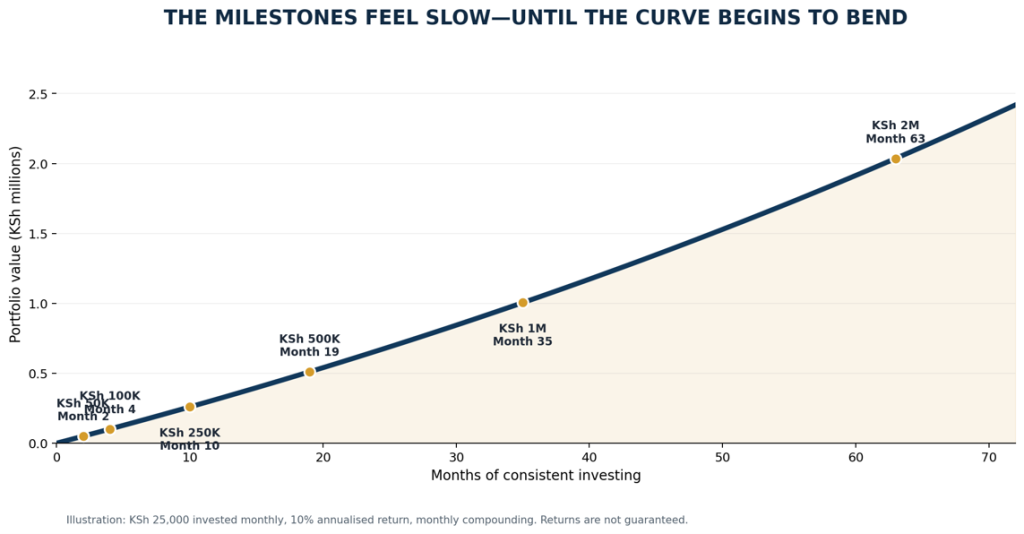
Figure 1: An illustrative path through the six milestones. Early progress is driven mainly by contributions; the curve gradually steepens as the portfolio base grows.
The first KSh 500,000 also teaches diversification. The question is no longer only how to save, but how to allocate. How much should remain liquid? How much can accept market volatility? What belongs in fixed income, equities, property, business or other assets? At this stage, good investing becomes less about finding one magical product and more about constructing a portfolio in which each asset has a clear job.
Then comes the first KSh 1,000,000. For many investors, this is the moment the journey becomes emotionally real. A million shillings is not an automatic passport to wealth, but it creates a meaningful buffer. It can generate returns that are visible, absorb market movements without instantly threatening your entire plan and give you room to think beyond survival. You are no longer trying to prove that you can start. You are proving that you can sustain.
The first million changes your relationship with risk. Before it, every loss may feel personal and every market decl