
Increase Govt Expenditure to compensate for reduced Credit Growth – Analysts

The Kenyan Government intends to increase its budget on infrastructure, education, health and social safety net and preparations for the elections the 2017/18 Fiscal Year.
The National Treasury’s ‘2017 Budget Policy Statement’ states that the areas outlined ‘remains a priority so as to realise benefits and maintain positive growth momentum, create jobs, reduce poverty and inequality.”
Financial and economic analysts have projected a positive outlook on Kenya with expectations of continued policy reforms reducing government debt to cut its soaring fiscal deficit.

The Central Bank of Kenya says Kenya has been found in an age of uncertainty attributed to a lack of predictability on US policy on trade that is likely to impact it economy.
“We have adequate buffers in case of any eventuality including a USD1.5 billion standby loan facility with the International Monetary Fund to cushion. There could be some headwinds. The most significant ones still remain the external environment,” said Dr. Patrick Njoroge, CBK Governor during a media briefing.
CBK, Cytonn Investments, Britam Asset Managers projected the economy to grow by 5.7%, 5.4% – 5.7% and 5.0% – 5.6% in 2017 respectively from about 5.9 percent in 2016.
Regionally, with global uncertainty, fueled by Brexit’s potential ripple effect to the European Union, major elections in the Eurozone – France and Germany-, the anticipated US policies after the election President Donald Trump, stability in oil prices and global trade slowdown, Kenya is projected to outperform the rest of Sub-Saharan Africa over 2017-2018.
Read: US President Donald Trump Hints on Plans for Africa
BMI Research says the primary growth driver will be the continued expansion of the transport network, improvements to power generation capacity and the growing real estate sector in Nairobi underpin our very positive outlook on the Kenyan construction sector.
However, “Kenya’s real GDP growth will decelerate over the coming quarters as credit growth remains weak following the government’s cap on lending rates. Even so, the outlook for economic activity remains largely positive, and an election in August and relatively low short-term borrowing costs open the door to some fiscal stimulus to offset slower credit growth.
According to a report released on Thursday by Britam Asset Managers, the government needs to grow its expenditure by the targeted 16.4 percent this fiscal year, and achieve the expected 17.6 percent increase in revenues in order to meet the projected economic growth. The government must therefore spend to sustain GDP growth above 5.0 percent in 2017, as private sector credit growth remains subdued.
However, the report points out that economic activity is expected to slow down, 2017 being an election year. Historically, Kenya’s elections years have been associated with low GDP growth, as the polls delay private sector investments due to political uncertainty.

According to the report, other factors likely to affect economic growth include high inflation, drought, and increased global oil prices.
Heading into 2017, food inflation is expected to be the main driver of overall inflation with cost of transport and household items also going up. Matatu fares, petrol prices, Kerosene and electricity respectively will affect inflation significantly.
Read: Food Inflation Expected to Remain High
Speaking during the release of the report themed “Sustaining Growth in a Resilient Economy” in Nairobi, Britam Asset Managers CEO Kenneth Kaniu said that unfavourable climatic conditions and drought are expected to affect agricultural productivity, increase electricity costs and reduce the availability of water.

“We expect the above factors to culminate in upward pressure on overall inflation in 2017. Inflation will therefore trend towards the upper range of CBK’s target of 7.5% in 2017,” said Kaniu.
Effect of Interest Caps
The report observes sluggish growth in the private sector due to the introduction of the law capping bank interest rates in 2016, with the sector posting a slowed growth of 4% in Q4 in 2016 from 18% in Q4 2015.
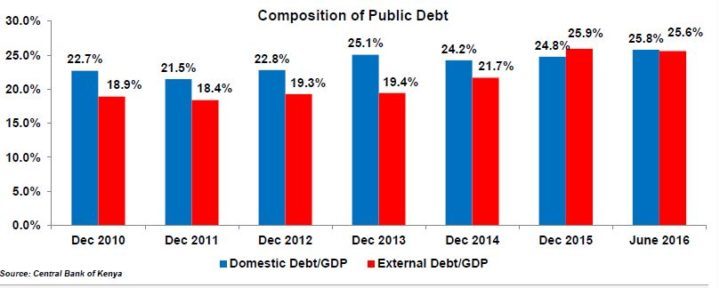
The report recommends that the government should keep directing most of its foreign debt towards development expenditure in order to meet future interest payments, noting that the country’s external debt has steadily increased from 18.9% as a percentage of GDP in 2010 to 25.6% as at June 2016.
The report notes that Kenya has historically underperformed on development expenditure relative to recurrent expenditure, with the 2017 fiscal year targeted development expenditure of 8.3% of GDP being lower than regional peers. The government will therefore need to meet its development expenditure targets during the current fiscal year in order to sustain economic growth.
Related:
- Kenya Risks Being Downgraded Due to Swelling Debt
- Tough Times Ahead if Ever Increasing National Debt is not Tamed, Warns World Bank
The resilience of the shilling
The report also notes that despite an increase in the cost of oil and the declining performance of Nairobi Securities Exchange, Kenya’s currency remained one of the most resilient in Sub-Saharan Africa in the last two decades, with an annualized depreciation rate of around 4.0%. In effect, the shilling has outperformed even currencies pegged to the US Dollar such as the Nigerian Naira and Egyptian Pound.
Globally, the report says that growth is expected to pick up slightly in 2017 as commodity exporters benefit from stable prices. Fiscal stimulus in developed countries is also expected to support growth.
Following a decision by OPEC member countries to cut oil production by 1.8 million barrels a day, crude oil prices are forecast to increase in 2017. However, upward pressure on crude oil prices will be counteracted by increased supply from the US.
On international trade, the report notes that Kenyan exports to the UK made up 7% of the country’s total exports in 2015 and 2016, underscoring the importance of the trade ties to the Kenyan economy. However, nationalist sentiments in the UK after Brexit, and attendant currency weakness risks has made Kenyan exports to the UK uncompetitive.

About David Indeje
David Indeje is a writer and editor, with interests on how technology is changing journalism, government, Health, and Gender Development stories are his passion. Follow on Twitter @David_IndejeDavid can be reached on: (020) 528 0222 / Email: info@sokodirectory.com

- January 2026 (220)
- February 2026 (243)
- March 2026 (62)
- January 2025 (119)
- February 2025 (191)
- March 2025 (212)
- April 2025 (193)
- May 2025 (161)
- June 2025 (157)
- July 2025 (227)
- August 2025 (211)
- September 2025 (270)
- October 2025 (297)
- November 2025 (230)
- December 2025 (219)
- January 2024 (238)
- February 2024 (227)
- March 2024 (190)
- April 2024 (133)
- May 2024 (157)
- June 2024 (145)
- July 2024 (136)
- August 2024 (154)
- September 2024 (212)
- October 2024 (255)
- November 2024 (196)
- December 2024 (143)
- January 2023 (182)
- February 2023 (203)
- March 2023 (322)
- April 2023 (297)
- May 2023 (267)
- June 2023 (214)
- July 2023 (212)
- August 2023 (257)
- September 2023 (237)
- October 2023 (264)
- November 2023 (286)
- December 2023 (177)
- January 2022 (293)
- February 2022 (329)
- March 2022 (358)
- April 2022 (292)
- May 2022 (271)
- June 2022 (232)
- July 2022 (278)
- August 2022 (253)
- September 2022 (246)
- October 2022 (196)
- November 2022 (232)
- December 2022 (167)
- January 2021 (182)
- February 2021 (227)
- March 2021 (325)
- April 2021 (259)
- May 2021 (285)
- June 2021 (272)
- July 2021 (277)
- August 2021 (232)
- September 2021 (271)
- October 2021 (304)
- November 2021 (364)
- December 2021 (249)
- January 2020 (272)
- February 2020 (310)
- March 2020 (390)
- April 2020 (321)
- May 2020 (335)
- June 2020 (327)
- July 2020 (333)
- August 2020 (276)
- September 2020 (214)
- October 2020 (233)
- November 2020 (242)
- December 2020 (187)
- January 2019 (251)
- February 2019 (215)
- March 2019 (283)
- April 2019 (254)
- May 2019 (269)
- June 2019 (249)
- July 2019 (335)
- August 2019 (293)
- September 2019 (306)
- October 2019 (313)
- November 2019 (362)
- December 2019 (318)
- January 2018 (291)
- February 2018 (213)
- March 2018 (275)
- April 2018 (223)
- May 2018 (235)
- June 2018 (176)
- July 2018 (256)
- August 2018 (247)
- September 2018 (255)
- October 2018 (282)
- November 2018 (282)
- December 2018 (184)
- January 2017 (183)
- February 2017 (194)
- March 2017 (207)
- April 2017 (104)
- May 2017 (169)
- June 2017 (205)
- July 2017 (189)
- August 2017 (195)
- September 2017 (186)
- October 2017 (235)
- November 2017 (253)
- December 2017 (266)
- January 2016 (164)
- February 2016 (165)
- March 2016 (189)
- April 2016 (143)
- May 2016 (245)
- June 2016 (182)
- July 2016 (271)
- August 2016 (247)
- September 2016 (233)
- October 2016 (191)
- November 2016 (243)
- December 2016 (153)
- January 2015 (1)
- February 2015 (4)
- March 2015 (164)
- April 2015 (107)
- May 2015 (116)
- June 2015 (119)
- July 2015 (145)
- August 2015 (157)
- September 2015 (186)
- October 2015 (169)
- November 2015 (173)
- December 2015 (205)
- March 2014 (2)
- March 2013 (10)
- June 2013 (1)
- March 2012 (7)
- April 2012 (15)
- May 2012 (1)
- July 2012 (1)
- August 2012 (4)
- October 2012 (2)
- November 2012 (2)
- December 2012 (1)