
Big Harvests And Milk Are Magic Pills Against Conflict In Africa
KEY POINTS
In Africa where ethnic, regional, and religious divisions have weakened democracy and frayed nations, food is one of the most bipartisan issues.
KEY TAKEAWAYS
Adapting heat-tolerant wheat varieties, Ethiopia boosted its cultivated areas of wheat production from 50,000 hectares in 2018, is now producing wheat on 650,000 hectares, and is on track to cultivating 2 million hectares in 2023. It harvested 2.6 million tons and plans to begin exporting to Kenya and Djibouti next year.
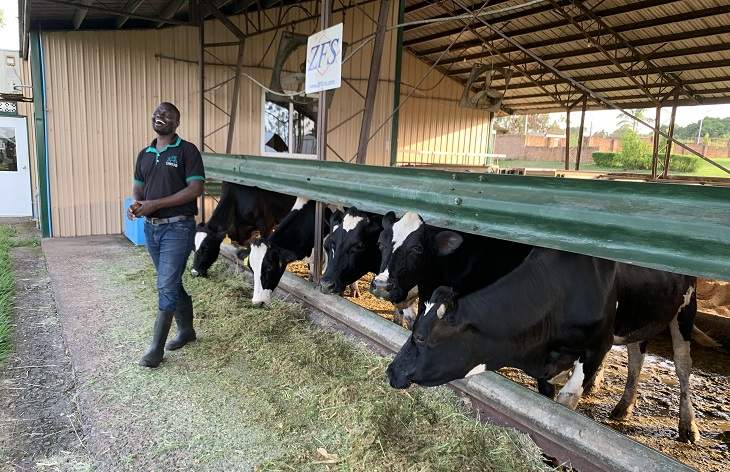
At the edge of Gulu city in northern Uganda, lies Gulu Country Dairy, founded by a youthful maverick veterinary doctor, Tonny Kidega.
Kidega is a unicorn of sorts; he is possibly the only Ugandan farmer who has consistently sold a liter of raw milk for between Shillings 2,000 (US$0.54) and 3,000 (US$ 0.81). In other parts of the country, dairy farmers are making do with an average of Sh700 (US$0.19). “We are obsessive about the quality of our milk. It has a signature, and our customers expect it and pay for it”, Kidega said.
The feeding and milking of the cattle are meticulous. The cows are machine-milked, and no human hands touch the milk. There is hardly any smell in the cattle pens although the cows stomp on a messy dung and urine blend on the floor of the pen.

“That mess is gold”, Kidega said. “We scoop it up three times a day, and sort it between what goes into the biogas tanks and the manure spreader.”
From the biogas tanks, trenches slope down into an extensive maize garden. The maize is densely green and strikingly tall. It, and the grass that is growing everywhere around the farm, are shredded daily into feed for the cows.
Nearby are lines of slightly raised walls with cement floors, and covered with tarpaulins. They hide one of the secrets of Kidega’s success – cattle feed. He’s stacked up enough of the feed to last two dry seasons.
Related Content: Over 2 million people in Kenya face acute hunger due to drought, warns IRC
It is in the data
At the unit that houses the milk processors, he has a circular chart with many numbers, arrows, and color codes. It is a schedule of when the cows are expected to the calf. He’s timed most of it to happen in projected dry seasons when other farmers run out of feed and their animals are least productive. It is a data-heavy operation, and Kidega uses the numbers to deadly effect.
Pre-Covid, the farm had 40 animals with 20 milking cows. Because of having to respond to the pandemic, and seeking higher productivity, he’s brought the number down to just 15, which gives him 320 litres of milk a day, only shy of what he used to get with 20. He is looking to breed the number down further – and get more milk. “We push and innovate very hard for productivity, and you can see how that is important for profitability if I am getting nearly the same amount of milk from a handful of cows that I used to get from a larger herd”, he said.
Kidega’s house is barely 80 meters from the cattle pens and small plant. Gulu Country Dairy represents the kind of clever, efficient, and climate-smart farming that could turn around Africa’s agricultural fortunes. And Kidega is a model of the youthful innovative farmer experts believe are needed to engineer an agricultural revolution.
We sit on an overgrown lawn (“you can’t mow this lawn, this grass is money”, he says) behind a long building that serves as a training facility for farmers as the sun sets. Here, he has farmers coming from as far as Kenya and Tanzania, sometimes just to workshop a problem they are facing. To our left is the home where Kidega lives with his wife and two children. The children are making loud happy noises.
“You know, my children are home-schooled”, he says, “and they play around climbing trees, and even in the cattle pens. They love cows, and in 15 years, I think they will be years ahead of their peers”, he says with some satisfaction.
Bitter-sweet Fairy Tale
The maize garden juts against the sunset like a small forest. An ecosystem of small innovative farms has cropped up around Kidega’s establishment, and on the gentle hillsides across they stand out in the dusk, brightly lit. It is serene. This is a fairy tale. Except it wasn’t always. It is a story of pain and overcoming horror, and the testimony to the fact that conflict-wracked societies where people have been driven to starvation, can stage a comeback.
Twenty years ago, Gulu was one of many areas in northern Uganda where the smell of death stifled the air.
A peculiarly brutal rebellion by Joseph Kony’s Lord’s Resistance Army (LRA) left nearly 2 million people internally displaced, killed over 100,000 people, and saw the abduction of between 60,000 to 100,000 children, and the rape of thousands of young girls abducted and women raped.
The region descended into hell. The local economy collapsed, and its agricultural fields were abandoned and grew wild. In the years since the war ebbed in 2002, and finally ended in 2006, northern Uganda has staged a remarkable recovery. The region has become the breadbasket of war-ravaged South Sudan.
As a child, Kidega was a victim of the LRA war. He spent two years on the run with his family, hiding out for most of that period in the bushes near the border with South Sudan. He has come a long way.
In a time when the African Union says the disruption of grain exports caused by the Russia-Ukraine war risks a “catastrophic scenario” of food shortages and skyrocketing price rises, Gulu Country Dairy looks like an outlier.
The Russia-Ukraine War Shock
Nearly 350 million Africans, more than a quarter of the continent’s population, were already suffering from hunger because of conflict, drought, and poverty before the Russia-Ukraine came along to worsen the food insecurity crisis. Grain supplies have been disrupted, and the prices of staples and fuel are skyrocketing.
Several countries are major wheat importers and buy much of their supply from Russia and Ukraine. Ukraine and/or Russia provide nearly 100 percent of Somalia’s and Benin’s wheat imports, 80 percent of the Democratic Republic of Congo’s and Egypt’s, and over 60 percent for several countries including Rwanda and Uganda.
Sanctions against Russia, port and sea routes, and fighting have disrupted exports.
In late May, the African Development Bank (AfDB) was already reporting a 45 percent increase in wheat prices on the continent.
With prewar Russia and Ukraine together exporting 28 percent of the world’s fertilizers made from nitrogen and phosphorous, as well as potassium, the shocks came very quickly. Fertilizer prices doubled in the East African region from their levels a year ago within two months after the Russian invasion of Ukraine.
Fuel prices, so critical to the cost of food production and transport, are 25 percent and 40 percent more expensive in many parts of Africa than a year ago.
Ghosts that haunt Africa’s fields
These crises have found long-term structural problems that bedevil Africa’s food security and agricultural production. Africa is the only continent that imports more food than it produces, moving from a net exporter of agricultural products in the 1990s to the net importer it is today.
In addition to the around 350 million Africans who were already going to bed hungry every night in the wake of the Covid-19 pandemic, although, for example, Sub-Saharan Africa produced a lot more cereal in 2018 than it did three decades earlier, the pace of agricultural growth on the continent is not keeping up with population growth.
Increased food demand and changing consumption habits are leading to the rapidly rising net food imports, which, according to the AfDB, are expected to grow from $43 billion in 2019 to over $110 billion by 2025.
The increase in the density of the rural population in most of Sub-Sahara has brought more land pressure and significantly impacted agricultural systems resulting in a reduction in the size of farms, and their fragmentation.
It has been noted that in Asia, a similar situation led to agricultural intensification, resulting in an increase in agricultural yields. In Africa, increases in production have mostly been the result of increasing the area under cultivation. It was the only developing region in which the percentage of area expansion exceeded growth in yield over the period 1990–2007.
Several factors are responsible for this. Among others, Gro Intelligence notes that fertilizer application rates in sub-Saharan Africa (for both chemical and organic fertilizers) are low relative to the rest of the world. In 2006, average fertilizer use in Africa was about 8 kilograms per hectare—a tenth of the global average. Partly as a result of this, crop yields in sub-Saharan Africa are significantly below that of other regions.
Although Sub-Saharan Africa dedicates nearly as much land to growing corn as the U.S.A., it produces only a sixth of U.S.A. output.
Additionally, little land on the continent is irrigated. Of the 183 million hectares of cultivated land in Sub-Saharan Africa, 95 percent is rain-fed and less than 5 percent benefits from some sort of agricultural water management practice—by far the lowest irrigation development rate of any region in the world.
Other modern methods and inputs are also exceedingly underutilized. Africa’s farm systems are the least mechanized in the world, and the continent has by far, the lowest rate of improved seed use of any region.
The Forest and Trees
However, while the outlook for the African agricultural forest might seem grim, it is littered with hopeful trees.
As a December 2020 Brookings Institution research report noted that the “alarming narrative” of Sub-Saharan Africa’s spiraling food import bill is misleading, and at best inaccurate. Four countries—Nigeria, Angola, the Democratic Republic of the Congo (DRC), and Somalia—account for most of SSA’s net agricultural import position. The rest of most of the countries in the region are actually net agricultural exporters.
And several countries have posted impressive increases in some agricultural products. Ghana increased local annual rice production from 150,000 metric tons in 2016 to 655,000 MTs in 2019 as part of plans to become self-sufficient.
Despite the headlines and the Tigray war, Ethiopia has reported that it has not imported wheat this year. Adapting heat-tolerant wheat varieties, Ethiopia boosted its cultivated areas of wheat production from 50,000 hectares in 2018, is now producing wheat on 650,000 hectares, and is on track to cultivating 2 million hectares in 2023. It harvested 2.6 million tons and plans to begin exporting to Kenya and Djibouti next year.
Risks and possibilities
In the near term, though, the risks remain for most of the continent.
According to the Armed Conflict Location & Event Data Project (ACLED), rather than wars and insurgencies, riots and protests now account for over half of violent events in Africa.
Recent violent protests sparked by domestic price increases in Sierra Leone illustrate how inflationary pressures can easily foment instability. Also, memories are still not too distant of how food prices sparked the Arab Spring uprisings in the early 2010s across North Africa.
In Kenya and South Africa, gangs are filling their ranks with desperate young people who find them to be the only organizations that will give them a day’s meal.
Hunger is also fuelling militarisation (((***note, it is MILIATIANISATION, not MILITARISATION)))))) and the growth of extremist violent groups in regions like the Sahel, where a climate change crisis has exacerbated food insecurity. Joining an extremist group, which plunders and murders for food, is a surer way for some to a meal ticket.
In Gulu, Kidega reflects that the magic pills against these tensions and threats are in Africa’s farms.
Related Content: The Hunger Menace In East Africa; Case Study Of Kenya
“Increased yields have major social and political benefits”, he said. “It helps reduce conflict over land because you are able to produce twice or more as much on the same plot so you don’t need to grab another”.
Food also has a flip side. The hungry might take to the barricades and revolt against the government of the day, but in Africa where ethnic, regional, and religious have weakened democracy and frayed nations, food is one of the most bipartisan issues. It holds out the possibilities to organize a new type of politics.
As Agnes Kalibata, the president of the Nairobi-headquartered Alliance for a Green Revolution in Africa (AGRA) put it; “We learned from the last food crisis [2007-2008] that we should not be afraid of a food crisis. What we should be worried about is lack of action once we understand the problem.”
In the coming weeks in these series, then, we will examine how a continent with 60 percent of the world’s arable land might be able to feed itself again as it once did. Who are the innovative men, women, and organizations making that possible? How could African countries with food surpluses supply those with deficits? And what will be the rewards for those who succeed in putting food in more African mouths?
Related Content: Africa Requires USD 2.8 Trillion By 2030 to Meet Climate Finance Goals
The author, Charles Onyango-Obbo, is a journalist, writer, and curator of the “Wall of Great Africans”. Twitter@cobbo3

About Soko Directory Team
Soko Directory is a Financial and Markets digital portal that tracks brands, listed firms on the NSE, SMEs and trend setters in the markets eco-system.Find us on Facebook: facebook.com/SokoDirectory and on Twitter: twitter.com/SokoDirectory

- January 2026 (220)
- February 2026 (248)
- March 2026 (287)
- April 2026 (207)
- May 2026 (192)
- June 2026 (238)
- July 2026 (279)
- August 2026 (223)
- September 2026 (95)
- January 2025 (119)
- February 2025 (191)
- March 2025 (212)
- April 2025 (193)
- May 2025 (161)
- June 2025 (157)
- July 2025 (227)
- August 2025 (211)
- September 2025 (267)
- October 2025 (297)
- November 2025 (230)
- December 2025 (220)
- January 2024 (238)
- February 2024 (227)
- March 2024 (190)
- April 2024 (133)
- May 2024 (157)
- June 2024 (145)
- July 2024 (136)
- August 2024 (154)
- September 2024 (212)
- October 2024 (255)
- November 2024 (196)
- December 2024 (143)
- January 2023 (182)
- February 2023 (203)
- March 2023 (322)
- April 2023 (297)
- May 2023 (267)
- June 2023 (214)
- July 2023 (212)
- August 2023 (257)
- September 2023 (237)
- October 2023 (264)
- November 2023 (286)
- December 2023 (177)
- January 2022 (293)
- February 2022 (329)
- March 2022 (358)
- April 2022 (292)
- May 2022 (271)
- June 2022 (232)
- July 2022 (278)
- August 2022 (253)
- September 2022 (246)
- October 2022 (196)
- November 2022 (232)
- December 2022 (167)
- January 2021 (182)
- February 2021 (227)
- March 2021 (325)
- April 2021 (259)
- May 2021 (285)
- June 2021 (272)
- July 2021 (277)
- August 2021 (232)
- September 2021 (271)
- October 2021 (303)
- November 2021 (364)
- December 2021 (249)
- January 2020 (272)
- February 2020 (310)
- March 2020 (390)
- April 2020 (321)
- May 2020 (335)
- June 2020 (327)
- July 2020 (333)
- August 2020 (276)
- September 2020 (214)
- October 2020 (233)
- November 2020 (242)
- December 2020 (187)
- January 2019 (251)
- February 2019 (215)
- March 2019 (283)
- April 2019 (254)
- May 2019 (269)
- June 2019 (249)
- July 2019 (335)
- August 2019 (292)
- September 2019 (306)
- October 2019 (313)
- November 2019 (362)
- December 2019 (318)
- January 2018 (291)
- February 2018 (213)
- March 2018 (275)
- April 2018 (223)
- May 2018 (235)
- June 2018 (176)
- July 2018 (256)
- August 2018 (247)
- September 2018 (255)
- October 2018 (282)
- November 2018 (282)
- December 2018 (184)
- January 2017 (183)
- February 2017 (194)
- March 2017 (207)
- April 2017 (104)
- May 2017 (169)
- June 2017 (205)
- July 2017 (189)
- August 2017 (195)
- September 2017 (186)
- October 2017 (235)
- November 2017 (253)
- December 2017 (266)
- January 2016 (164)
- February 2016 (165)
- March 2016 (189)
- April 2016 (143)
- May 2016 (245)
- June 2016 (182)
- July 2016 (271)
- August 2016 (247)
- September 2016 (233)
- October 2016 (191)
- November 2016 (243)
- December 2016 (153)
- January 2015 (1)
- February 2015 (4)
- March 2015 (164)
- April 2015 (107)
- May 2015 (116)
- June 2015 (119)
- July 2015 (145)
- August 2015 (157)
- September 2015 (186)
- October 2015 (169)
- November 2015 (173)
- December 2015 (205)
- March 2014 (2)
- March 2013 (10)
- June 2013 (1)
- March 2012 (7)
- April 2012 (15)
- May 2012 (1)
- July 2012 (1)
- August 2012 (4)
- October 2012 (2)
- November 2012 (2)
- December 2012 (1)