
NCBA Advances Women Entrepreneurship Drive as AFAWA Programme Unlocks Investment Opportunities for 82 SMEs
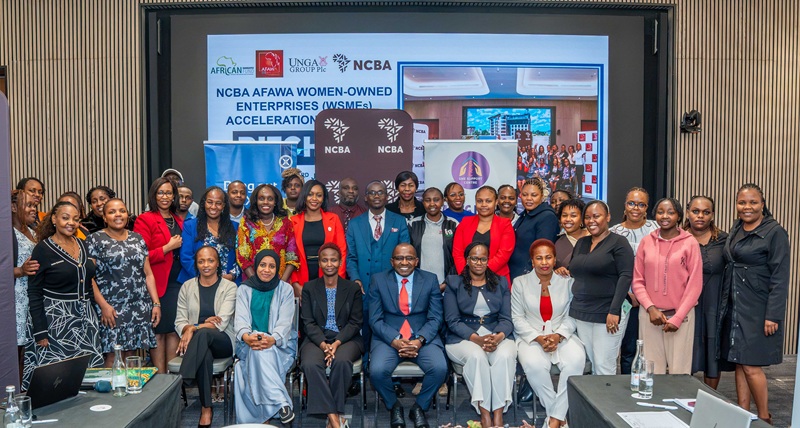
NCBA Bank has reaffirmed its commitment to empowering women entrepreneurs by convening the final investment pitching event of the NCBA AFAWA Women Small and Medium Enterprises (WSMEs) Acceleration Programme. AFAWA (Affirmative Finance Action for Women in Africa) is a pan African is a pan-African initiative by the African Development Bank, designed to bridge the $42 billion to $49 billion financing gap facing women entrepreneurs. The Acceleration Programme ran in partnership with the African Guarantee Fund (AGF) is designed to equip women-owned businesses with the skills, networks and access to finance needed to achieve sustainable growth for their enterprises.
Held over two days, the Pitch session brought together 32 women entrepreneurs who presented their business growth plans and funding requirements before an investment panel comprising representatives from NCBA, the African Guarantee Fund (AGF), Unga Group and the SME Support Centre. The event marks the culmination of an intensive business acceleration journey that has prepared participating enterprises to become investment-ready and unlock growth capital.
Women-owned businesses play a vital role in Kenya’s economy, accounting for an estimated 48% of the country’s micro, small and medium-sized enterprises (MSMEs) according to a joint report by the International Finance Corporation (IFC) and the World Bank. Despite them contributing significantly to employment and economic activity, many continue to face barriers to accessing finance, markets and business development support that limit their ability to scale. The NCBA AFAWA WSMEs Acceleration Programme was established to bridge these gaps through an integrated model that combines business development, mentorship, coaching, market exposure and financing.

Since its inception, the programme has supported 82 women-owned SMEs across two cohorts. The current cohort, with an average participant age of between 38 and 40 years represents a diverse cross-section of Kenya’s agricultural economy, spanning value chains including cereals, pulses, fresh fruits and vegetables, avocados, mushrooms, poultry and eggs, tomatoes, meat, coffee, animal feeds, macadamia, bananas, fish, seedlings, rabbits and value-added food products such as cakes. Through structured business acceleration and mentorship, participants have strengthened their business models, governance, financial management and investment readiness ahead of the final pitching sessions. The programme aims to unlock USD 5 million in financing for participating businesses, with USD 1.365 million already unlocked, demonstrating the impact of pairing business capability development with tailored financial solutions.
Linda Onyango, Chief Executive Officer of the SME Support Centre, said the programme was designed to ensure entrepreneurs leave with far more than improved access to finance. “Our role has been to equip these women entrepreneurs with the practical skills, confidence and strategic mindset needed to build resilient businesses. Throughout the programme, we’ve worked closely with them to strengthen their governance, financial management, business planning and pitching capabilities so that when they seek investment, they are truly investment ready.”
Speaking on the event, NCBA Group Director Retail Banking, Dennis Njau said the programme reflects the banks strategic commitment to Banking on Belief: Empowering Ambitions, recognising that every entrepreneur deserves the opportunity to realise their potential regardless of the circumstances they face.
“At NCBA, we believe every ambition matters. Through our Banking on Belief strategy, we are committed to supporting entrepreneurs with not only the capital they need to grow, but also the skills, networks and confidence to build resilient businesses. This programme demonstrates our belief that when we invest in people and communities, we unlock transformative impact.”
Ann Mwangi, representing the African Guarantee Fund (AGF), said the programme was intentionally designed to prepare women entrepreneurs to become investment-ready and confidently access formal financing. “Our goal is to build a pipeline of bankable women-owned businesses that are ready to access financing through our partner, NCBA. Together with our anchor partner, Unga Group, we have designed this programme to equip entrepreneurs with the skills, confidence and business readiness needed to be viewed as credible borrowers and position themselves for sustainable growth.”
The initiative also advances NCBA’s Change the Story agenda by addressing both the financial and non-financial barriers that have historically limited the growth of women-owned enterprises. Rather than focusing solely on access to credit, the programme equips entrepreneurs with the capabilities required to build sustainable businesses that contribute to stronger value chains, greater financial inclusion and long-term economic resilience.
The programme is delivered through a strategic partnership bringing together complementary expertise from the African Guarantee Fund (AGF), the Affirmative Finance Action for Women in Africa (AFAWA), SME Support Centre (SSC), Unga Group and NCBA Bank.
Guided by the philosophy of Ubuntu; “I am because we are”, the partnership reflects a shared belief that lasting impact is achieved through collaboration. AGF and AFAWA provide the risk-sharing framework that expands access to finance for women entrepreneurs, the SME Support Centre delivers business acceleration and mentorship, Unga Group provides industry exposure and market insights, while NCBA delivers the financial solutions that enable businesses to scale. Together, the partners have created an ecosystem that empowers entrepreneurs with the knowledge, networks and capital needed for long-term success.
“This programme demonstrates what is possible when institutions come together around a shared purpose,” added Njau