
Who Really Sets the Price of Money? Inside Kenya’s Interest-Rate Power Struggle
By Emmanuel Korir,
When Kamau Thugge, Governor of the Central Bank of Kenya, addressed the East Africa Banking School Conference on July 14, he did more than deliver a routine policy update. He reignited a battle over who truly controls the price of money placing millions of borrowers, thousands of loan contracts and the credibility of Kenya’s monetary-policy system at the centre of a collision between the country’s banking regulator and its highest court.
Thugge’s message was straightforward: when the Monetary Policy Committee changes the Central Bank Rate (CBR), commercial banks should immediately adjust their loan rates. There’s no need to consult the National Treasury or wait for a Cabinet Secretary’s approval. He believes that monetary policy is solely the responsibility of the CBK and banks must adhere to it directly.

However, the Supreme Court has already expressed its position not just once, but twice.
A Law Written for a Different Era, Reawakened in Court
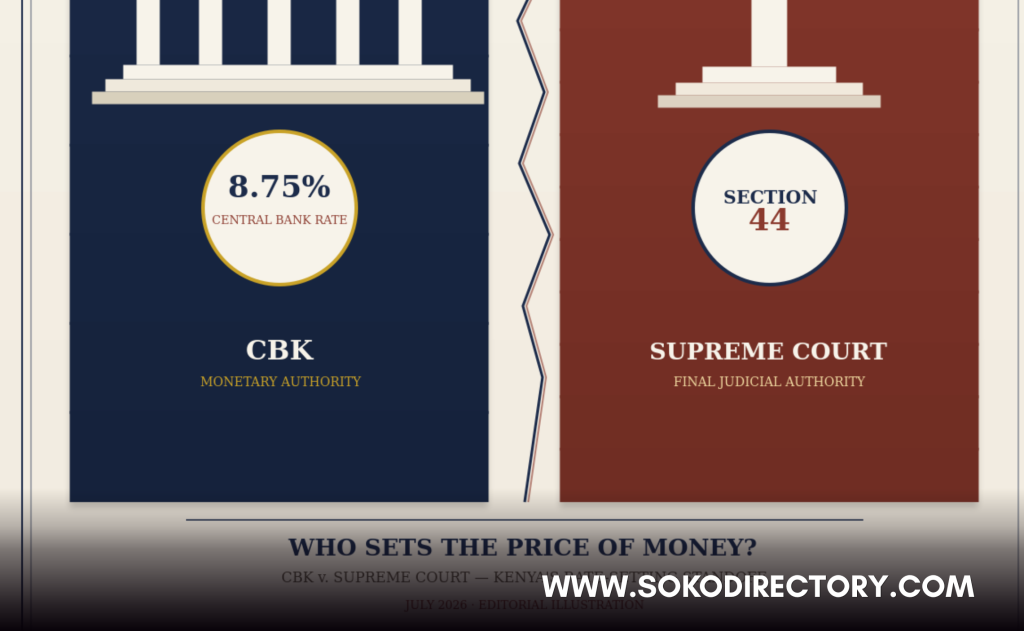
This dispute arises from Section 44 of the Banking Act, a regulation that has been quietly sitting on Kenya’s legal books for many years. It clearly states that no institution can raise its banking fees without first obtaining approval from the Cabinet Secretary for the National Treasury.
For a long time, banks treated this requirement as a mere formality, often passing it down informally since a 2006 legal notice allowed the Finance Minister to delegate approval powers to the CBK Governor. This arrangement worked well until a sanitary-towel manufacturer named Santowels Limited claimed it had been overcharged.
Santowels had been a client of Stanbic from 1993 to 1997. It later filed a lawsuit, arguing that the bank altered its lending rates without Treasury approval, leading to interest charges that far exceeded what was legally permissible. The case navigated through the High Court, the Court of Appeal and ultimately reached the Supreme Court, spanning over two decades of legal disputes.
In June 2024, a landmark decision was made by the highest court in the case of Stanbic Bank Kenya Limited v Santowels Limited, which clarified that interest rates on loans and banking services are strictly regulated by Section 44. The judges pointed out that banks cannot rely on fine print or unilateral discretion clauses to alter their charges to borrowers. They emphasized that obtaining ministerial approval is essential, rather than just a mere formality.
A related case involving Spire Bank reinforced this principle, and when the Kenya Bankers Association sought to challenge the constitutionality of Section 44, the High Court decisively dismissed that notion in December 2025. The court determined that this law is specifically intended to safeguard borrowers from unexpected and arbitrary increases in rates.
The financial consequences are significant. Stanbic was ordered to refund over Sh10 million to a single customer, while Spire had to completely reassess a client’s loan balance. Legal experts have warned that this ruling could lead to refund claims totaling billions of shillings throughout the banking sector, as customers who experienced price hikes without Treasury approval pursue their own compensation.
Conversely, the Central Bank of Kenya (CBK) has its own stance: monetary policy should not be delayed by political processes. Governor Thugge has a different interpretation of the Constitution, referencing Article 231, which grants CBK an independent role in managing monetary policy. From the regulator’s viewpoint, requiring Treasury approval every time the Central Bank Rate (CBR) changes would effectively allow a political office to veto interest rate adjustments. This could hinder CBK’s ability to tackle inflation, promote growth, or cool down an overheated economy.
This is precisely why banks such as Equity, KCB, NCBA, and Family Bank moved swiftly in February 2026 to reduce their lending rates to 8.75 percent right after the CBK eased its policy without waiting for any ministerial approval. They are banking on the idea that the Supreme Court’s ruling, which originated from a dispute over discretionary rate hikes from the 1990s, was not meant to apply to the clear, formula-based system that regulators have only recently put in place.
What Happens Next
The situation is still far from settled. The Supreme Court’s ruling remains in effect until a future case either clarifies or overturns it, meaning that banks adhering to the CBK’s guidance without Treasury approval are still at risk of encountering the same legal issues that severely impacted Stanbic and Spire. However, disregarding the regulator also carries its own risks, considering the CBK’s oversight of every licensed lender in the nation.
For everyday borrowers, the stakes are quite significant: they need to determine if a loan that was repriced following a CBR cut was done legally and whether this could eventually lead to a refund. For the banking sector, it presents a governance dilemma with no clear solution in sight until either Parliament opts to amend Section 44, the Treasury and CBK reach a formal agreement, or another case prompts the Supreme Court to reassess the balance between monetary policy independence and consumer protection laws.
In the meantime, banks in Kenya are maneuvering through the loan pricing landscape under a legal cloud that could still have implications in the future.
READ ALSO: Save Consistently, Grow Your Money and Stand a Chance to Win Up to KES 50,000 with M-Shwari

About Soko Directory Team
Soko Directory is a Financial and Markets digital portal that tracks brands, listed firms on the NSE, SMEs and trend setters in the markets eco-system.Find us on Facebook: facebook.com/SokoDirectory and on Twitter: twitter.com/SokoDirectory

- January 2026 (220)
- February 2026 (248)
- March 2026 (287)
- April 2026 (207)
- May 2026 (192)
- June 2026 (238)
- July 2026 (279)
- August 2026 (223)
- September 2026 (95)
- January 2025 (119)
- February 2025 (191)
- March 2025 (212)
- April 2025 (193)
- May 2025 (161)
- June 2025 (157)
- July 2025 (227)
- August 2025 (211)
- September 2025 (267)
- October 2025 (297)
- November 2025 (230)
- December 2025 (220)
- January 2024 (238)
- February 2024 (227)
- March 2024 (190)
- April 2024 (133)
- May 2024 (157)
- June 2024 (145)
- July 2024 (136)
- August 2024 (154)
- September 2024 (212)
- October 2024 (255)
- November 2024 (196)
- December 2024 (143)
- January 2023 (182)
- February 2023 (203)
- March 2023 (322)
- April 2023 (297)
- May 2023 (267)
- June 2023 (214)
- July 2023 (212)
- August 2023 (257)
- September 2023 (237)
- October 2023 (264)
- November 2023 (286)
- December 2023 (177)
- January 2022 (293)
- February 2022 (329)
- March 2022 (358)
- April 2022 (292)
- May 2022 (271)
- June 2022 (232)
- July 2022 (278)
- August 2022 (253)
- September 2022 (246)
- October 2022 (196)
- November 2022 (232)
- December 2022 (167)
- January 2021 (182)
- February 2021 (227)
- March 2021 (325)
- April 2021 (259)
- May 2021 (285)
- June 2021 (272)
- July 2021 (277)
- August 2021 (232)
- September 2021 (271)
- October 2021 (303)
- November 2021 (364)
- December 2021 (249)
- January 2020 (272)
- February 2020 (310)
- March 2020 (390)
- April 2020 (321)
- May 2020 (335)
- June 2020 (327)
- July 2020 (333)
- August 2020 (276)
- September 2020 (214)
- October 2020 (233)
- November 2020 (242)
- December 2020 (187)
- January 2019 (251)
- February 2019 (215)
- March 2019 (283)
- April 2019 (254)
- May 2019 (269)
- June 2019 (249)
- July 2019 (335)
- August 2019 (292)
- September 2019 (306)
- October 2019 (313)
- November 2019 (362)
- December 2019 (318)
- January 2018 (291)
- February 2018 (213)
- March 2018 (275)
- April 2018 (223)
- May 2018 (235)
- June 2018 (176)
- July 2018 (256)
- August 2018 (247)
- September 2018 (255)
- October 2018 (282)
- November 2018 (282)
- December 2018 (184)
- January 2017 (183)
- February 2017 (194)
- March 2017 (207)
- April 2017 (104)
- May 2017 (169)
- June 2017 (205)
- July 2017 (189)
- August 2017 (195)
- September 2017 (186)
- October 2017 (235)
- November 2017 (253)
- December 2017 (266)
- January 2016 (164)
- February 2016 (165)
- March 2016 (189)
- April 2016 (143)
- May 2016 (245)
- June 2016 (182)
- July 2016 (271)
- August 2016 (247)
- September 2016 (233)
- October 2016 (191)
- November 2016 (243)
- December 2016 (153)
- January 2015 (1)
- February 2015 (4)
- March 2015 (164)
- April 2015 (107)
- May 2015 (116)
- June 2015 (119)
- July 2015 (145)
- August 2015 (157)
- September 2015 (186)
- October 2015 (169)
- November 2015 (173)
- December 2015 (205)
- March 2014 (2)
- March 2013 (10)
- June 2013 (1)
- March 2012 (7)
- April 2012 (15)
- May 2012 (1)
- July 2012 (1)
- August 2012 (4)
- October 2012 (2)
- November 2012 (2)
- December 2012 (1)