
Ksh 1000 Would Buy You More Goods In January 2021 Than Today

KEY POINTS
Many people have shared their shopping lists, complaining of how the sharp spike in prices of basic food items like milk, bread, sugar, and maize flour in recent months, has made it difficult for them to afford three meals a day.
KEY TAKEAWAYS
In January 2022, the overall inflation rate in the country fell slightly for the second straight month - to 5 percent - but the prices of basic food commodities like maize flour and wheat flour, potatoes, vegetables, and fruits continued rising.
The Kenya National Bureau of Statistics (KNBS) says for poorer households where food accounts for about 36 percent of total spending, the burden is even higher.
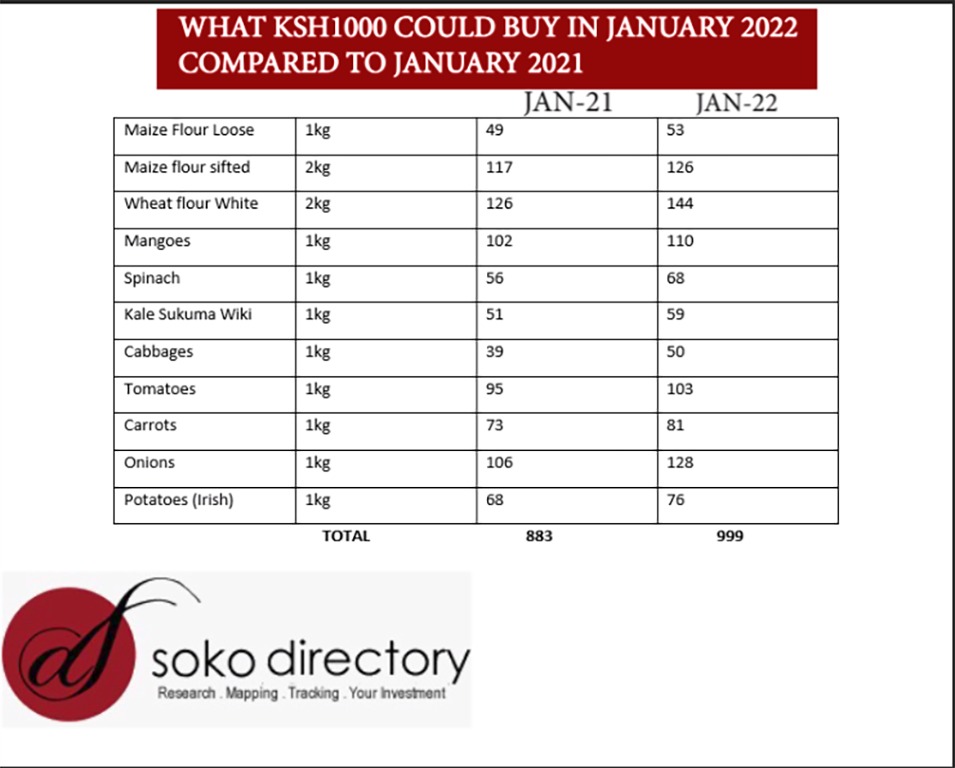
In January 2021, a thousand Kenyan shillings would buy you 1kg Loose Maize Flour (49 shillings), 2Kg Sifted Maize flour (117 shillings), 2 kg Wheat Flour White (126 shillings), 1kg mangoes (102 shillings), 1kg spinach (56 shillings), 1kg Sukuma Wiki (51 shillings).
It would also buy you 1Kg cabbage (39 shillings), 1Kg tomatoes (99 shillings), 1Kg carrot (73 shillings), 1kg onion (106 shillings), and 1kg Irish potato at 68 shillings This means you needed a total budget of 883 shillings.
In 2022, you need a budget of 999 shillings to get the same commodities.

Many people have shared their shopping lists, complaining of how the sharp spike in prices of basic food items like milk, bread, sugar, and maize flour in recent months, has made it difficult for them to afford three meals a day.
The situation has disproportionately impacted low- and middle-income households majorly. A thousand shillings can only get a few items. This means that if one thousand is your shopping limit, you either have to drop some products completely, take smaller quantities or even shift to other brands.
The increase in the cost of living in the country can be attributed to several issues including a combination of external and domestic factors.
Read More: Sugar Prices Up By 56%, Cooking Gas Spike By 167% As We Dance For Politicians
Due to the pressure from the International Monetary Fund (IMF) to raise more revenue, the government has increased taxes on everyday household goods such as cooking gas, fuel, and food.
For instance, value-added tax (VAT) was not applied to cooking gas for many years but a levy of 16 percent was imposed in July 2021.
In January 2022, the overall inflation rate in the country fell slightly for the second straight month – to 5 percent – but the prices of basic food commodities like maize flour and wheat flour, potatoes, vegetables, and fruits continued rising.
The Kenya National Bureau of Statistics (KNBS) says for poorer households where food accounts for about 36 percent of total spending, the burden is even higher.
The cost can also partly be due to the effects of Covid-19, which hit tourism and exports. The Kenyan shilling has been losing value by about 6 percent since May 2021, pushing up the prices of all imported goods.
The pandemic has also disrupted global supply chains, making it more expensive and tedious to access and move goods and services across borders
The issue of price rises has for some time dominated the political sphere in the country and is bound to play a big role in August’s general elections, especially now that every politician is using it as a building block campaign strategy to show how much they care about the citizens.
Read More: Gold Prices Hit A 13-Month High Amidst Ukraine-Russia War

- January 2026 (220)
- February 2026 (246)
- March 2026 (286)
- April 2026 (169)
- January 2025 (119)
- February 2025 (191)
- March 2025 (212)
- April 2025 (193)
- May 2025 (161)
- June 2025 (157)
- July 2025 (227)
- August 2025 (211)
- September 2025 (270)
- October 2025 (297)
- November 2025 (230)
- December 2025 (219)
- January 2024 (238)
- February 2024 (227)
- March 2024 (190)
- April 2024 (133)
- May 2024 (157)
- June 2024 (145)
- July 2024 (136)
- August 2024 (154)
- September 2024 (212)
- October 2024 (255)
- November 2024 (196)
- December 2024 (143)
- January 2023 (182)
- February 2023 (203)
- March 2023 (322)
- April 2023 (297)
- May 2023 (267)
- June 2023 (214)
- July 2023 (212)
- August 2023 (257)
- September 2023 (237)
- October 2023 (264)
- November 2023 (286)
- December 2023 (177)
- January 2022 (293)
- February 2022 (329)
- March 2022 (358)
- April 2022 (292)
- May 2022 (271)
- June 2022 (232)
- July 2022 (278)
- August 2022 (253)
- September 2022 (246)
- October 2022 (196)
- November 2022 (232)
- December 2022 (167)
- January 2021 (182)
- February 2021 (227)
- March 2021 (325)
- April 2021 (259)
- May 2021 (285)
- June 2021 (272)
- July 2021 (277)
- August 2021 (232)
- September 2021 (271)
- October 2021 (304)
- November 2021 (364)
- December 2021 (249)
- January 2020 (272)
- February 2020 (310)
- March 2020 (390)
- April 2020 (321)
- May 2020 (335)
- June 2020 (327)
- July 2020 (333)
- August 2020 (276)
- September 2020 (214)
- October 2020 (233)
- November 2020 (242)
- December 2020 (187)
- January 2019 (251)
- February 2019 (215)
- March 2019 (283)
- April 2019 (254)
- May 2019 (269)
- June 2019 (249)
- July 2019 (335)
- August 2019 (293)
- September 2019 (306)
- October 2019 (313)
- November 2019 (362)
- December 2019 (318)
- January 2018 (291)
- February 2018 (213)
- March 2018 (275)
- April 2018 (223)
- May 2018 (235)
- June 2018 (176)
- July 2018 (256)
- August 2018 (247)
- September 2018 (255)
- October 2018 (282)
- November 2018 (282)
- December 2018 (184)
- January 2017 (183)
- February 2017 (194)
- March 2017 (207)
- April 2017 (104)
- May 2017 (169)
- June 2017 (205)
- July 2017 (189)
- August 2017 (195)
- September 2017 (186)
- October 2017 (235)
- November 2017 (253)
- December 2017 (266)
- January 2016 (164)
- February 2016 (165)
- March 2016 (189)
- April 2016 (143)
- May 2016 (245)
- June 2016 (182)
- July 2016 (271)
- August 2016 (247)
- September 2016 (233)
- October 2016 (191)
- November 2016 (243)
- December 2016 (153)
- January 2015 (1)
- February 2015 (4)
- March 2015 (164)
- April 2015 (107)
- May 2015 (116)
- June 2015 (119)
- July 2015 (145)
- August 2015 (157)
- September 2015 (186)
- October 2015 (169)
- November 2015 (173)
- December 2015 (205)
- March 2014 (2)
- March 2013 (10)
- June 2013 (1)
- March 2012 (7)
- April 2012 (15)
- May 2012 (1)
- July 2012 (1)
- August 2012 (4)
- October 2012 (2)
- November 2012 (2)
- December 2012 (1)