
The Man Who Built The Stage For His Own Critics: Why Baba’s Legacy Will Outlive The Noise, The Betrayal, And The Political Season Of Small Men
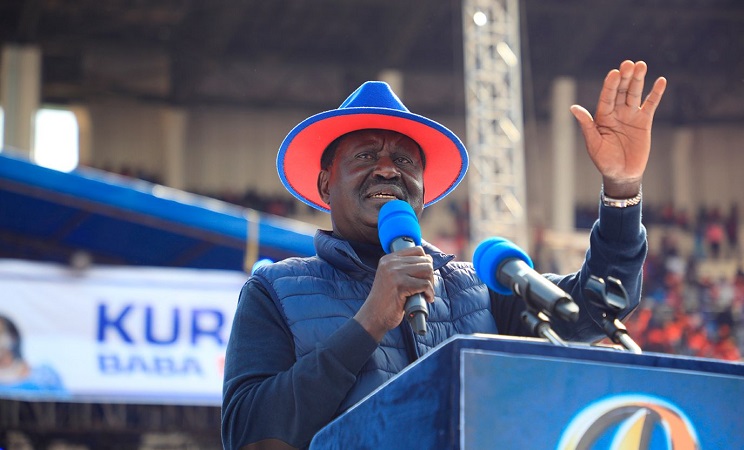
I disagreed with Baba. I said it openly, without fear or apology. I believed his handshake with Ruto was not a strategy but a surrender—a tragic misstep that fractured the faith of millions who once saw him as the conscience of the nation. Yet, deep within my defiance, I could not escape the truth: the very freedom I used to criticize him was born from his fight. It was his voice, bruised and battered, that cracked open the walls of oppression and gave us breath in a suffocating republic.
Before Baba, speaking against power was treason in Kenya. After him, it became a constitutional right. He built the bridge on which we now march, chant, and dissent. He bore the wounds that became our democracy’s first alphabet. He was jailed so we could argue; he was tortured so we could think; he was silenced so that we might speak without fear. Even those who despised him spoke freely because of the democratic canvas he stretched with his own suffering.
We live in an age of forgetfulness where convenience buries truth. Many of us criticize Baba without knowing the depth of pain that made him. We forget he endured solitary confinement for years, not for money or power, but for a dream that Kenya could be a home for ideas, not idols. His courage was not rehearsed—it was raw, born of scars. His resilience was not for applause—it was for survival. The democracy we now abuse with cheap politics stands on his bones.

When he shook Ruto’s hand, I felt betrayed. The youth felt robbed of the last hero who understood their anger. Yet as days passed, I began to see the paradox of leadership—how vision and fatigue can coexist. Baba was not perfect; he was profoundly human. He had reached an age where survival sometimes masqueraded as peace, and peace as compromise. But even in error, his motives were rooted in the soil of justice, not greed.
Unlike others, Baba never weaponized the courts against his critics. He was insulted daily, defamed by the loud and the ignorant, yet he never sued a soul. That restraint was not weakness—it was wisdom. It proved he believed in the people’s right to question even their liberator. He was a rare politician who didn’t mistake disagreement for disrespect. In him, democracy found a father who allowed his children to rebel and still come home.
In a country addicted to sycophancy, his tolerance was revolutionary. He created a political culture where citizens could challenge gods without being struck down. He didn’t preach democracy; he practiced it. And that is why, even when I disagreed with him, I could never hate him. Because men like Baba do not demand loyalty—they earn it through their endurance, through the way they carry pain with grace.
Read Also: The Man, The Enigma, The Myth: Raila Odinga Bows Out
The Kenya of today, with all its chaos and contradictions, is still an echo of his unfinished project. Every protest, every free headline, every insult hurled at a leader without fear—these are the children of his defiance. His story is not written in textbooks; it is tattooed in the collective memory of a nation that once walked in darkness until he lit the way with his own flame. He showed us that freedom is expensive, and he paid the advance.
I remember how, during elections, he was cheated, mocked, and humiliated. Yet he never called for blood. While others burned, he called for calm. While others plotted revenge, he chose restraint. That moral discipline separated him from the rest. He understood something his enemies never will—that power without legitimacy is merely violence in a suit. He fought for justice, not vengeance.
We must admit, his death came at a time when his relationship with the youth was strained. Many of us had drifted away, disappointed by what felt like surrender. Yet in death, reflection brings humility. We see now that even revolutionaries tire, and heroes sometimes fall into the very systems they once dismantled. But his body of work, his moral architecture, remains the blueprint for what true resistance looks like.
He was the rare Kenyan politician whose name was synonymous with conscience. He didn’t just oppose regimes; he defined opposition itself. Even when power tempted him, it never transformed him into a tyrant. His ambition was not for wealth, but for legacy. And that’s why, when the history of Kenya is written in centuries to come, his name will not appear as a footnote—it will be the chapter title.
Baba’s ability to forgive those who jailed and tortured him was beyond politics—it was spiritual. He turned pain into purpose, defeat into defiance. Where others sought revenge, he sought reform. That is the difference between a leader and a ruler, between a statesman and a politician. In a country of looters, he was a builder. In a sea of opportunists, he was an anchor of conviction.
Even his enemies respected his endurance. They tried to break him with humiliation, yet he smiled through the betrayal. They called him names, yet his silence often thundered louder than their insults. He understood that in politics, dignity is the only currency that doesn’t depreciate. And he guarded his with his life. That is why, even in disagreement, his critics are still his children.
His death has left a vacuum that cannot be filled with titles or offices. What he represented—moral rebellion—cannot be inherited. It must be lived. We now face the painful reality that the same politicians who mocked him in life are now parading at his burial with plastic tears. They want closure, not justice. They want silence, not truth. But we owe him more than ceremony—we owe him continuity.
Let it be clear: our generation stands on borrowed courage. We were not there when he was beaten, but we enjoy the fruits of his bruises. We were not in detention cells, yet we now hold microphones to insult those who built them. That irony should humble us. We must ask ourselves whether we are worthy heirs of his struggle or just noisy beneficiaries of someone else’s pain.
When I look at today’s Kenya, I see a democracy under siege by greed, fear, and apathy. Yet somewhere deep within that chaos, I still hear Baba’s voice urging us not to surrender the dream. He warned us that the enemy of freedom is not always a dictator—it is also the comfort of citizens who choose silence. That warning rings louder now than ever before.
Baba understood that leadership is not about applause, but endurance. He was often misunderstood, yet he never stopped showing up. When others rested, he marched. When others calculated, he believed. And even when he lost, he lost with dignity. In that, he taught us the greatest political lesson: that the fight for truth is not measured by victory, but by consistency.
In his eyes, Kenya was always a promise worth bleeding for. He didn’t fight to be president; he fought so that any Kenyan could be one. That’s why even in defeat, he never truly lost. Because every young activist, every fearless journalist, every stubborn voter who refuses to sell their soul for 200 shillings, is living proof that his fight continues through us.
We must not let the political vultures rewrite his story to fit their comfort. They want to bury his body and his ideals in the same grave. But his ideals are immortal—they belong to the soil, to the wind, to the generations yet unborn. His spirit will haunt every corrupt leader who dares to pretend that tyranny is order. His ghost will whisper freedom in every ear that still listens.
Let us mourn him not with tears, but with action. Let us organize, educate, and mobilize. Let his death be the last warning shot to a generation too distracted to defend its democracy. Because if we fail to pick up his torch, the darkness will return—and this time, there may be no one left to light the candle again.
Baba’s journey from prison to parliament, from exile to election, from rejection to reverence, is the story of a man who refused to be ordinary. He redefined endurance. He humanized rebellion. He proved that power, when pursued for the people, is not greed but grace. His legacy challenges us to live not for comfort but conviction.
And so, even though I once disagreed with him, I now see the fuller picture. My criticism was an act of freedom; his life made that possible. He raised a nation that could question him without fear, and that, more than anything, is the truest measure of leadership. Because the greatest leaders are not those who demand obedience—they are those who create the freedom to be opposed.
Read Also: A King Belongs to His People: Why Raila’s Farewell Must Not Be Rushed

About Steve Biko Wafula
Steve Biko is the CEO OF Soko Directory and the founder of Hidalgo Group of Companies. Steve is currently developing his career in law, finance, entrepreneurship and digital consultancy; and has been implementing consultancy assignments for client organizations comprising of trainings besides capacity building in entrepreneurial matters.He can be reached on: +254 20 510 1124 or Email: info@sokodirectory.com

- January 2026 (220)
- February 2026 (248)
- March 2026 (287)
- April 2026 (207)
- May 2026 (192)
- June 2026 (238)
- July 2026 (279)
- August 2026 (223)
- September 2026 (134)
- January 2025 (119)
- February 2025 (191)
- March 2025 (212)
- April 2025 (193)
- May 2025 (161)
- June 2025 (157)
- July 2025 (227)
- August 2025 (211)
- September 2025 (267)
- October 2025 (297)
- November 2025 (230)
- December 2025 (220)
- January 2024 (238)
- February 2024 (227)
- March 2024 (190)
- April 2024 (133)
- May 2024 (157)
- June 2024 (145)
- July 2024 (136)
- August 2024 (154)
- September 2024 (212)
- October 2024 (255)
- November 2024 (196)
- December 2024 (143)
- January 2023 (182)
- February 2023 (203)
- March 2023 (322)
- April 2023 (297)
- May 2023 (267)
- June 2023 (214)
- July 2023 (212)
- August 2023 (257)
- September 2023 (237)
- October 2023 (264)
- November 2023 (286)
- December 2023 (177)
- January 2022 (293)
- February 2022 (329)
- March 2022 (358)
- April 2022 (292)
- May 2022 (271)
- June 2022 (232)
- July 2022 (278)
- August 2022 (253)
- September 2022 (246)
- October 2022 (196)
- November 2022 (232)
- December 2022 (167)
- January 2021 (182)
- February 2021 (227)
- March 2021 (325)
- April 2021 (259)
- May 2021 (285)
- June 2021 (272)
- July 2021 (277)
- August 2021 (232)
- September 2021 (271)
- October 2021 (303)
- November 2021 (364)
- December 2021 (249)
- January 2020 (272)
- February 2020 (310)
- March 2020 (390)
- April 2020 (321)
- May 2020 (335)
- June 2020 (327)
- July 2020 (333)
- August 2020 (276)
- September 2020 (214)
- October 2020 (233)
- November 2020 (242)
- December 2020 (187)
- January 2019 (251)
- February 2019 (215)
- March 2019 (283)
- April 2019 (254)
- May 2019 (269)
- June 2019 (249)
- July 2019 (335)
- August 2019 (292)
- September 2019 (306)
- October 2019 (313)
- November 2019 (362)
- December 2019 (318)
- January 2018 (291)
- February 2018 (213)
- March 2018 (275)
- April 2018 (223)
- May 2018 (235)
- June 2018 (176)
- July 2018 (256)
- August 2018 (247)
- September 2018 (255)
- October 2018 (282)
- November 2018 (282)
- December 2018 (184)
- January 2017 (183)
- February 2017 (194)
- March 2017 (207)
- April 2017 (104)
- May 2017 (169)
- June 2017 (205)
- July 2017 (189)
- August 2017 (195)
- September 2017 (186)
- October 2017 (235)
- November 2017 (253)
- December 2017 (266)
- January 2016 (164)
- February 2016 (165)
- March 2016 (189)
- April 2016 (143)
- May 2016 (245)
- June 2016 (182)
- July 2016 (271)
- August 2016 (247)
- September 2016 (233)
- October 2016 (191)
- November 2016 (243)
- December 2016 (153)
- January 2015 (1)
- February 2015 (4)
- March 2015 (164)
- April 2015 (107)
- May 2015 (116)
- June 2015 (119)
- July 2015 (145)
- August 2015 (157)
- September 2015 (186)
- October 2015 (169)
- November 2015 (173)
- December 2015 (205)
- March 2014 (2)
- March 2013 (10)
- June 2013 (1)
- March 2012 (7)
- April 2012 (15)
- May 2012 (1)
- July 2012 (1)
- August 2012 (4)
- October 2012 (2)
- November 2012 (2)
- December 2012 (1)