
Schneider Electric and Enactus reveal English-speaking Africa’s brightest battery innovators
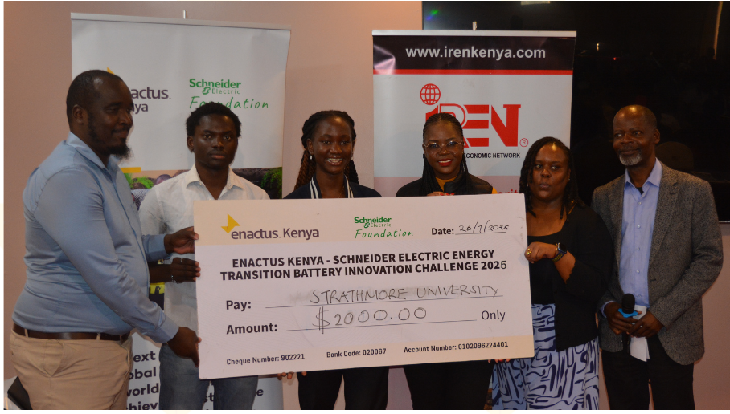
Schneider Electric, the global leader in energy management and automation, and recognised sustainability leader, together with Enactus, the international NGO dedicated to inspiring students through entrepreneurial action, proudly announce the winners of the 2025 Energy Transition Battery Innovation Challenge, funded by the Schneider Electric Foundation.
This year’s first-place winners exemplify the ingenuity and impact of youth-led innovation across the region and are:
- South Africa: BioWatt from WITS University
- Kenya: Strathmore University with Afya Cell
- Nigeria: Joseph Sarwuan Tarka University with Energiv
- Zimbabwe: University of Zimbabwe’s LithiumX project.
Now in its second year, the Battery Innovation Challenge was conceived by a South African Schneider Electric engineer and is funded by the Schneider Electric Foundation. It empowers young innovators to design battery solutions addressing the region’s most pressing energy challenges. The initiative also forms part of the Foundation’s New Skills for the Future and Innovation programme.

The programme also celebrates the continued success of the 2024 winners who have used the prize money from the Schneider Electric Foundation to further develop their concepts, including:
- Zimbabwe: Second place winner, Bindura University of Science Education (BUSE), evolved their project CaLIX into VoltStep, a micro-battery module capable of storing the low-voltage current generated from piezoelectric sensors. This is a commercially viable, socially impactful enterprise.
Within its first year, the project sold 8,070 pairs of VoltStep shoes, generating USD 104,910 in revenue, provided reliable lighting access for 892 rural students by extending study hours, produced over 900 kWh of renewable kinetic energy, and reduced household lighting costs by up to 65%. This project also helped earn them second place in the 2025 Enactus World Cup.
- Kenya: The winning team, Afterlife, provides second life applications by repurposing and recycling worn out batteries. They also won other awards with their solution like the “Power the Community 2025 International Design Competition” and is now a registered company who also joined the Emerging Circular Leaders programme, sparking national conversations on circular economy innovation.
- Nigeria: Originally launched as Repo during the challenge which won third place, the project has evolved into Ecovolt—a scalable clean energy solution made from recycled e-waste. Ecovolt powers household appliances and small businesses created 20 youth jobs and sold 40 units, with 55 more on order currently.
- South Africa: Airnergy & Tech Solutions, third-place winners, have successfully commercialised their innovation.
The success of Airnergy & Tech Solutions
Indicative of the programme’s success is Airnergy & Tech Solutions, who have gone on to successfully commercialise their solutions ElectroBoost300, a 300W portable power station, now on Takealot (South Africa’s largest online retailer), providing reliable lithium-based storage for households, students, and small businesses.
“Schneider Electric believed in us. Their support and funding helped Airnergy & Tech build a viable product, and that gave our team the confidence to keep pushing forward with sustainable energy innovation,” says Neo Moabi of Airnergy & Tech Solutions.
Adds Elihle Obi, Marketing Communications & Corporate Citizenship Director, English-speaking Africa at Schneider Electric. “The Battery Innovation Challenge is proof that with the right support, students in our region can create scalable, sustainable solutions that accelerate today and tomorrow’s energy transition. We are proud to form part of this truly lifechanging initiative.”
2025 Winners
This year’s Battery Innovation Challenge winners demonstrated technical ingenuity, community relevance, and strong potential for scaling impact and have received Euro cash prizes from the Schneider Electric Foundation:
Zimbabwe
- First place – University of Zimbabwe (LithiumX, €2000): Low-cost recycling of lithium-ion batteries using eco-friendly hydrometallurgy.
- Second place– National University of Science and Technology (Ukukhanya 2.0, €1500): Affordable solid-state sodium–air hybrid battery delivering clean, off-grid community power.
- Third place – Harare Institute of Technology (PowerPulse, €1000): Aluminium–air chemistry battery using recycled aluminium and organic waste-based cathodes.
Kenya
- First place – Strathmore University (Afya Cell, €2000): AI-powered battery health analyser that extends battery life for EVs, solar, and IoT systems.
- Second place – Meru University (E-Waste Management Through Renewable Energy Integration, €1500): Recovering lithium-ion batteries from e-waste for affordable community solar storage.
- Third place – Machakos University (ChargeAgain, €1000): Repurposing discarded vehicle batteries for sustainable solar storage in rural communities.
South Africa
- First place – BioWatt (University of the Witwatersrand – WITS, €2000): Harnessing microbial fuel cells and efficient circuits to generate electricity from organic waste while promoting STEM education and reducing e-waste.
- Second place – EcoVolt Innovation (University of the Witwatersrand – WITS, €1500): Pioneering sodium-ion and solid-state hybrid batteries using recycled materials, AI-powered monitoring, and community training.
- Third place –Shared by Renewa Fuels (Cape Peninsula University of Technology) &