
Mansa-X Under the Microscope: Seven Hard Questions, the Facts Behind Them and the Disclosures Investors Still Deserve

Mansa‑X has emerged as one of the most significant investment products in East Africa, both in terms of scale and visibility. By mid‑2026, assets under management across its Kenya‑shilling and US‑dollar funds had reached KES 184.32 billion, a level that naturally attracts scrutiny. Yet scrutiny, when met with transparency and evidence, can strengthen investor confidence rather than weaken it. The fund’s record, mandate, and governance framework demonstrate that Mansa‑X is not only delivering returns but also operating within a disciplined and regulated structure designed to safeguard investors.
Performance is the most visible measure of any investment product, and Mansa‑X’s record is both consistent and verifiable. The Kenya‑shilling fund has delivered an average annualised net return of 18.37% from January 2019 to June 2026. The US‑dollar fund, launched in November 2022, has achieved 12.51% over the same period. Interim results for the first half of 2026 showed net returns of 10.97% for the KES fund and 6.54% for the USD fund. If sustained, these would equate to annualised rates of 23.15% and 13.51% respectively.
Historical data reinforces this picture. Between 2019 and 2025, the KES fund reported annual net returns ranging from 15.45% to 20.74%. The USD fund, though younger, reported 12.10% in 2023, 12.50% in 2024, and 13.37% in 2025. A KES 1 million investment made in January 2019 was valued at KES 3.59 million by March 2026 after fees, while a USD 10,000 investment in November 2022 had grown to USD 14,949. These figures, supported by audited statements, demonstrate a multi‑year record that is both testable and reconcilable. They confirm that performance is not a one‑off windfall but the result of a repeatable strategy.

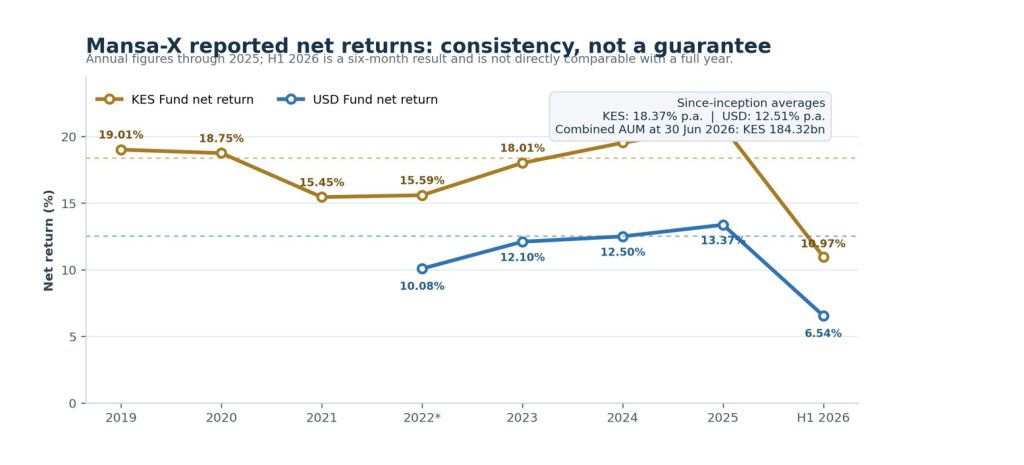
Figure 1. Reported annual net returns for the KES and USD funds. H1 2026 is shown as an actual six-month return, not an annual return. The dotted lines mark the manager-reported since-inception annualised averages to 30 June 2026.
Mansa‑X is not a conventional money‑market fund. It is a special collective investment scheme with a global, multi‑asset, long‑short mandate. Its portfolio may include currencies, listed equities, stock indices, sovereign fixed income, commodities, precious metals, derivatives, and cash across major international markets. This breadth of mandate is the source of both its return potential and its complexity.
The fee structure reflects this sophistication: a 5% annual financial‑services charge, prorated daily, and a 10% performance fee on returns above a 25% hurdle for the KES fund and 15% for the USD fund. There are no initial or redemption fees, but a six‑month lock‑in applies. These terms are transparent and aligned with the nature of the strategy. They also highlight why Mansa‑X should not be compared directly with money‑market funds, where strategies, risks, fees, and liquidity terms are materially different.
The umbrella structure of the fund has occasionally prompted questions about cross‑liability between sub‑funds. In practice, each sub‑fund maintains independent mandates, accounting records, portfolios, unitholders, and net asset values. Management and reporting are carried out separately, and no sub‑fund’s assets have ever been used to settle another’s liabilities. While the trust deed does contain a cross‑liability provision, the operational reality is one of separation and discipline. Investors can therefore be confident that the structure is regulated, overseen by a trustee and custodian, and subject to external audit.
Income reporting has shown that more than 80% of the two funds’ income is classified as offshore trading gains. This is consistent with the fund’s global mandate and reflects realised and unrealised positions across currencies, equity indices, commodities, sovereign fixed income, and equities. While the distinction between realised and unrealised gains is important, the broader point is that income is generated within approved investment limits and subject to board oversight.
Valuation practices follow internationally accepted standards. Instruments with observable market prices are marked to quoted values, while those without active quotations are valued using recognised methods overseen by management, trustee, and auditor. Daily unit prices are published, ensuring transparency. This framework provides investors with confidence that valuations are credible and independently verified.
Risk management is embedded in the fund’s operations. Position exposures and liquidity limits are continuously monitored against predetermined thresholds, and scenario analysis forms part of the investment process. Stress testing is conducted to evaluate sensitivities to currency moves, interest‑rate shocks, equity declines, commodity gaps, and liquidity squeezes. These practices ensure that the fund is resilient across multiple market conditions.
Counterparty exposure is managed under IFRS 9’s expected‑credit‑loss framework. Trading is restricted to approved counterparties selected for financial strength, operational capacity, and regulatory standing. Exposure is monitored continuously, and impairment is recognised on a forward‑looking basis. This approach ensures that credit risk is addressed proactively rather than reactively.
Revenue recognition has been identified as a key audit matter, reflecting the complexity of multi‑market trading systems and large transaction volumes. Importantly, the auditor issued an unqualified opinion on the financial statements as a whole. This confirms that revenue recognition and valuation processes meet professional standards. The designation of a key audit matter signals heightened auditor attention, not adverse findings.
The distinction between audited and non‑audited commentary is also important. Factsheets and trustee reports provide timely interim data, but audited statements remain the definitive source. Investors can be confident that audited information is reliable, while non‑audited commentary serves as supplementary explanation.
Mansa‑X operates under the oversight of the Capital Markets Authority (CMA). It has a licensed manager, trustee, custodian, and external auditor. These safeguards are substantive and provide a strong foundation for investor confidence. They ensure that the fund is not only delivering returns but also operating within a regulated governance framework.
Taken together, the evidence demonstrates that Mansa‑X is a professionally managed, well‑regulated, and transparent investment product. Its performance record is consistent, its mandate is sophisticated, and its governance framework is robust. Operational safeguards, valuation practices, risk management, and audit assurance all contribute to a structure that is credible and disciplined.
While no investment can eliminate risk, Mansa‑X offers investors a serious and well‑governed vehicle for global market exposure. Its multi‑year track record, regulatory oversight, and transparent operations provide a solid basis for confidence. Investors can therefore approach Mansa‑X with assurance that it is designed to deliver returns within a clear and regulated framework, combining strong historical performance with robust governance.
Confidence in Mansa‑X is not built on marketing claims or defensive responses. It is built on evidence: audited performance, regulated structure, disciplined risk management, and transparent reporting. These elements together confirm that Mansa‑X is a credible investment product, worthy of its scale and visibility, and positioned to continue serving investors with professionalism and integrity.
Read Also: Mansa-X H1 2026: The Fund Turning Market Discipline Into Double-Digit Investor Returns

About Steve Biko Wafula
Steve Biko is the CEO OF Soko Directory and the founder of Hidalgo Group of Companies. Steve is currently developing his career in law, finance, entrepreneurship and digital consultancy; and has been implementing consultancy assignments for client organizations comprising of trainings besides capacity building in entrepreneurial matters.He can be reached on: +254 20 510 1124 or Email: info@sokodirectory.com

- January 2026 (220)
- February 2026 (248)
- March 2026 (287)
- April 2026 (208)
- May 2026 (191)
- June 2026 (238)
- July 2026 (279)
- August 2026 (53)
- January 2025 (119)
- February 2025 (191)
- March 2025 (212)
- April 2025 (193)
- May 2025 (161)
- June 2025 (157)
- July 2025 (227)
- August 2025 (211)
- September 2025 (267)
- October 2025 (297)
- November 2025 (230)
- December 2025 (220)
- January 2024 (238)
- February 2024 (227)
- March 2024 (190)
- April 2024 (133)
- May 2024 (157)
- June 2024 (145)
- July 2024 (136)
- August 2024 (154)
- September 2024 (212)
- October 2024 (255)
- November 2024 (196)
- December 2024 (143)
- January 2023 (182)
- February 2023 (203)
- March 2023 (322)
- April 2023 (297)
- May 2023 (267)
- June 2023 (214)
- July 2023 (212)
- August 2023 (257)
- September 2023 (237)
- October 2023 (264)
- November 2023 (286)
- December 2023 (177)
- January 2022 (293)
- February 2022 (329)
- March 2022 (358)
- April 2022 (292)
- May 2022 (271)
- June 2022 (232)
- July 2022 (278)
- August 2022 (253)
- September 2022 (246)
- October 2022 (196)
- November 2022 (232)
- December 2022 (167)
- January 2021 (182)
- February 2021 (227)
- March 2021 (325)
- April 2021 (259)
- May 2021 (285)
- June 2021 (272)
- July 2021 (277)
- August 2021 (232)
- September 2021 (271)
- October 2021 (304)
- November 2021 (364)
- December 2021 (249)
- January 2020 (272)
- February 2020 (310)
- March 2020 (390)
- April 2020 (321)
- May 2020 (335)
- June 2020 (327)
- July 2020 (333)
- August 2020 (276)
- September 2020 (214)
- October 2020 (233)
- November 2020 (242)
- December 2020 (187)
- January 2019 (251)
- February 2019 (215)
- March 2019 (283)
- April 2019 (254)
- May 2019 (269)
- June 2019 (249)
- July 2019 (335)
- August 2019 (292)
- September 2019 (306)
- October 2019 (313)
- November 2019 (362)
- December 2019 (318)
- January 2018 (291)
- February 2018 (213)
- March 2018 (275)
- April 2018 (223)
- May 2018 (235)
- June 2018 (176)
- July 2018 (256)
- August 2018 (247)
- September 2018 (255)
- October 2018 (282)
- November 2018 (282)
- December 2018 (184)
- January 2017 (183)
- February 2017 (194)
- March 2017 (207)
- April 2017 (104)
- May 2017 (169)
- June 2017 (205)
- July 2017 (189)
- August 2017 (195)
- September 2017 (186)
- October 2017 (235)
- November 2017 (253)
- December 2017 (266)
- January 2016 (164)
- February 2016 (165)
- March 2016 (189)
- April 2016 (143)
- May 2016 (245)
- June 2016 (182)
- July 2016 (271)
- August 2016 (247)
- September 2016 (233)
- October 2016 (191)
- November 2016 (243)
- December 2016 (153)
- January 2015 (1)
- February 2015 (4)
- March 2015 (164)
- April 2015 (107)
- May 2015 (116)
- June 2015 (119)
- July 2015 (145)
- August 2015 (157)
- September 2015 (186)
- October 2015 (169)
- November 2015 (173)
- December 2015 (205)
- March 2014 (2)
- March 2013 (10)
- June 2013 (1)
- March 2012 (7)
- April 2012 (15)
- May 2012 (1)
- July 2012 (1)
- August 2012 (4)
- October 2012 (2)
- November 2012 (2)
- December 2012 (1)