
When the Order Is Bigger Than Your Bank Balance, It Should Not Be Bigger Than Your Business
The real business challenge is often not finding a customer. It is finding the money to serve that customer before payment arrives.
Every entrepreneur dreams of receiving a large order. The email lands, the phone rings or the local purchase order is finally issued, and for a few precious minutes the future feels wide open. Then reality walks into the room carrying a calculator. The supplier wants a deposit. Workers need wages. Packaging must be bought. Transport has to be booked. Taxes, insurance and clearing charges do not wait for the customer to pay. Suddenly, an order that should feel like a breakthrough begins to feel like a crisis.
This is the quiet working-capital problem behind many stalled Kenyan businesses. A company may be profitable on paper and still be unable to deliver because its cash is trapped elsewhere: in stock, in unpaid invoices or in equipment already serving another contract. Profit answers the question, “Is this business making money?” Cash flow answers the more urgent question, “Can this business pay for what must happen today?” A healthy business needs both.

That is why pre-shipment financing matters. In simple language, it is working capital provided before goods are shipped or an order is completed. It can help an eligible business buy inputs, manufacture or assemble products, pay for packaging, transport goods and meet other costs directly connected to fulfilling a confirmed transaction. The financing is then repaid according to agreed terms, normally from the proceeds of the trade. It is not free money, and it does not turn a weak deal into a good one. Used carefully, however, it can bridge the dangerous gap between winning business and being paid for it.
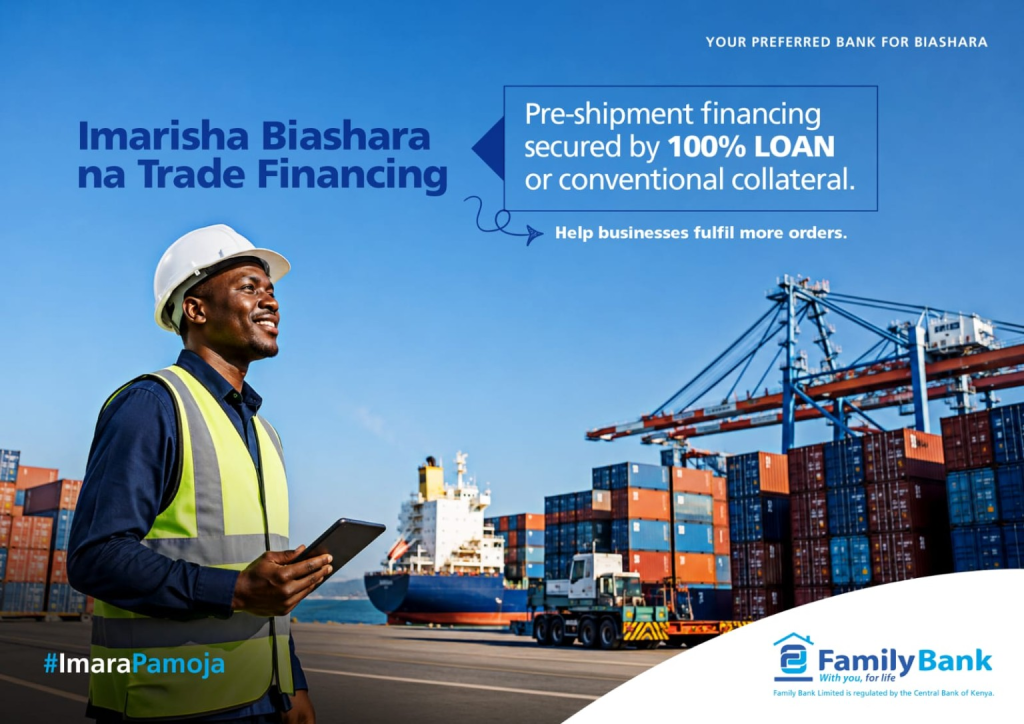
The Family Bank artwork captures this opportunity in a powerful promise: pre-shipment financing secured by a 100% loan or conventional collateral, designed to help businesses fulfil more orders. The wording is important. A “100% loan” here refers to an eligible cash-backed form of security, not a promise that every applicant will automatically receive the entire cost of an order without assessment. Conventional collateral may also be considered. The exact amount, security, pricing, documents and repayment structure remain subject to the bank’s appraisal and the specific transaction.
For an entrepreneur, the benefit is practical. Imagine a furniture maker who receives an order to supply desks to a school. The customer will pay after delivery, but timber, fittings, labour and transport must be paid for now. Without financing, the owner may reject the order, deliver late or borrow expensively from several informal sources. With well-structured pre-shipment finance, the business can purchase the required inputs, organise production and deliver within the agreed timeline. A completed order produces more than revenue: it builds credibility, preserves the customer relationship and improves the chance of winning the next contract.
The same principle applies to a grain trader buying stock for a confirmed buyer, a manufacturer producing goods for export, a contractor supplying equipment, or a distributor preparing a shipment. The facility can protect the business from draining every shilling of its own cash into one order. That matters because rent, salaries, utilities, and everyday operations continue even while a major contract is being fulfilled. Good financing does not merely fund the order; it helps keep the rest of the business alive while the order moves.
Family Bank naturally enters this conversation because its trade-finance offering goes beyond one product. Its official trade-finance information lists pre-shipment finance for working capital prior to delivery, local purchase order financing for suppliers and contractors, invoice or certificate discounting for advances against unpaid invoices, import-duty financing, post-import financing, structured trade finance, letters of credit, guarantees and bills avalisation. Different businesses face different gaps, so the right question is not simply, “Can I get a loan?” It is, “Which facility matches the exact stage of my transaction?”
If the obstacle comes before delivery, pre-shipment finance may be the relevant conversation. If goods have already been supplied and a credible invoice is awaiting payment, invoice discounting may be more suitable. If an importer needs support with port charges or supplier-payment arrangements, another trade-finance instrument may fit better. Matching the tool to the transaction prevents a business from using an expensive or poorly timed facility for the wrong purpose.
Entrepreneurs should also understand what a bank is likely to examine. A confirmed order is a beginning, not the entire case. The bank may need to establish that the buyer is genuine and able to pay, that the supplier can actually deliver, that the margins are sufficient, and that the requested financing is tied to a real commercial cycle. Business registration records, tax and compliance documents, bank statements, management accounts, contracts, quotations, invoices, purchase orders, delivery schedules and evidence of previous performance may all become important depending on the transaction.
Before signing, the entrepreneur should calculate the whole deal, not just the sales value. Start with the contract price, then subtract the cost of goods, labour, logistics, taxes, insurance, bank charges, interest and a sensible allowance for delays or unexpected expenses. Confirm when the customer will pay and whether that date matches the financing period. Ask what happens if the buyer delays, rejects part of the delivery or changes the order. A large contract with a thin margin can become a large loss once financing costs and delays are included.
Discipline after approval is just as important as approval itself. The money should follow the purpose for which it was borrowed. Mixing contract funds with personal spending, diverting money to unrelated projects, or assuming the next order will repair today’s gap is how useful finance becomes dangerous debt. Keep proper records, invoice promptly, document delivery, follow up on payment, and route the proceeds as agreed. Strong execution today improves the business’s ability to negotiate better support tomorrow.
Entrepreneurs must also avoid the trap of treating collateral as an administrative detail. Security represents a real asset or cash commitment that can be called upon if the business fails to meet its obligations. Read the facility letter carefully. Ask for a clear explanation of the interest basis, fees, insurance, security, repayment dates, late-payment consequences and all conditions before drawdown. A good banker should be able to explain the structure in language the business owner understands; a good entrepreneur should keep asking until every number makes sense.
The deeper lesson is that access to finance improves when a business becomes easier to understand. Separate personal and business money. Bank sales consistently. Prepare management accounts. Maintain clean tax and statutory records. Keep copies of contracts and delivery notes. Build a history of completing orders well. Know the company’s margins and cash-conversion cycle. These habits do not guarantee approval, but they give a lender better evidence on which to assess the business and give the entrepreneur better control even before any financing is obtained.
Many promising businesses do not fail because customers disappeared. They fail because success arrived faster than their cash flow could carry it. One large order consumed the money needed for ordinary operations; one delayed payment triggered missed salaries; one poorly priced contract erased months of profit. Trade finance is valuable because it treats commerce as a cycle: an order is received, inputs are bought, goods are prepared, delivery is made, and payment comes back. Finance should support that cycle, not fight it.
For Soko Directory readers and every entrepreneur standing before a bigger opportunity than the cash currently available, the message is simple: do not throw away a credible order merely because the timing of money is difficult. Take the order, the cost breakdown and the payment terms to a qualified trade-finance officer. Ask Family Bank to assess the transaction and explain the appropriate structure. Compare the total cost with the expected margin, understand the security, and proceed only when the numbers still work after realistic stress testing.
The most powerful businesses are not always those with the deepest pockets. Often, they are the ones that understand how to combine a real market opportunity, disciplined records, dependable execution, and the right financial partner. When those pieces come together, an order stops being an intimidating piece of paper and becomes what it was meant to be: goods produced, people employed, customers served, money earned and a business strengthened for the next opportunity.
Before approaching the bank, carry the confirmed order or contract, cost breakdown, delivery schedule, buyer payment terms, recent bank statements and business records. Ask about total cost, security, repayment source, drawdown conditions and the risks if payment is delayed.
Read Also: Beyond Certificates: How Family Group Foundation Is Turning Youth Skills into Economic Opportunity

About Steve Biko Wafula
Steve Biko is the CEO OF Soko Directory and the founder of Hidalgo Group of Companies. Steve is currently developing his career in law, finance, entrepreneurship and digital consultancy; and has been implementing consultancy assignments for client organizations comprising of trainings besides capacity building in entrepreneurial matters.He can be reached on: +254 20 510 1124 or Email: info@sokodirectory.com

- January 2026 (220)
- February 2026 (248)
- March 2026 (287)
- April 2026 (208)
- May 2026 (191)
- June 2026 (238)
- July 2026 (279)
- August 2026 (174)
- January 2025 (119)
- February 2025 (191)
- March 2025 (212)
- April 2025 (193)
- May 2025 (161)
- June 2025 (157)
- July 2025 (227)
- August 2025 (211)
- September 2025 (267)
- October 2025 (297)
- November 2025 (230)
- December 2025 (220)
- January 2024 (238)
- February 2024 (227)
- March 2024 (190)
- April 2024 (133)
- May 2024 (157)
- June 2024 (145)
- July 2024 (136)
- August 2024 (154)
- September 2024 (212)
- October 2024 (255)
- November 2024 (196)
- December 2024 (143)
- January 2023 (182)
- February 2023 (203)
- March 2023 (322)
- April 2023 (297)
- May 2023 (267)
- June 2023 (214)
- July 2023 (212)
- August 2023 (257)
- September 2023 (237)
- October 2023 (264)
- November 2023 (286)
- December 2023 (177)
- January 2022 (293)
- February 2022 (329)
- March 2022 (358)
- April 2022 (292)
- May 2022 (271)
- June 2022 (232)
- July 2022 (278)
- August 2022 (253)
- September 2022 (246)
- October 2022 (196)
- November 2022 (232)
- December 2022 (167)
- January 2021 (182)
- February 2021 (227)
- March 2021 (325)
- April 2021 (259)
- May 2021 (285)
- June 2021 (272)
- July 2021 (277)
- August 2021 (232)
- September 2021 (271)
- October 2021 (303)
- November 2021 (364)
- December 2021 (249)
- January 2020 (272)
- February 2020 (310)
- March 2020 (390)
- April 2020 (321)
- May 2020 (335)
- June 2020 (327)
- July 2020 (333)
- August 2020 (276)
- September 2020 (214)
- October 2020 (233)
- November 2020 (242)
- December 2020 (187)
- January 2019 (251)
- February 2019 (215)
- March 2019 (283)
- April 2019 (254)
- May 2019 (269)
- June 2019 (249)
- July 2019 (335)
- August 2019 (292)
- September 2019 (306)
- October 2019 (313)
- November 2019 (362)
- December 2019 (318)
- January 2018 (291)
- February 2018 (213)
- March 2018 (275)
- April 2018 (223)
- May 2018 (235)
- June 2018 (176)
- July 2018 (256)
- August 2018 (247)
- September 2018 (255)
- October 2018 (282)
- November 2018 (282)
- December 2018 (184)
- January 2017 (183)
- February 2017 (194)
- March 2017 (207)
- April 2017 (104)
- May 2017 (169)
- June 2017 (205)
- July 2017 (189)
- August 2017 (195)
- September 2017 (186)
- October 2017 (235)
- November 2017 (253)
- December 2017 (266)
- January 2016 (164)
- February 2016 (165)
- March 2016 (189)
- April 2016 (143)
- May 2016 (245)
- June 2016 (182)
- July 2016 (271)
- August 2016 (247)
- September 2016 (233)
- October 2016 (191)
- November 2016 (243)
- December 2016 (153)
- January 2015 (1)
- February 2015 (4)
- March 2015 (164)
- April 2015 (107)
- May 2015 (116)
- June 2015 (119)
- July 2015 (145)
- August 2015 (157)
- September 2015 (186)
- October 2015 (169)
- November 2015 (173)
- December 2015 (205)
- March 2014 (2)
- March 2013 (10)
- June 2013 (1)
- March 2012 (7)
- April 2012 (15)
- May 2012 (1)
- July 2012 (1)
- August 2012 (4)
- October 2012 (2)
- November 2012 (2)
- December 2012 (1)