
SIB Bets On Kenya Power’s 65% Upside As Focus Shifts From Tariffs To Operational Efficiency
Kenya Power is no longer just a story about a utility selling electricity to homes, shops, factories, and offices. The deeper story, as Standard Investment Bank’s valuation update makes clear, is that Kenya Power is being pushed into a new electricity age where the most valuable asset may not be the bill it sends to customers, but the grid it controls.
SIB has upgraded Kenya Power from HOLD to BUY and placed a fair value estimate of KES 25.57 per share on the company, against a market price of KES 15.50 at the time of the report. That implies a 65.0% upside. But this is not a blind celebration. It is a cautious vote of confidence in a business that has real assets, a national network, improving numbers, and a dangerous efficiency problem that can either unlock value or destroy it.
The reason this matters is simple. Kenya’s electricity market is opening up. The Energy (Electricity Market, Bulk Supply and Open Access) Regulations, 2026 are designed to dismantle the old single-buyer structure and create a more competitive, multi-supplier electricity market. In ordinary language, large consumers will increasingly be able to buy power from different suppliers, while Kenya Power’s network becomes the road through which that power travels.

Kenya Power may lose part of its historic monopoly over direct retail sales, especially among high-value commercial and industrial customers. But it can still win if it becomes the indispensable infrastructure landlord of the electricity economy: the company that owns and operates the wires, collects wheeling charges, keeps the network stable, and earns from every serious player that needs access to the national grid.
Read Also: Kenya Power Goes Digital For Electricity Connection Applications To Speed Up Service Delivery
The biggest enemy is not competition but leakage
Competition will hurt Kenya Power if the company remains slow, inefficient, and dependent on tariff protection. But the most immediate enemy is not competition but leakage. SIB notes that system losses improved from 23.16% to 21.21%, but this is still far above the regulator’s target. The report frames the gap as a direct hit to earnings because losses above the allowable threshold cannot simply be passed to consumers through tariffs.
The numbers are brutal. SIB estimates that every one percentage point of system losses above the target costs costs Kenya Power about KES 1.5 billion in revenue. At the current inefficiency level, the company is leaking roughly KES 6.9 billion from annual earnings. This is why smart meters, feeder upgrades, energy accounting, replacement of faulty meters, and grid automation are not technical side issues. They are the core investment thesis.
A normal business loses money when customers refuse to pay. Kenya Power loses money even before some of that power becomes a bill. Every percentage point recovered is not just an engineering win; it is cash, margin, confidence, and valuation coming back into the company.
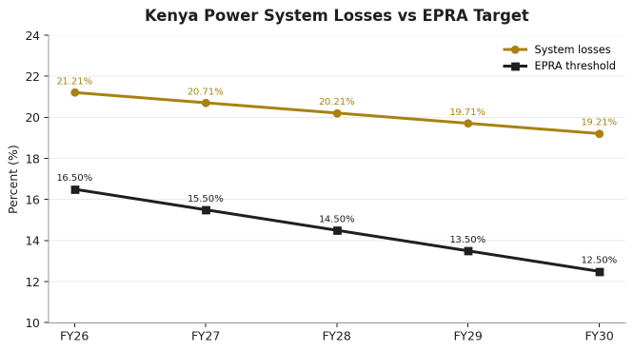
Source: SIB estimates. Annual system losses and EPRA thresholds from FY26 to FY30.
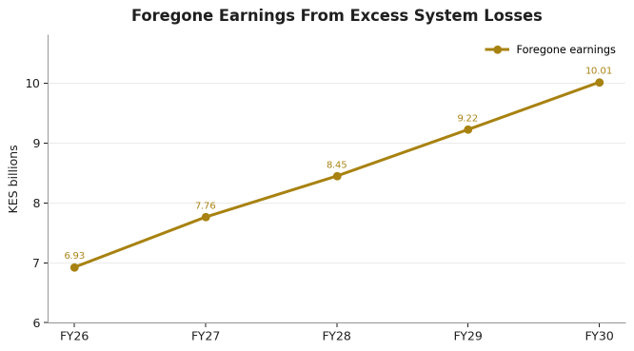
Source: SIB estimates. Values converted to KES billions from the report table.
The tariff review was withdrawn, but the message from the regulator is clear
Kenya Power’s tariff review, submitted on behalf of the sector, has been withdrawn. On the surface, this looks like a setback for a company that faces revenue shortfalls when actual electricity demand falls below the assumptions used to set tariffs. But SIB’s interpretation is more important: future tariff relief will likely be conditional.
The regulator is no longer likely to reward inefficiency with blanket tariff increases. Any tariff adjustment will require technical validation from EPRA, and the report suggests that relief will be linked to Kenya Power reducing system losses below the target loss factor and expanding or improving its network. In other words, the company cannot simply ask households and businesses to pay more while the grid continues to bleed value.
This is a healthier direction for the economy. Expensive power punishes factories, SMEs, schools, hospitals, cold rooms, salons, welders, millers and every household that depends on electricity to survive. If Kenya Power wants a stronger revenue base, it must earn it through efficiency, reliability and customer trust.
The hidden debt problem: why payables matter like borrowings